I know I said this blog would be quiet for a while as I head to Delhi, but with a few minutes to spare before going to the airport, I HAD to post this figure. A DATED Staffordshire figure is as rare as hens' teeth...and here we have one!
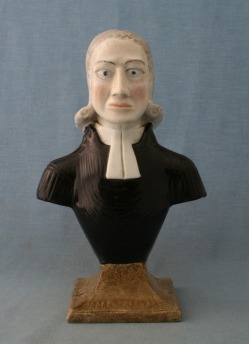
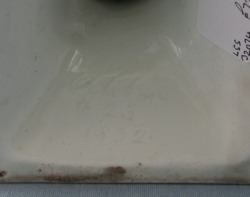
This pearlware bust of a rather alarmed looking Wesley (or did he have a thyroid problem?--those eyes really bulge) is marked beneath the glaze "October 23 1832." And you can find it in the stock of Martyn Edgell. www.edgell.me.uk/sales.asp
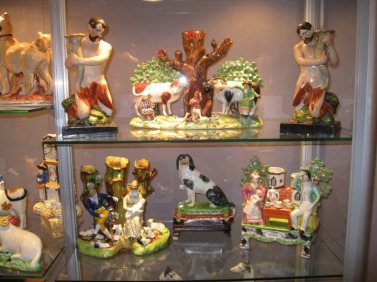


Next Friday night, I will be in Delhi--and I will try to update my blog from afar, but if things are a little quiet on this page for a while, know that I will make up for lost time when I get back. But more importantly, where were you last Friday night?  I was at a gathering of that oh-so-exclusive club, the Staffordshire Figure Association (you too can join the SFA for a mere $35 a year, no character references required!), and we had a blast.

About a dozen members of the club gathered at the New York Ceramics Fair at around 7p.m. We walked a block or two along Fifth Avenue to a very elegant apartment overlooking Central Park. Our hosts could not have been more gracious as they fed and watered us and allowed us to meander through their home admiring their collection. The collection focused on Shakespeare, and I was amazed by the number of figures (both pre-Victorian and later) that reflect this theme. We dragged ourselves away reluctantly...but onto the next treat. We walked a mere two or so minutes to a Madison Avenue restaurant (and if I could remember the name I would tell you because the French help was SO rude) where we wiled away the hours talking about pottery as we enjoyed a delicious meal.

Our group included collectors new and old, dealers, and auction house representatives. Elinor Penna, this year's SFA Pres, organized everything. I would say she did a remarkable job, but when it comes to making things happen, remarkable is the norm for Elinor. Without her, this magical evening could not have happened. If you want to join the SFA--or even just get on the free bulletin mailing list--email Elinor at elpen@aol.com. I leave you with a picture--no blog entry is complete without one.

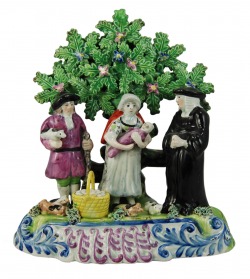
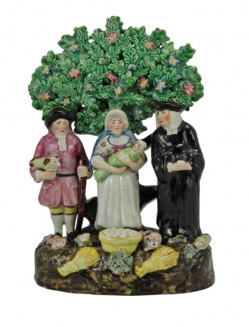
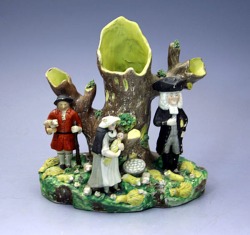
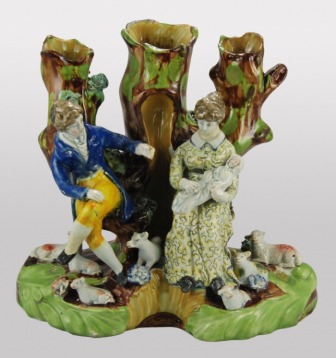
This superb spill holder was photographed on Elinor Penna's stand at the NY Ceramics Fair. It is 9.5 inches tall. I call this group The Happy Family. The grouping more commonly occurs with a bocage, rather than a spill holder. The broad base needed to support the large spill has given the potter plenty of room for animal adornments!  Note how babies in Staffordshire figures are usually swaddled, wrapped tightly to resemble stiff little white sausages. Swaddling was believed to help infants develop straight limbs. It also conveniently immobilized them so parents could get on with daily chores. Of course, if I had lived then I would have immobilized my babes just so I could admire the pottery. Isn't this spill holder charming and impressive? And as I leave for India, I part with the traditional Indian greeting: namaste.

 
NY Ceramics Fair 01/26/2009
 

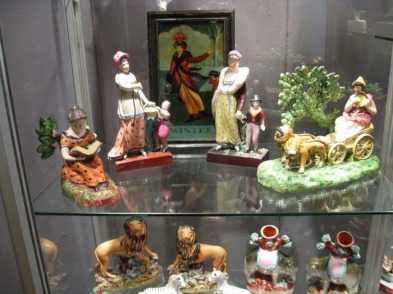
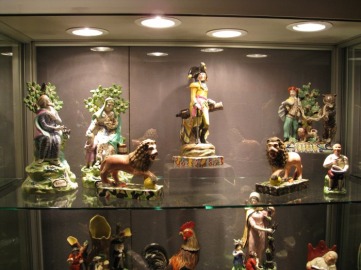
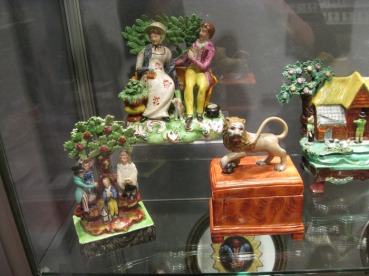
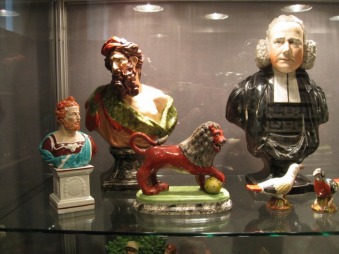
Move over the rest of the world: the third week in January belongs to New York. Yes, the weather was nasty, the skies were gray, but inside the elegant Fifth Ave building that housed the New York Ceramics Fair it was Paradise. To see so many fabulous figures under one roof was a rare treat. The dealers were braced for the worst, in light of the current economy....but surprise: sales held up well, by all accounts.

From Elinor Penna's stand


From Elinor Penna's stand


From John Howard's stand


From the stand of Sampson Horne.


From the stand of Sampson Horne.


John Howard's stand.


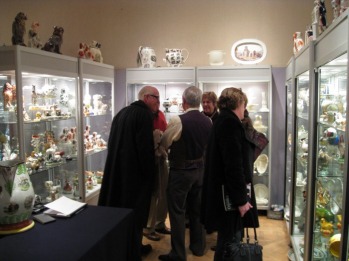
As you can see, the show was busy and it was hard to get pictures of the cases. Never try to stand between a collector and a figure he covets!  Highlights for me included two fantastic lectures: Rob Hunter talked on early Southern ceramics, and Miranda Goodby revealed new information gleaned from Enoch Wood's diary, acquired by Hanley Musuem in 2005. And what did Myrna buy? More on that later. But the impressively large jug visible on the table on John Howard's stand reportedly sold--and not to me!

 
Can't Wait... 01/24/2009
 

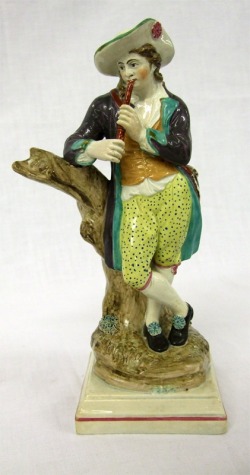
When I saw a photo of this figure, I just knew I HAD to have it. In these tough times, all of us are cutting back somewhere. I will cut back everywhere...but not on special figures. And this particular figure was on my Wish List.  Note I use upper case letters for the Wish List! Figures that make it onto the List are super special. I don't want to have a collection of figures stacked three deep on shelves and locked within cupboards. I want each figure to be significant to me. I want to know exactly where it stands in my home, I want to look at it often, and I want it looking good whenever my eye goes its way.

So why did this figure make the Wish List? I have seen two photos in books--Hanley Museum's version is one--of figure from these molds. Although the photos are black and white, the figures still blew me a way. Both figures are marked Neale &Co, for Jame Neale who potted in Hanley between about 1780 and 1790. Neale enamels are superb. So gently soft and sweet. I could only imagine what the figure looked like in color!

So when I got the picture I am sharing with you and had my first glimpse of this piper, in glorious Neale enamels, I was quite overcome. Yes, it was marked, yes it was perfect (aside from a slight nick at the end of the pipe which simply does not count.) And of course I wanted it...really badly. The Pottery Gods were on my side and this piper will become an American citizen for the next span of his life. I am so happy to have him. I know he will always delight me. And perhaps one day I will find his mate.


Staffordshire figure of a piper, pearlware, marked NEALE & CO. Circa 1785.


Last month I lectured in Florida, and afterwards someone asked the question that I always want to be asked because the answer is so surprising. "Why was pottery made in Staffordshire?"

The seemingly obvious answer to this question is that Staffordshire had lots of clay. After all, isn't that the ingredient that potters need most? But strangely, clay had nothing much to do with the dominance of the Potteries. Instead, coal lay behind the district's success!

The Potteries' location on an outcropping of coal lay at the heart of its prosperity. By the early 1800s, earthenware increasingly comprised white clays from southern England. Yes, shipping clay to the Potteries was expensive, but shipping coal would have been far worse. Firing one ton of pottery required up to twelve tons of coal. So access to coal was critical to the industry's success.

Incidentally, the Potteries was not without clay--but most of it was the type of clay needed to withstand the high firing temperatures that kiln bricks and equipment endured. Another advantage! But access to coal was critical. To prove the point: the regions in the south of England that exported their clays to the Potteries never threatened the Potteries dominance because they lacked coal.

Incidentally, it seems that all coal is not created equal. Again, the Potteries was fortunate in having easily accessible long-flame coal, the very type needed for firing kilns. Clearly Staffordshire pottery was destined to be!


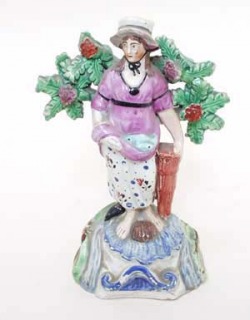
And how can a blog entry not have a picture? So I close with this figure of a girl holding fish in her skirt. She is emblematic of Water. Figures emblematic of the four elements--Air, Water, Fire, Earth--are among the plethora of wares that Staffordshire's potters wrought.


Poor Maria 01/14/2009
 

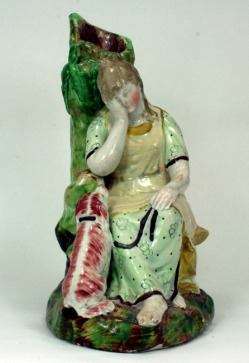
As an unabashed dog lover, I am intrigued by the figure of a lass weeping besides her dog. I must admit that I have not yet found an example I want to own...but I do keep on looking. So what's the scoop behind the figure dubbed Poor Maria? 


Staffordshire figure known as "Poor Maria." Circa 1810.


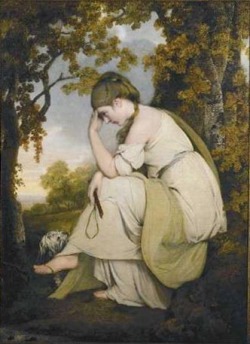
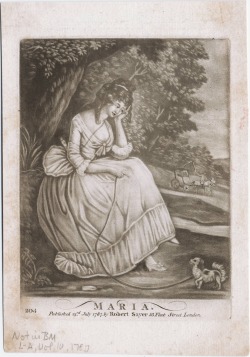
This figure derives from a book titled A Sentimental Journey through France and Italy. It was written by Laurence Sterne and published weeks before his death in 1768. Sterne wrote, "I discovered Poor Maria sitting under a poplar--she was sitting with her elbow in her lap, and her head leaning on one side within her hand. She was dress'd in white, and much as my friend had described her except that her hair hung loose, which before was twisted within a silk net. She had, superadded likewise to her jacket, a pale green ribband, which fell across her shoulder to the waist; at the end of which hung her pipe. Her goat had been as faithless as her lover; and she had got a little dog in lieu of him, which she had kept tied by a string to her girdle."

From the 1770s, artists (including Angelica Kauffmann) painted Maria with her dog, but Joseph Wright of Derby's Maria with her Dog Silvio (1781) is perhaps the best known painting and the source of the Staffordshire figure. Robert Sayer's engraving in a 1797 edition of Sterne's book further popularized the image. Both images are above. Hope you are as delighted by them as I am.

 
The Tithe Pig 01/09/2009
 

In the early 19th century, the centuries-old practice of tithing, or giving 1/10 of your produce, to the church prevailed--and it was unpopular and contentious. Read my book if you want to know the gritty details, and they are fascinating. If you tithed milk, did you have to deliver the milk to the church or did the vicar have to come and milk the cow? If you gave every tenth lamb, could you offer the runt of the litter? And what if the litter comprised only 5 lambs?

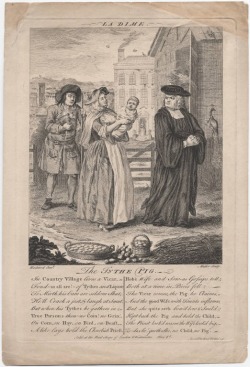
Tithing was contentious to say the least. The proceeds were used to support the Church of England, yet people of every religious bent had to pay it! And because tithes were primarily an agricultural tax, the economic output of merchants, manufacturers, and bankers escaped taxation. Gallows humor surfaced to deride this hated form of taxation. In 1751, Boitard engraved a humorous scene showing the farmer and his wife giving 1/10th of their produce to the parson--and included was their tenth child! By 1765, Derby had mimicked this in a porcelain vignette, and by the early 1800s the Staffordshire potters were doing the same.

Two Staffordshire tithe pig bocage groups around  7-1/2" tall. Both are from the stock of Elinor Penna..


Tithe pig figure groups also occur without bocages but with spillholders. These groups tend to have largish footprints. Boitard's inspirational engraving is found also on early transfer printed creamwares. From 1833, England started a process of reforming the tithing process, which culminated in the Tithe Act of 1936 (yes 1936)...but final payments to tithe owners only came about in 1996!

Staffordshire tithe pig figure with spill holder. From the stock of John Howard. H: ~8".


And the art work that started it all: Boitard's engraving that Staffordshire's potters mimicked in clay.


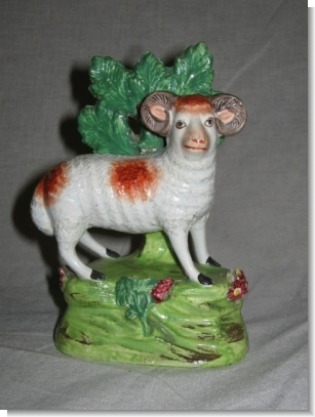
If I were to collect around a 'theme', it would be sheep. Early Staffordshire figures of sheep are charming--and sheep gives so much scope for collecting because many composite figure groups include a scattering of sheep. But I love sheep as stand alone figures. Their enchantingly goofy expressions and varied poses make for infinite collecting possibilities. Last time I had 12 ladies to lunch, I set our dining table formally...and then scattered Staffordshire sheep down its length. Everyone was fascinated.


I bought this little ram from John Shepherd a while ago. The distinctive floral sprig on the base also occurs on figures marked Dale (for John Dale, Burslem).


Anyway, to give you a giggle, I thought I would share this auction listing for a tiny recumbent sheep (actually a ram as it had horns). The figure had long since lost it's bocage, but to the seller this was no problem--rather it was a plus!

"IT'S BROKEN!"  Yes, yes, yes and yes… it is.  BUTT our Billy Goat Gruff comes honorably to us from child's play.  Once Mother guarded "her goat" when it had a little foliage sprig or bud vase behind and above the goat.  Once dear children coveted and cried to play… ever so carefully with Billy.  "No" said Mother but one day they did and DROPPED Billy and BROKE OFF his floral sprig and… Mother gave up and HAPPILY EVER AFTER Billy the gruff goat, with his broken horn too, was …child's play.  Although he may not have been named Billy, we are sure the children named him.  We are sure that he held high rank among the speaking toys and was always, always, always included in "everything".  Even later when little hands were big enough to have their own children and go off to the Civil War, Billy was still a tender spot of fond remembrance and …was introduced to a new generation who, too, were pleased to make Billy's acquaintance.  That's why we found him in the desk draw.  He was part of the family, not a piece of "old china".  Good condition, as found condition.  If one starts new to Billy and looks at him straight on, he shows no damage excepting that after a minutes scrutiny, one might detect that his left ear is gone.  Only by turning Billy around… or being intimate with Staffordshire figurines from the get-go… does one discover that… Billy's floral sprig has long been broken off.  Some, including all children, will say that not only does Billy "not need" "that" but that he is also "better" without it.  Billy certainly displays well for what he is; an old gruff goat.  He's charming, very attractive and has a defiant expression that is easy to love and find support in.

A figure you can 'find support in'. Don't you just love it? Therapists, take heed. Time to take your patients shopping...for just the right figure.

 
Hope 01/01/2009
 

Happy 2009. May the new year bring you all you wish for yourselves. I start the year with great hope for our collecting field. This may seem strange at a time of economic gloom....but truthfully something else has been worrying me even more. The declining number of young people with an interest in and passion for old things is bothersome to those of us who hope our treasures will pass to others. I admit to dismal failure with my three children. When I am 'called', expect rapid delivery of my wonderful figures to the nearest charity shop, or, worse yet, a yard sale! And I truly don't know any other collectors whose children share an interest in their parents' Staffordshire figures....so contemplating this issue always leaves me feeling gloomy.

But last night HOPE was born in my heart. Late afternoon as I was readying to go out and celebrate the new year with friends, my phone rang. A delightfully charming lady wished to order a copy of my book. A book sale is always good news--but as we chatted, even better news followed. This lady has two daughters and both share her love of Staffordshire figures. They collect them too! Clearly, this lady has succeeded where I have failed, but she left me with Hope. Firstly, there are indeed younger collectors building new collections. And secondly, her daughters' interest emerged as they matured--so perhaps patience will be rewarded after all.

I have bounced through the first day of 2009, filled with Hope that this is the year when even more people will be enchanted by the figures that never cease to amaze me.


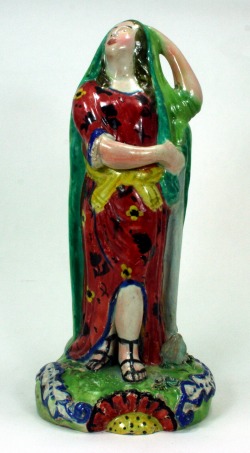
Staffordshire figure symbolizing Hope, circa 1815. About 8 inches tall.
Hope is one of the theological virtues. Traditionally it is portrayed in art in female form, looking heavenward with an anchor at her side. The anchor originates from St. Paul, which describes hope as "an anchor of the soul." (Heb. 6:19)


And there is yet another reason for Hope in 2009. CNBC's investment guru, Jim Cramer, recently noted that art and collectibles are holding up so well in these tough economic times. Cramer, who believes there is always a bull market somewhere, recommends that everyone have a portion of their portfolio in art/collectibles. Diversification makes good sense. Perhaps Cramer will be the next collector of Staffordshire figures!