Beautiful Bovine 02/27/2009
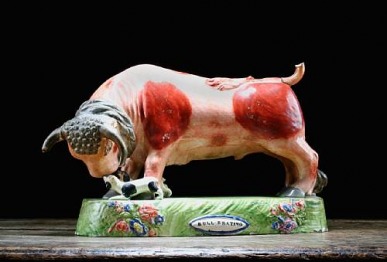
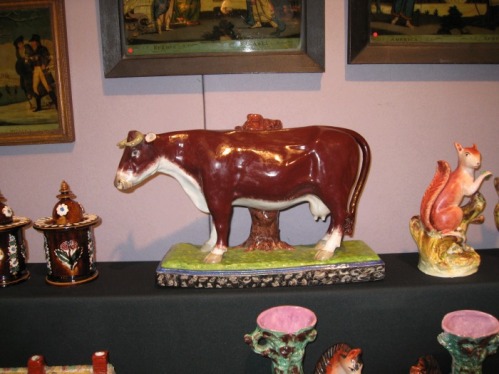
Sighted at the NYCF was this extraordinary Staffordshire figure. ![]() Pearlware figure of a large cow on the stand of Elinor Penna at the New York Ceramics Fair. What colorful, naive appeal! All those US folk art collectors chasing large weather vanes formed as cows would have done better to pursue this gorgeous cow. It did not have the stratospheric tag associated with weather vanes on the US market! I believe it left the Ceramic Fair tucked beneath the strong arm of its new owner. BULL-BEATING 02/23/2009
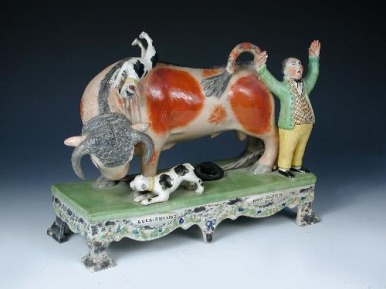
Have you seen the unusual bull baiting figure that sold at Bonhams UK last month for just over GBP 2600, including charges? Interestingly, this bull baiting figure, pictured below, uses a particularly attractive base that is also found on other figures in the 'Sherratt' style ( such as Death of Munro, Doctor Syntax, and even a Polito's Menagerie). Clearly, the figure had some damage. Bull's horns, dogs' legs--these are not atypical injuries to a baited bull. The tail was obviously broken, but I believe the pieces were still available to the new owner. The knotted rope that goes under the bull was missing. This is an injury I don't like, and I hope the new owner just leaves the figure without rope, rather than "restoring". A restoration dead center hurts my eye. Unknown Buyer, please, please don't restore that rope! Clearly, this traditional bull baiting figure includes a man, and two plaques, one reading BULL-BEATING and the other NOW CAPTIN LAD. Bonhams' bull baiting had only one title plaque and no man. But the NOW CAPTIN LAD plaque was omitted because the man was omitted! Those are the encouraging words uttered by the man to either his bull or dogs. Grieving Girls. 02/19/2009
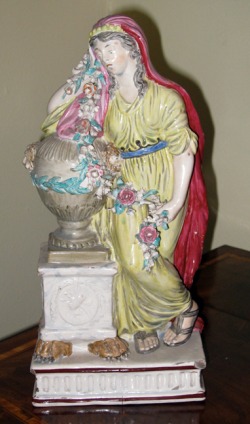
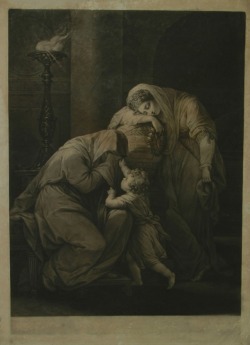
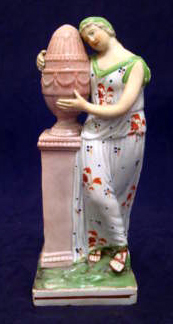
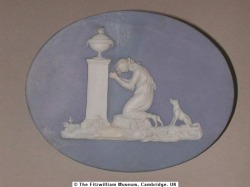
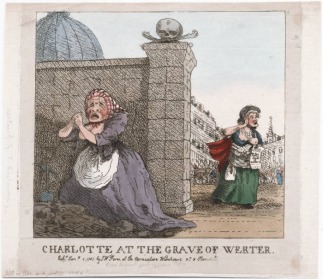
Three grief stricken ladies. Who are they? These figures are catalogued incorrectly SO frequently that it has taken me a while to sort out who is who...and why. So here goes. 1. Andromache Weeping Over the Ashes of Hector ![]() Andromache weeping over the ashes of Hector, a mezzotint byThomas Burke after Angelica Kauffman, published by WW Rylands,1771. Apologies for the bad picture. The first figure is clearly Andromache weeping over the ashes of Hector because it is derived from a print so titled. I must admit that until I found the print, I had some trouble believing this. Hector was killed in the Trojan War and his body was returned to Andromache. The Iliad describes Andromache as lamenting over Hector's body--not his ashes! Jacques-Louis David's oil painting of c1780 also shows Andromache weeping over Hector's body--neither an ash nor an urn in sight. Seems that Angelica Kauffman painted the scene (with ashes?), inspiring the mezzotint above. Derby had made figures after the mezzotint by 1780, and this probably inspired earthenware look-alikes--usually made in Leeds. 2. Charlotte at the Tomb of Werther. ![]() Staffordshire figure of Charlotte at the Tomb of Werther. Circa 1790-1810. Height approx. 9". The Sorrows of Young Werther was a German novella published in 1774. Werther kills himself when he cannot have Charlotte, the woman he loves. Charlotte buries him under a linden tree. Again there is no mention of ashes, so is the figure clutching a funeral urn Charlotte? ![]()
Yes, I know Wedgwood's design is far removed from our figure. Yet there is no getting away from the urn on a pillar that appears with both the Staffordshire figures and the Wedgwood design. Did the figures influenced Lady Elizabeth Templeton's design, or was it the other way around? Which came first? I don't know. But any way you look at it, figure #2 appears to be Charlotte at the Tomb of Werther. ![]()
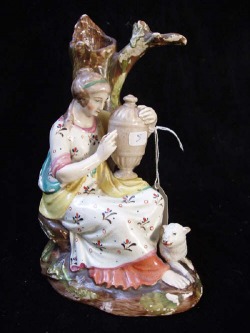
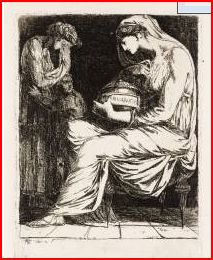
3. Agrippina with Germanicus's Ashes. If you look at my blog posting of Dec 16, 2008, you will see a seated lady clutching a funeral urn. (See the picture below.) I explain that Halfpenny dubs this figure Antonia with Germanicus's Ashes. However, the figure really depicts Agrippina with Germanicus's Ashes--probably the figure was derived from Runciman's print of c1772 that now belongs to the Tate. ![]()
![]() The Tate says of this etching: "A large picture of this subject by another Scottish artist, Gavin Hamilton, is also in the Tate's collections; it was shown at the Royal Academy in 1772, the probable year of this etching. Runciman himself produced an oil painting on the theme for the R.A. in 1780. The subject was therefore a standard one for the neo-classical period, and Runciman's treatment of it here sums up the Grecian inspiration of the time. Many thanks to my friends in New Zealand for posing this interesting question. Early figures? Ouch! 02/15/2009
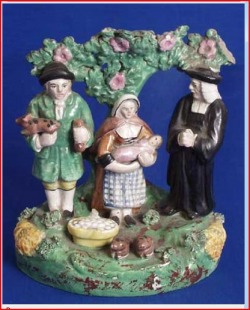
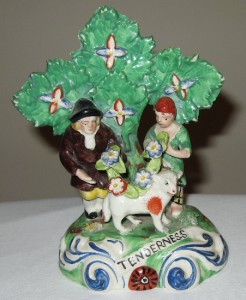
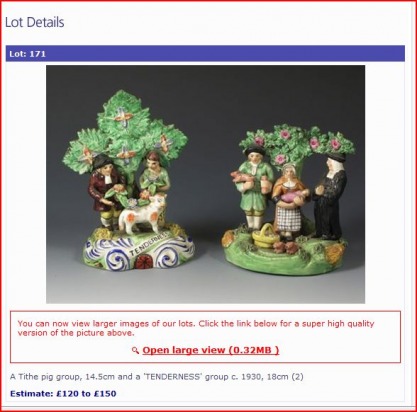
I frequently am asked to authenticate the Tithe Pig figure, below, that is too commonly sold as an early 19th century figure. Similarly, I receive email enquiries about the age of Tenderness, below. Both figures are reproductions of early 19th century figures. They were made by the Kent factory, which operated until around 1960. I don't know the exact year these figures were made, but my kindest guess would be early 1900s. Please don't mistake these for genuine early figures. I know it is Buyer Beware, but perhaps if we all shout out every time we see incorrect listings, we can save other collectors from costly mistakes. Spotted at the NYCF... 02/12/2009
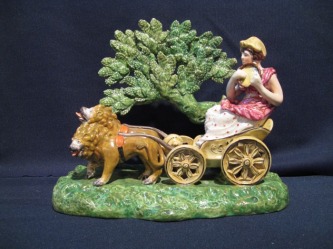
Was I people-watching at the NYCF? I could have been, because apparently quite a few well-known personalities shop here...but of course, I figure-watched instead. One of the more unusual items on sale was the large chariott, on the stand of Elinor Penna. Wikipedia says that 'the chariot is the earliest and simplest type of carriage, used in both peace and war as the chief vehicle of many ancient peoples." But to pottery collectors, it is one of the rarer figure groups, and here the bocage was in good shape. |