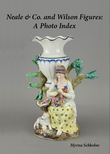
The Boxing Baroness 07/30/2009
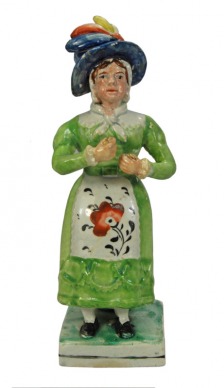
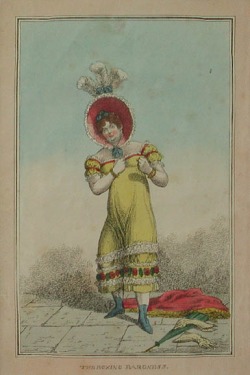
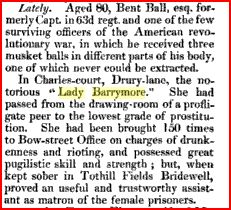
I bought this Staffordshire figure a while ago because it intrigued the social historian in me. Who was the lady with a determined expression, fists clenched? Don't you love the attitude-- not to mention the bonnet! I had never seen another figure like this. Something in me said that this was not just a random figure, but a likeness of a real person, now forever captured in clay. After much digging, I found this very rare hand colored engraving that I believe captures on paper the very same lady. ![]() Title: The Boxing Baroness Artist: Williams, Charles (London, active, 1797 - 1830) Date: March 1819 Medium: Original Hand-Coloured Etching The Boxing Baroness, the title of the etching above, is known from only a few copies. It was created in for Bon Ton Magazine in March 1819 by Charles Williams, an important British satirical artist and caricaturist. Our Boxing Baroness, the fashionably dressed lady in pugilistic stance, is the notorious Lady Barrymore, wife of the fast-living Seventh Earl of Barrymore, who enjoyed amateur boxing. The Earl succeeded to his title at age 3. He came from bad stock and was known as 'Hellgate' because of his rakish lifestyle. The young earl dissipated his life in a series of madcap pleasures. He was a big gambler, and it is estimated that he went through GBP300,000 in 5 years. Anything was good for a gamble, and he once bet he could race on foot against a man mounted on horseback. His gambling reached its lows when he bet the Duke of Bedford that he could get a man to eat a live cat! Boxing, or pugilism as it was then frequently called, was one of the Earl of Barrymore's particular pleasures. It was fashionable for aristocratic young men to exercise themselves at a sport that even the Prince of Wales had enjoyed in his younger and slimmer days, so the Earl kept a pugilist as his constant companion. He also boxed with his mistress, Miss Charlotte Goulding. The lady--hardly the right word, in this case--was neither rich nor well-born, being the daughter of a sedan chairman. It must have been true love for in June, 1792, the couple claimed to have eloped to Gretna Green. Seems they may never have reached Scotland but perhaps they were married soon after. The new Lady Barrymore enjoyed sparring with her husband---bare-fisted, as was the practice in those days. Their pleasure was short-lived. In 1793, the Earle's musket accidentally discharged and killed him at the age of 24. He was on the verge of financial ruin. What of Lady Barrymore, our pearlware figure? Seems she lived for many more years and, as her obituary in the Gentleman's Magazine of 1832 tells, she was renowned for her pugilistic skill...among other things! In determining whether my figure was indeed our Boxing Baroness, one thing puzzled me. The figure seems to be clutching something little in her hands. Why would a boxer do this? Last night, the penny dropped! I came across this ad in The London Journal of 1722. So my Boxing Baroness is holding a coin in each hand. That, it seems, was the way women judged the settling of the score in those days. If you are recoiling in horror at all this, relax. Things really aren't so different today--but female fisticuffs is now less PC. Seems in the early days of boxing, from after 1700, women discovered that they were not such delicate creatures after all, and they participated whole-heartedly in prize-fighting (and fighting just to settle differences). These were no-holds-barred battles--no stays were worn and usually women stripped to their slips. References to female pugilists occur with surprising frequency--but our Boxing Baroness is surprisingly rare. If my blog entry were worthy of a Dedication, this one would be dedicated to that great lover of all Staffordshire figures, Elinor Penna. Elinor sold me this amazing figure. Thank you, Elinor, PS 07/27/2009

If you have already read the blog posting below, dated 7/26, please go back to it for the PS. Too sweet to miss. Sheep Family 07/26/2009
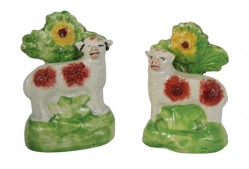
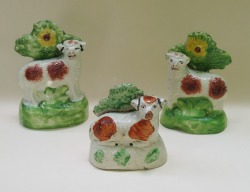
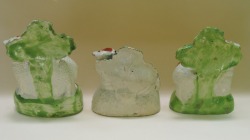
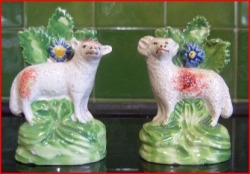
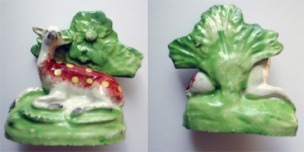
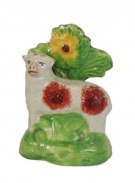
Once upon a time, while slogging away at my book, I came across an unusual little Staffordshire figure of a sheep. The figure was definitely early (pre-Victorian), but the bocage was molded in one and was quite flat on the back. The figure was painted all the way around, but the bocage was flat. Mentally--but not in print!--I called this sheep "The Last Bocage Figure" because it seemed to represent a transition to the simpler modeling of the Victorian era. Was this the beginning of the birth of flat backed figures? No way of knowing...but it did keep me guessing. Cheerful little figure, isn't it? In the next few years, I saw another couple of examples of the same sheep. Always the sheep faced left. Surely there had to be one facing right, I thought. My theory is that figures that would have been held in the left hand (face right) are the first to break...and thus the hardest to find today. And then one day I found it. And my "Last Bocage Figure" became a pair. A match made in heaven. Of course, I have been watching ever since for another example of the same bocage. This is the fun of collecting. And I hit gold last month, with a recumbent sheep. Yes, the same bocage. The flower has not been painted yellow, but the mold shape and detailing are the same. And here he is with his new family. As you can see from the photos taken from the back, this time the bocage is unpainted at the back....so perhaps this potter's thought processes on the decorativeness of backs had evolved a degree further than most. The sheep are all definitely early 19th century. The colors of the bodies and glazes support that. Do shout if you see this bocage on any other figures. I am optimistic about pairing my recumbent sheep--or should I say 'ram' because he has lovely horns? It will take time, but challenges such as these make collecting fun. When I lecture, I am routinely asked 'how much do these figures cost?' I answer that you can spend tens of thousands of dollars, or you can buy a fabulous little figure for less than the price of a NY hotel room. Of course, this gives me much wiggle room! I stay in cheap NY hotels, but some in my audience prefer suites at the Plaza. I bought all three of these figures for less than the price of a modest hotel room. So you don't need deep pockets to have a fabulous collection. But sometimes, when something really special comes your way, it truly is worth reaching deep into your pocket. Trust me, I have been there....and I have never regretted it! PS: Thanks to my cyberspace friend and fellow collector, Peter, for generously sharing his sheep, below. I guess we now have a Last Bocage Flock. Seeing this pair made my day. Aren't they delicious? ![]() PPS. Our flock is turning into a menagerie. Many thanks to a lovely blogger for generousy sharing her Last Bocage deer. Dear Seller... 07/22/2009
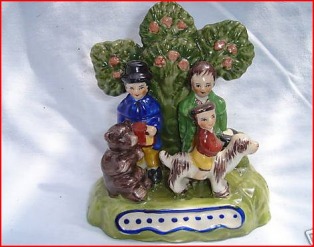
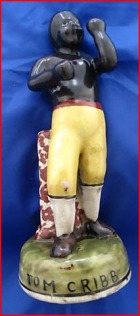
"Dear Seller, I am sure you listed with the best intentions but..." is how I usually start emails to sellers listing reproduction figures as The Real Thing. I like to give sellers the benefit of the doubt, because frequently they have listed with the best intentions. Tonight, I wrote two emails in that spirit to the sellers of these items. This figure is described as "STAFFORDSHIRE BOCAGE STYLE FIGURE OF TWO MAN A BOY ON TOP OF A DOG AND A BEAR IN VERY GOOD CONDITION WITH NO CHIPS OR CRACKS STANDS AT 6.1/2 INCHES HIGH 6 INCHES WIDE." Grammar and spelling errors are not mine! No claims of great antiquity are made here, but isn't a Staffordshire figure one that was made in Staffordshire? So I wrote. Dear shirtshop1001, Your figure is in very good condition because it is very new. It was made in Asia, not Staffordshire, sometime from 1990--copied from a colour picture that was published in a book in that year. I am sure you listed with the best intentions so thought you would like to have this added info. Best wishes, Myrna Schkolne We'll have to see what happens. The item is for sale on eBay, item 280375829630. I will add this picture to the BEWARE page on this site. This page is intended as a rogue's gallery of repro figures, to guide novice collectors. An experienced collector emailed me that he felt nauseous after looking at the BEWARE page. My sort of man! This reproduction figure of the boxer Tom Cribb comes with an amusing sales patter. Described as a Staffordshire figure dating from "pre 1900s" the listing (item 330346625562) reads (again, the grammar and spelling errors are not mine!) THIS ITEM IS VERY OLD IT HAS BEEN IN MY GRANS CABINETT IN HAYMARKET FOR AT LEAST 50yrs SHE HAD THE PAIR (tom molyneux & tom cribb) TIMES WERE HARD AND SHE SOLD MOLYNEUX NOW ITS TIME TO LET THE CHAMPION GO CANT SEE ANY MARKS BUT HAD DEALER VERIFY IT AS OLD AND STAFFORD LIGHT CRAZING IN THE CERAMIC Dear paskybabe, I am sure you listed with only the very best intentions so I thought you would like to know that this figure is a very modern reproductions of an early 19th century figure. Your figure was possibly made in Asia, copied from a picture of the original that appeared in "Circus & Sport: Staffordshire Figures 1780-1840", published around 1990. You can see an original figure in color in my book, and an example of this repro figure is illustrated on www.mystaffordshirefigures.com under the tab titled BEWARE. With best wishes, Myrna Schkolne This is quite a common reproduction and appears on eBay routinely. Wish I had remembered to add that the 'genius' who made this nasty thing--and I should say 'pair' rather than 'thing' because Cribb is customarily paired with Molyneux--got something else wrong: Molyneux was black, but Cribb was white! If you want to see The Real Thing--be it a performing animal group or beautiful pairs of Cribb and Molyneux--look in my book. Lovingly photographed, because I do love these early Staffordshire figures so. The story of those early boxers is fascinating. Did you know they were the first sports stars of modern time? Prior to pugilism emerging as a sport in the late 1700s, the only sports stars were famous horses and dogs! The Cribb-Molyneux fights of 1810 and 1811 riveted the British public, and thousands turned out to watch those then-illegal events. That Molyneux, a former American slave, might wrest the national boxing title from Cribb, a very white Englishman, was too horrific to comtemplate! Molyneux really did win the first fight but he was cheated of victory and he lost the rematch the next year. Boxing matches of those days were very different from those of today. Boxers did not wear gloves. Rounds were untimed and lasted until a man went down. He then had 30 seconds to be up or it was over. Matches lasted many long rounds, many long hours. Boxers fought few times in their lives because the human body can only take so much. Fabulous Staffordshire figures pay eternal tribute to these courageous men--and crude copies irritate me! PS: I have since had replies from both sellers. The seller of the performing animal group writes: My description does go on to say that it is "Staffordshire style" and not that it was actually made in Staffordshire. Well, yes...but it didn't read that way yesterday! Today's revision notes STAFFORDSHIRE STYLE BOCAGE FIGURE OF TWO MAN A BOY. And the title still has no mention of 'style'. As for the black Cribb, the seller writes: HI THERE MYRNA,many thanks for your email and the advice,this item was in my nans cabinett all my life,60+years.didnt know if it was right or wrong took advice from dealer ( Ooops ) not allways correct .To someone who hasnt got one still makes a good space filler Kind regards cy He has posted my email at the bottom of the listing. Guess potential buyers can now choose whom to believe. Provenance Counts. 07/18/2009
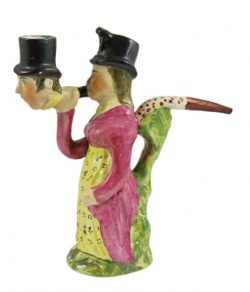
I was in Boston this week and first stop was Charles St, to visit the numerous antiques galleries I had browsed last March when I lectured to the China Students Club of Boston. Surprise: most have gone. Sign of the times, I fear. ![]() This fascinating Staffordshire figure is formed as a pipe. It too bears illustrious labels. It was once in the Earle Collection, one of the most famous collections of English Pottery. Major Cyril Earle's book, "The Earle Collection of Early Staffordshire Pottery" is a classic. I am not sure what happened to the collection, but this figure's label reads "Earle Collection Hull Museum." I expect that Hull Museum acquired the collection and later parted with it. Thank you, Hull Museum! I have come across quite a few figures from the collection over the years. The impressive figure of Mars, for sale on the Showcase page by James M. Labaugh Antiques, was my most recent Earle "find." In this case there was no label, but close comparison with the large photo in the book confirmed that this handsome figure is indeed the same one that Cyril Earle owned. Wedgwood Figures 07/14/2009
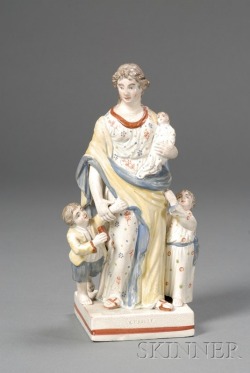
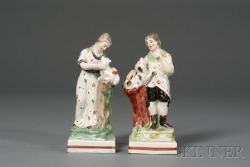
Sold at Skinner this week were some rather unusual figures marked WEDGWOOD. Figures marked thus are generally not believed to have been made by the Wedgwood manufactory. Possibly they were made for Wedgwood--the firm may have needed to fill orders it didn't want to produce. Some of the figures are very similar to those formed from molds that Enoch Wood used--so perhaps EW made some of these figures for Wedgwood. More probably, the figures were made by Ralph Wedgwood, who potted in the 1790s. The figures are consistent with that period, and given the fame of the Wedgwood name even then, Ralph would have been stupid not to jump on the bandwagon and mark his wares. The figure of Charity, above, was sold at Skinner. It is impressed CHARITY on the front, and WEDGWOOD behind. Another like it is in the Potteries Museum. The boy with dog and girl with cat, here marked Wedgwood, were also sold at Skinner. See another example similarly marked on p224 of my book. An example of the boy with dog also occurs marked "T. Smith." This is the mark of Theophilus Smith. He was a prosperous potter in the late 1790s. Unfortunately, he came to a bitter end. His wife had an affair, and Theophilus tried to kill the 'other man.' For this, he landed in jail. His wife came to visit him (dumb? repentant?), whereupon Theophilus tried to kill her before turning his weapon on himself with fatal consequences. He died in 1802. Fascinating Factoids.
So back to the Wedgwood figures. Lord knows who made them. We really can only speculate. But it is always nice to own a marked figure, because it does force you to ponder these things. George Skey Lions 07/11/2009
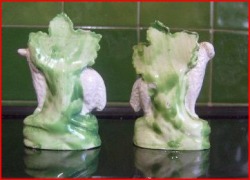
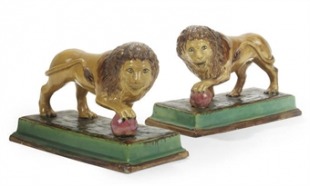
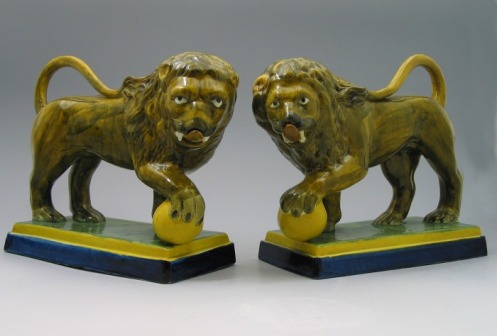
A couple of months ago, my friend Malcolm Hodkinson drew my attention to a large pair of lions coming up at auction in London. From a small catalog picture, they appeared to be traditional early 19th century Staffordshire lions. But looked at in the flesh or in a large picture, the differences were apparent. The modeling was not quite early 19th century. But notably the colors and glazes were all wrong for a c1825 date. These lions had colored glaze decoration typical of the late 19th century. The felines were made by George Skey, who operated in Tamworth, Staffordshire, from 1864. His firm was bought by Doulton around 1930. And the auction house had cataloged the lions correctly. Since then, another pair has come up at auction in the UK, again cataloged correctly. Sometimes these lions are marked and that aids auctioneers, who are required to know an awful lot about an enormous range of goods. It is possible that mistakes will be made--in fact I have just encountered a pair described as circa 1840 coming up for auction July 12. So watch out for these lions. If you want them, that's fine. But please don't mistake them for The Real Thing. ![]() Magnificent pair of early 19th century Staffordshire lions. Photo courtesy of John Howard Antiques. Fabulous Figure: Billy Waters 07/07/2009
I have 'sung my song' on the Figures tab today. Catch the Fabulous Figure of Billy Waters by clicking on Figures. Billy Waters was a real person, a black American who impacted English entertainment. Read his tragic tale...and love the figure like I do. Thanks to John Howard Antiques for the photo. Ralph Wood Figures 07/03/2009
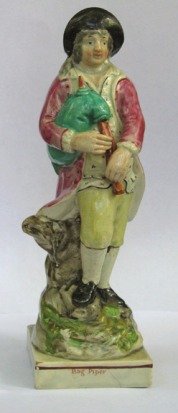
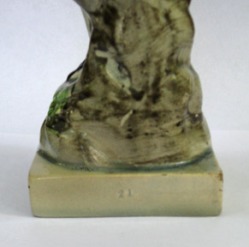
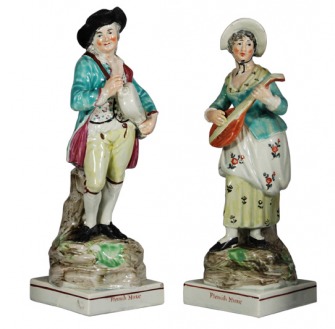
I always thought Ralph Wood figures were a bit of a yawn. Generally decorated in colored glazes, their ghostly appearance just didn't push my button--although I had to admit the modelling was superb. ![]() Ralph Wood figure titled "Bag Piper." Made in Staffordshire, circa 1795. H: 8-1/2". At first glance, I knew this was a RW figure. How did I know? The particular font used for the title is only found on RW figures. Together, the red line on the base, the enameling of the mound, and the figure mold itself all pointed to a RW attribution. A further clue: Look at the man's very large hands. His right hand is longer than his forearm!--and large, well modeled hands are another RW feature. I bought the figure from a photograph...a rather murky one at that...and couldn't wait to get it out the box and turn it around. The back of the figure confirmed my opinion. Note that the red line on the base is only on the front and both sides, NOT on the back. This is yet another RW decorative feature. And there it was! The cherry on the top was the number 21, impressed on the back. RW figures often have numbers impressed into them. The Potteries Museum owns a bag piper, similarly impressed with 21. You can see the same attributes--font used for script, red lines on three sides of base, decoration of base mound--on my pair of Flemish musicians. Each is titled "Flemish Music" and the mould number 132 is impressed behind each. Falkner records this mould number for a "girl with a musical instrument" (colored glazed figures are not titled and even some enamel figures are untitled, hence Falkner's generic description). He records 66 for "man, hurdy gurdy", which is what our fellow is. But on this particular day in the pot bank, someone impressed both bases with the same number. Although we call these numbers "mould numbers", they should really be called figure numbers because each was, I believe, impressed into the base at the time the figure was assembled. The mould used for the base itself was a generic form, with no number, and it could be used for varying figures. The seller of my RW bag piper did not know she was selling a RW figure. She apparently didn't notice the number impressed in the rear. In fact, she didn't even think to include a photograph of the rear of the figure. This is why a little knowledge is a dangerous thing! Lots of knowledge goes a long way in helping ferret out the unusual...and that's what makes collecting fun.:) Don't forget to notice Aurea Carter's "Flemish Music" in the Showcase. Clearly a RW figure, it is impressed 131. Yes, 131, not 132! Why the difference? Wish I knew. We aren't quite sure of the purpose of these numbers. The most we can say is that the same number occurs routinely on each figure--with exceptions. OUCH! 07/02/2009
Tonight, I goofed big time. Flipping through eBay, I noted a figure claiming to be early 19thC Walton. The figure form was familiar, but the WALTON marked was crude and lacked serifs, the base form was wrong, and the interior of the base was smooth, as you find in slipcast reproductions. |