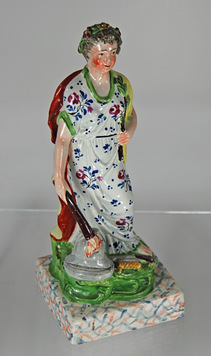
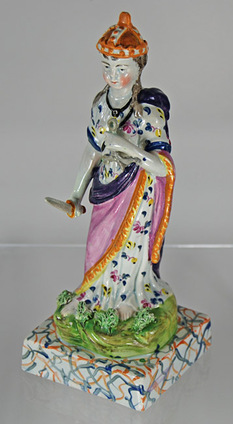
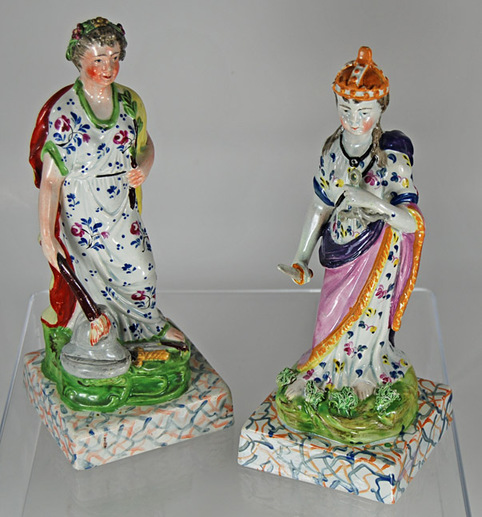
Large figures of Prudence and Fortitude are among the biggest allegorical figures the Potteries wrought. While I am always awed at the technical expertise that it took to make these large ladies, I don't want to live with one. Their statuesque physiques make me feel like a coat-hanger...so no, I have not succumbed to the charms of either figure yet.
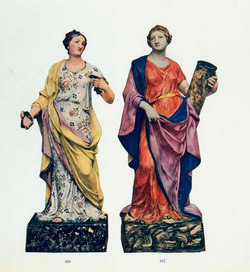
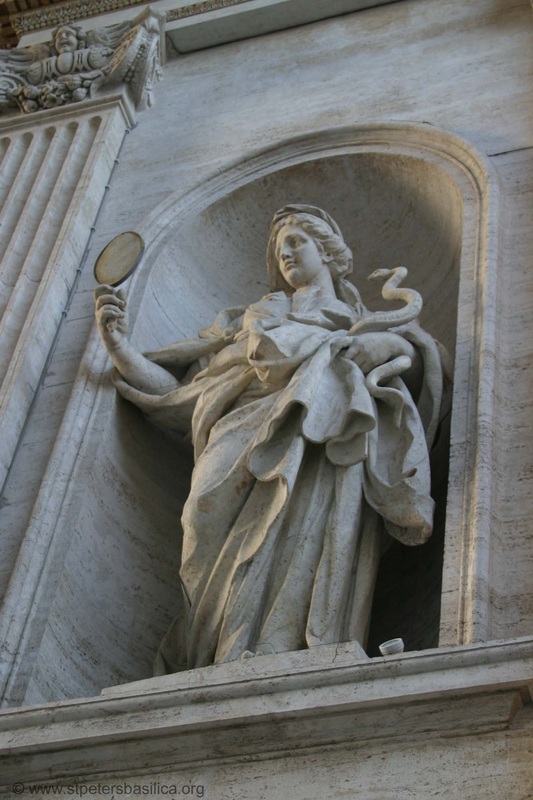
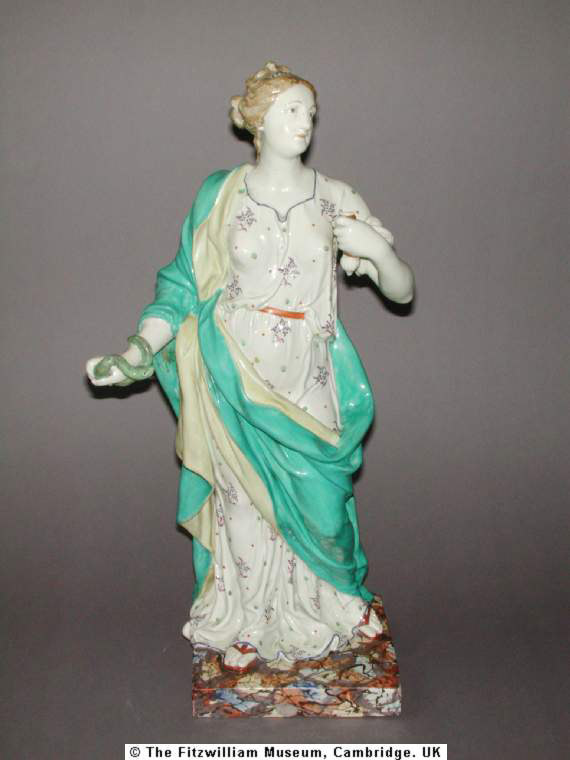
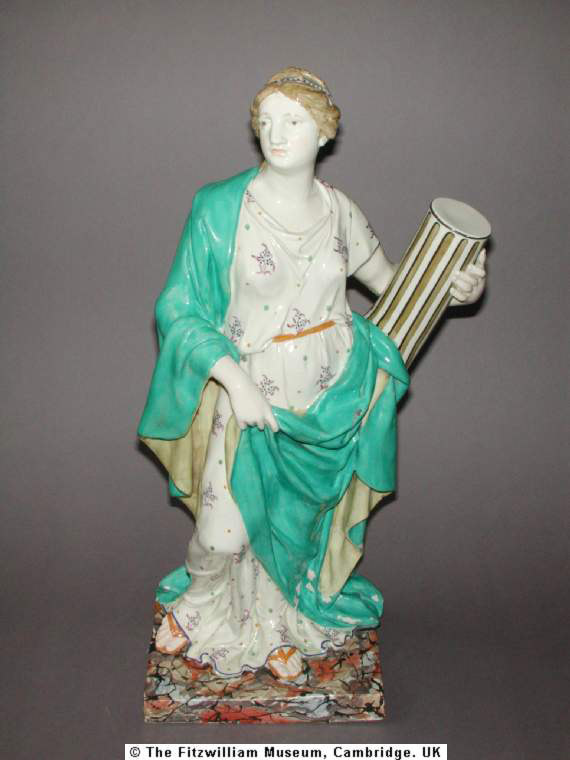
 Fortitude and Prudence from the Earle Collection. Here we have Prudence on the left and Fortitude on the right. For those of you who do not know (and believe me, I had to dig this up!) Prudence and Fortitude are Cardinal Virtues. Prudence is normally personified holding a mirror (implying the wisdom of self-knowledge) and a snake (from Matthew 10:16: “be ye wise as serpents”, with the Latin word for "wise" being "prudentes"). Fortitude carries a broken pillar to represent her strength.[1]
Figures of Prudence and Fortitude were among the many allegorical figures that were popular in the neoclassical period. Images, and three-dimensional representations abounded, so it is not surprising to find them also commemorated in clay. The design source for the figures is probably a plaster obtained from a London plaster maker.
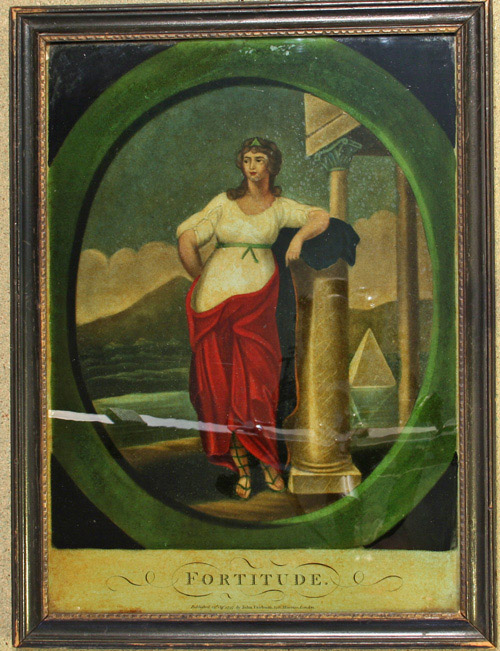
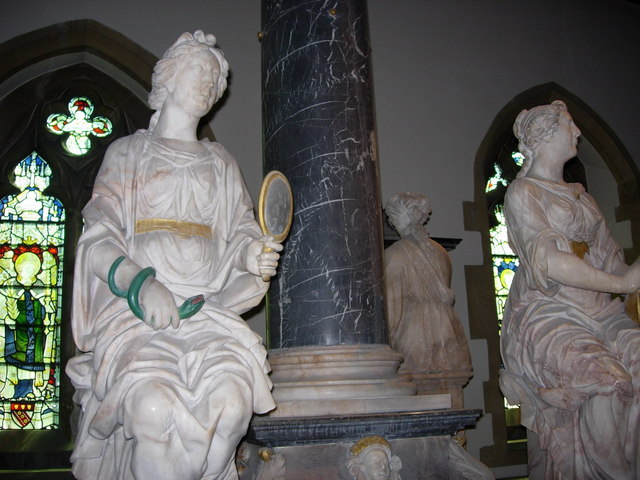
The most well known marbles of Fortitude and Prudence are in St. Peter's Basilica, Rome. England, however, had its own representations: A monument to Lady Digges at the Parish Church of St. Mary's, Chilham, erected in 1631, portrays the Cardinal Virtues, including Prudence and Fortitude.
While Prudence and Fortitude are today associated with Enoch Wood/Wood and Caldwell, Ralph Wedgwood also had a go at making these ladies. The two figures shown above from the Earle Collection are apparently marked WEDGWOOD. The WEDGWOOD figures of Prudence and Fortitude are indistinguishable from examples marked E. WOOD. This is not surprising, as Ralph Wedgwood helped himself to others' molds on sundry ocassions. But, in the absence of a mark, Prudence and Fortitude are commonly attributed to either Enoch Wood or Wood and Caldwell. Falkner notes a pair marked E. WOOD in a private collection. [2] Also, a pair impressed E. WOOD sold at Sotheby's New York, 29 January 1987, lot 378, the Collection of the Rev. Benjamin Lake. An example of Fortitude, bronze-glazed and impressed WOOD & CALDWELL, sold at Bonhams Chester a while ago.
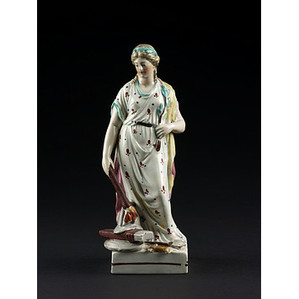
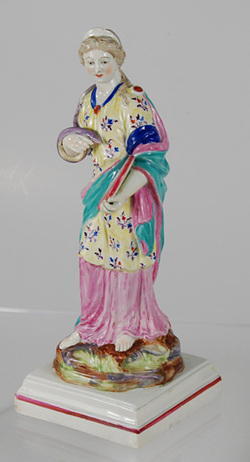
Below are some more examples of Prudence and Fortitude: And you might like this pair in the Fitzwilliam Museum, Cambridge. Click a picture to enlarge it. For the record, similarly styled figures sometimes occur on round rather than square bases. But still at a whopping size of around 24", they are no more lovable...yet every bit as majestic. So as I am not a fan of large figures, am I to remain forever without Prudence or Fortitude? Absolutely not! I have discovered a rare little figure of Prudence, This figure of Patience is marked NEALE & CO beneath, indicating it was made in the early 1780s. At just 7-3/4", this baby tucks onto a shelf easily. And are those enamels not edible? I always think Neale figures are to die for. Anyway, I have yet to find a small example of Fortitude....perhaps there isn't one. But for a collector, Patience is the most important Virtue, for with time, who knows what may turn up? 1. Hall, James, Dictionary of Subjects & Symbols in Art, pp. 127, 254 2. Falkner, Frank, The Wood Family of Burslem, p.59
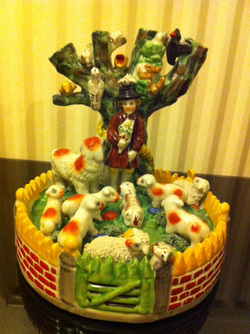
I didn't believe it could happen! Despite showing this monster under the REPROS tab on this page, AND despite a warning under BELIEVE IT? that this figure was being listed on eBay as "Jesus Christ as the good shepherd in the Garden of Paradise"....somebody bought it. I am not sure if he bought the eBay figure for GBP450 or if he bought it somewhere else. Anyway, this hideous reproduction of a wonderful Staffordshire farming group has a new home! The new owner found my site and realized his problem. He wrote to me: "I came across your website and now know that The piece I purchased is a reproduction of the piece Jesus Christ In Paradise. I would appreciate your advice on the piece as to value if any the piece has no markings and no damage. I await your response." A reproduction of Jesus Christ in Paradise? Please explain! And I don't do appraisals, but value? Ha! I replied very nicely, condoling and consoling. I have yet to have a reply. Ninety-nine percent of the inquiries I receive are about reproduction figures. It takes an awful lot of time to answer them all, but I do. Frequently, I get no response. Sometimes bad things happen to good people,but sometimes people get just what they deserve.
mystaffordshirefigures has joined Facebook. It has its own page and I am struggling with all the bells and whistles. If you are on Facebook, click the Like button at the very top of the sidebar on the right hand side. That way you will get all the updates on this site posted to your Facebook page. If you are not on Facebook, you may still want to Google and check out mystaffordshirefigures. There are new snippets posted that you may enjoy, plus comments as other readers join in. I think you can access this without joining Facebook, but I am not sure. Worst case, join! It is simple and I promise it is definitely not addictive. I must admit that I find this challenging...
I love classical figures but the quality MUST be dazzling. Most figures of Peace are run-of-the-mill and don't make the cut....just a little sad and worn looking. A particularly nice example of the traditional portrayal of Peace (below) is in the Victoria and Albert Museum. This wan, heavy-hipped lady is as good as this figure gets....yet I find her so uninspirational, such a downer.
 Photo: The Victoria and Albert Museum Years ago, I saw and bought a rather different figure of Peace, which I have shared with you in the past. The glaze and enamels are just beautiful, and she has a wonderful face. Plump and very English, bright and very engaging --nothing that looks as if it belongs on a Greek vase. As you can see, she definitely is Peace because she holds a laurel sprig and she wears a crown of laurels. At her feet are the implements of war, which she is burning. Note the pretty dress pattern and the crispness of the laurel leaves. And she stands on a vermicular base, rather than the usual white base banded with a line. Altogether, a far cry from the ordinary Peace figures that abound.
Fast forward a few years, and I came across a figure of Justice that, like my figure of Peace, stood on a vermicular base. I knew immediately that these two ladies were intended to pair. I hesitated because of restoration....and a friend beat me to the punch. I know "he who hesistates is lost", but I consoled myself by noting that Justice's red dress wouldn't have looked good with my Peace.
At this point, I had only seen one example of each of these figures of Peace and Justice....but I always live in hope. Then, a second example of Justice popped onto my radar screen. She was in a museum collection, alas locked away forever. And then, surprise! A third example of Justice came up. This time she was very definitely for sale, and thanks to John Howard, I have now completed my pair. Can you blame me for thinking that this was one of those moments when my Pottery God smiled in my direction. What are the odds of getting these two ladies together?
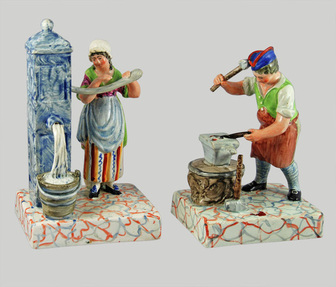
This is not the first time that John Howard has served as brilliant matchmaker for my collection. You may recall this extraordinary pair I shared years back. (BTW, next week this site turns 3 years old!)  Lady at water pump, known as "The Cow with the Iron Tail", and a blacksmith. You can read all about them on the FABULOUS FIGURES tab on this site. In this case, I had the lady (a rare figure with only about half a dozen recorded, two of which are in museum collections.) The man was known from only one heavily-restored example. So you see why John truly is a matchmaker extraordinaire. Matchmaker, matchmaker, make me a match go the lyrics from "Fiddler on the Roof." Now if John could only do something about my happy-to-be-single children!
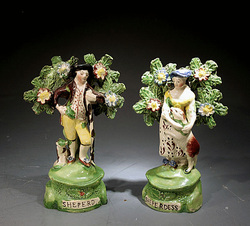
True pairs are increasingly hard to find, and I note that good original pairs of small figures seem to have disappeared. That's why I am surprised that this pair remains for sale on John's site.  From the stock of John Howard. Titled SHEPERD and SHEPHERDESS, they are clearly a true pair that have lived together always. The bocages are from the pot bank we call "Big Flower." This pot bank produced some very fine wares, and the enamels are nearly always particularly clear and bright. As a glimpse of the past, what more could you want?
I heard from someone who complained John Howard's new site takes too long to load. Checking around, I found nobody else with this issue. I suggested that the person with the problem update his browser. He tried Google Chrome and his speed is now lightening fast!
I suspect those of you with slow browsers may find my pages also take too long to load. If that's the case, please consider using a newer browser. You will be amazed at the difference. Pages can and should load instantly! Anything less is just too frustrating.
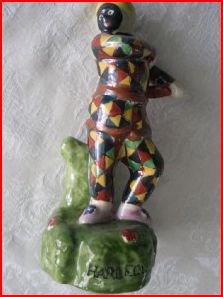
Commedia dell’arte is a form of theatre that originated in Europe around the 14th century. Characterized by masked performers, it evolved to have varying configurations in different parts of the continent. In Britain, enthusiasm for commedia dell'arte waned in the early 1700s and instead harlequinade evolved as a comic adaptation of it. Harlequinade performances were initially mimed but later included speaking roles and music. By 1800, harlequinade had become a goofy slapstick affair, and the lovers Harlequin and Columbine were pivotal characters. In those days, an evening at the theatre featured a mix of dramas and pantomimes, and a clownish harlequinade based on the pantomime was a nice touch to end the performance. Harlequin’s mischievous bawdy antics made him a lively addition to the stage and he—and Columbine, to a lesser degree—enlivened the English stage into the Victorian era.
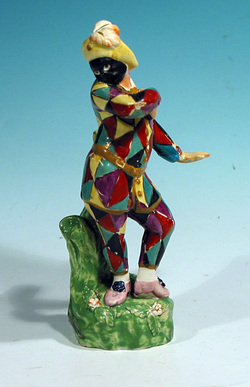
What of figures of Harlequin and Columbine? In the 1730s, Meissen made the first ceramic portrayals of Harlequin and Columbine. These porcelain figures were inspired by engravings of commedia dell’arte characters. English porcelain factories followed suit, using both engravings and Meissen prototypes to influence their designs. I believe Derby first made Harlequin with a black mask from around 1770. Staffordshire figures of Harlequin and Columbine are quite rare and closely resemble Derby porcelain forms.
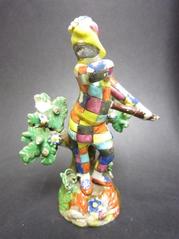
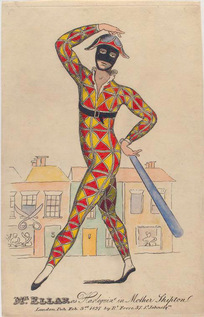
 Staffordshire pearlware figure of Harlequin, circa 1810. Formerly in the stock of John Howard. Note that Harlequin holds a black mask, but his face and hands are white.The figure above was made without a bocage, but I have recorded several examples with bocage--such as the example below.(Image source unknown.) I thought you might enjoy this theatrical print, published in 1827. It shows Mr. Ellar as Harlequin. Note that again it is the mask that is black, not Harlequin's skin. Unfortunately, cheap copies of Harlequin can today be found masquerading as the Real Thing. They pop up periodically on eBay. If you know nothing and want a quick pointer: I have never seen a titled early Harlequin, yet reproductions are frequently titled. The figure below is a reproduction--I wish I had a better picture. Meanwhile, I have a yarn to tell about a reproduction Harlequin recently described as circa 1820. Please click here or on Ouch on the Believe It menu at the top of the page to read all about it.  A modern reproduction figure of Harlequin. Just look at those feet!
Calling all collectors. Don't miss John Howard's new web site. I must admit I am addicted to the display of delectable figures and wares. One touch on my iPhone screen and I am there.....and I do this every day, more than once! http://www.antiquepottery.co.uk/antique-pottery-and-ceramics/
“Hee cannot be a gentleman which loveth not a dogge,” proclaimed the sixteenth-century Puritan cleric, John Northbrooke in his somber Treatise against Dicing, Even the strictest Puritan approved loving a dog!
Today's athletes are brawny human beasts, but early nineteenth-century sports stars were—with the exception of pugilists—animals. If you page through pre-Victorian copies of the illustrious Sporting Magazine, you will find engraving after engraving memorializing skilled horses and dogs. For dogs, conformation had not yet become a matter of concern (oh how shallow we have become!) Instead, dogs of great skill were illustrated for all to admire. Thus, Lord Camelford’s pugnacious dog Trusty earned a full page in the Sporting Magazine to display his squat, battle-scarred torso, and Billy, a rat-catching terrier of the 1820s, was depicted setting new records for that now-defunct sport. But most universally admired were gun dogs. After all, a gentleman’s achievements in the field were primarily the successes of his dogs.
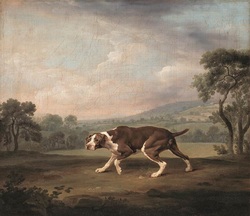
The pointer was the aristocratic dog of the pre-Victorian era. Pointers arrived in England from Spain in the early 1700s. Some of those early dogs were given Spanish names--was it to make them feel more at home in their new land? George Stubbs, renowned for his fabulous animal paintings, painted a Spanish pointer named Sancho in 1766.
 The Spanish Pointer, by George Stubbs. Photo: The Web Art Gallery. In an era when plagiarism prospered, Stubbs's famous image was to become representative of all pointers for decades to come. Engravings mimicking Stubbs's Spanish Pointer were used into the 19th century to represent then-famous pointers.
By 1800, breeding pointers with setters and foxhounds had yielded the English pointer. This dog was perhaps smarter than its owners! Pointers now fastidiously disdained rough country and water. Wily pointers were known to have refused to hunt for poor marksmen, and one even returned home in disgust after his master had fired repeatedly without bringing down a bird.
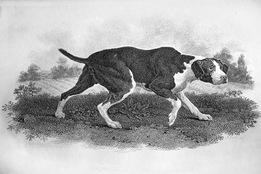
 The famed pointer Dash from the Rev. William Daniel’s "Rural Sports" of 1801. Dash was one of the most famous pointers of his time. This dog's fame earned him an engraving in the Rev. William Daniel’s Rural Sports. Dash's owner was persuaded to trade him for £160 worth of champagne and burgundy, a hogshead of claret, a fine gun, and another pointer--but only on the stipulation that if the dog were ever unable to hunt, his owner could buy him back for 50 guineas. In due course, a broken leg ended Dash’s hunting career, and he returned home to assume a new vocation as a stud. Meanwhile, I am certain Dash begat lots of other dogs, some of whom must have borne their father's name.
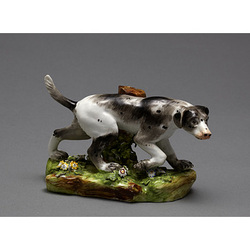
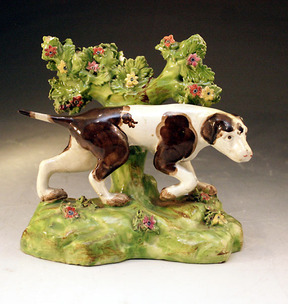
What of ceramic pointers? Well, the example below is clearly derived from George Stubbs's famous painting, but I don't like it one bit. Why? Well, it is porcelain and, to my eyes, totally devoid of soul. It was made by Derby circa 1775, and is in the collection of the Victoria and Albert Museum.  Photo:Victoria and Albert Museum But earthenware collectors, there is hope! Staffordshire's potters too created versions of Dash. This dog's doulful expression, tight crouch, intense gaze and beautiful bocage make it irresistable.  This dog is from the current stock of John Howard. I have had a very similar dog in my collection for a long time and have not, until now, seen another that approached it for quality. This bocage is typical of the Enoch Wood manufactory, and you will go a long way to find a nicer example. If it makes you feel better, our Puritan dog-lover, John Northbrooke, would have blessed your purchase!
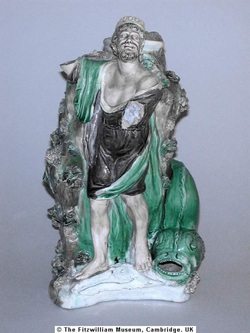
I love daft figures. Last year, I photographed this figure of Neptune in the reserve collection at the Brighton Museum, and it certainly qualifies as daft. I think Neptune is with a triton--that mythical half-man half-fish combination. The figure is a whopping 15-3/4" tall, excluding the trident.
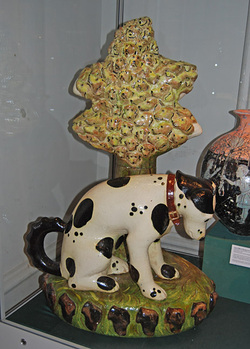
This really is an extraordinary object and it makes quite a statement. Okay, maybe this is one I wouldn't want to own, but I do find it fascinating. Despite its grotesque form, it clearly was a labor of love. Note the gilding on the hat, the dolphin's carefully shaded scales, the floral swags on the shield. And the back has not been short-changed. I haven't seen anything like it, but yesterday I discovered this in the Fitzwilliam Museum, Cambridge. This figure form is the same, but it has been decorated in colored glazes rather than enamels. If you thought the enamel-painted one was ugly, what do you make of this? You can link to the Fitzwilliam Museum's object record hereand see more pictures. Note the Fitzwilliam attributes its figure to Ralph Wood, and I have no reason to think otherwise. The enamel-painted version looks like it too belongs to the 1780 -1800 period. Having verbally abused Brighton's ugly figure, I recant: I would probably grab it if it were for sale. And that reminds me of something else. As I was leaving Brighton Museum--always a wrenching moment for I love the collection SO, and Stella Beddoe is an amazing Keeper--I spied a huge modern object in one of the foyer display cases. Titled Bud and Barkage and made by Carole Windham in 2000, this HUGE dog with bocage is a modern-day interpretation of what our potters once did. No doubt some will like Carole's clever work and others won't, but I was tickled to see that our potters' skills continue firing the imaginations of a new generation of artists.
|