I have avoided writing about items for sale on the web, but after all this is MY blog, so here goes. Have you noticed the lovely little stag sitting on Andrew Dando's site?
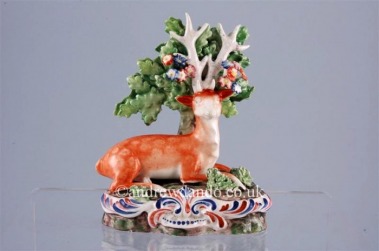
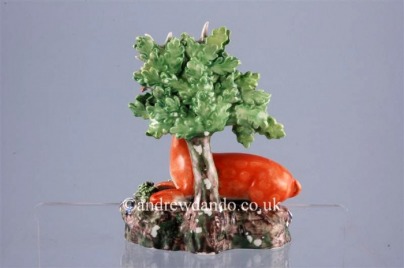
Now fault this if you can! Look at the sumptuosly scrolled base, the lavish bocage, the stag's softly dappled coat, the colors of the scrolling mirrored in the colors of the bocage flowers, and those antlers, those antlers, those antlers.....hard to believe those towering antlers have escaped damage over a 200 year period, isn't it?

You can look at larger-than-life-sized photos of this figure at http://www.andrewdando.co.uk/3.pottfig1-og-col.htm. Note Andrew's meticulous condition report disclosing negligible restoration to bocage tips and minor flaking of enamels (that has wisely been left untouched.) Dealers like Andrew stake their reputations on their condition reports and there are no disclaimers attached--the same cannot be said of auction house condition reports, which are so often scant on "conditon" and long on "disclaimers"! So with this treasure just an email away, why would you buy at auction?
 
Tittensor 09/22/2008
 

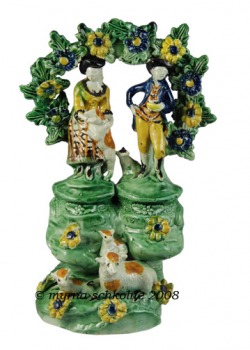
Figures marked "Tittensor" are thought to be the work of Charles Tittensor, who potted in the Potteries in the earliest decades of the 19th century. Such figures are rare beasts--and most times they are beastly ugly, with heavy modeling and especially clumsy, garish underglaze coloring. But this is not always the case. Tittensor also produced enamel painted figures. And sometimes even his underglaze figures are simply dazzling! Case in point:

This amazing 9" figure simply glows and the large yellow flowers are so eye catching. The structure comprises two figures--note the impressed titles SHEPHERD and SHEPHERDESS midway. The figures are placed on a fantastic triple meringue-like mound that is large enough to support some sizable sheep. And all is surmounted by a hoop bocage. Interestingly, the molds used for the shepherd and shepherdess are very like those used by other potters. Similarly styled figures (usually enamel painted) occur marked HALL and SALT--or not marked at all. But only Tittensor seems to have combined the two figures into a compound figure group.

When I have to bake cookies, I am often tempted to lump all the dough into one big cookie and be done with it. Seems Tittensor had the same approach to figure making!


Paragraph.


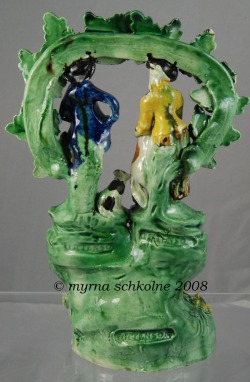
And lest we have any doubts as to the maker's name, Tittensor stamped his name into the figure very deeply on the back THREE times!

Although very rare, compound Tittensor figures of this type are not unique. I know of two slightly smaller ones illustrated in Anthony Oliver's Staffordshire Pottery and one in the collection of the Atlanta Historical Society--but I don't know of another that bears three Tittensor marks.

 
Classical Charm 09/18/2008
 

What did I know in my 30s? Where was my taste?? Sad to say, in those now-distant years I ignored classically styled figures. Boring, I thought, as I focused on figures reflecting everyday life in England in the early 1800s. But some years ago I had a revelation when I visited a large private collection: amidst the cheerful clutter one figure screamed LOOK AT ME. A serene Ralph Wood enamel painted Minerva was queen of the crowd. The coloring was amazing, the modeling so crisp. That figure gave me goosebumps, and thinking of it still does today.

Minerava opened my eyes to the charm of classical figures. Before you yawn, I agree: many are clunkers to be avoided. But I am not talking about all those anemic, heavy-hipped ladies. Read on.... .

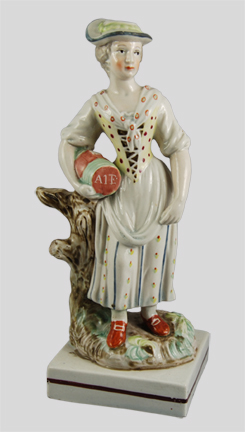
This perfect figure is referred to as "the hay maker" because examples occur titled thus. It was probably made by Ralph Wood II or II between 1785 and 1805 and is finely decorated in the delicate manner associated with early Wood enamels. The haymaker holds an ALE BARREL (so titled, which is unusual); mold number '31' is impressed beneath the base; a red band is around three sides of the base only--another Wood "feature". H: 7 1/4".

Mold number '31' is a recorded Wood mold number. This figure most commonly occurs decorated in the colored glazed typical of most Wood wares. Falkner (p12) illustrated a colored glaze example without a mold number but marked R WOOD. Halfpenny (p58) illustrated a colored glaze haymaker in the Potteries Museum, 286.P.1949. Also in colored glazes, see Fitzwilliam Museum, C.39-1930. See Grigsby p437 for another and p438 for mention of a figure impressed '31' but from a different mold in the Potteries Museum (48P70). (Halfpenny (p327) mentions the same mold number having more than one use.)

And now that I have told you more than you wanted to know, just look at the figure :)


This strapping lass depicts either Plenty or Ceres--I will admit to being totally confused as to how to tell the difference, so please tell me! There is nothing anemic about her. Just look at those rosy cheeks. I love the family of figures that occurs on brown-bases. H: 8.5".

A side note: the figure is perfect. That means unrestored. Yes, I can see the little nibbles on the base, but they are so minor I wouldn't have them touched in. Just 200 years of wear, and so much less bothersome to the eye than poor restoration.


I bought both these figures from Aurea Carter, but look at the Showcase and you will find others, ranging from Juno Antiques' sweetly lovely Ceres (already have similar or I'd be tempted) to Elinor Penna's amazing 22" Enoch Wood Fortitude, which I would love to own.

 
Tiny Treasure 09/07/2008
 

The best things supposedly come in small parcels, and Staffordshire figures are no exception. The longer I collect, the more I am attracted to tiny treasures. Case in point: the critter below.

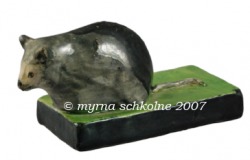
Pearlware figure of a mouse, made in Staffordshire circa 1820. H: 1 3/4"; W 2 3/4"


To state the obvious, this is a mouse. But it was not so apparent to the seller, who advertised it as a cat! An early mouse is a rarity, and I had seen one only once before: formed from the same molds as this mouse and paired with a similarly sized cat. Unfortunately, the rear half of that mouse was quite restored--to my eye, the long, heavy tail seemed to belong to some other beast--so I passed on bidding. But it didn't deter others from chasing the final hammer price into four figures...in GBP, that is!  Fortunately, I was able to get my mouse for very, very much less and frankly I don't care if I never find a cat. The mouse is perfect, and what more could I want?


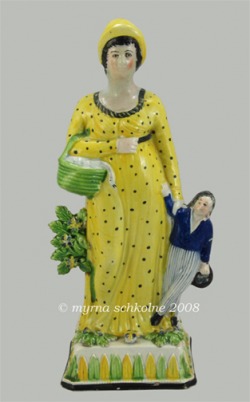
Relax, men. We all know how invaluable you can be. But this lovely pearlware mother and child are doing just fine on their own. When found paired, this lady stands beside a figure dressed as a sailor. Here the lad's striped sailor trousers are meant to look just like dad's. The figure is about 9" tall.

So why did I buy a single figure, rather than wait to acquire a pair? Firstly, a true (or even well matched) pair is difficult to find; in fact, it is one of the rarer figure pairs and I might never find a fine pair. Secondly, the figures comprising this pair usually were formed without attached bocages, andI have never seen a pair --or even a lone male--with bocage, so the bocage was intriguing. Thirdly, and most importantly, I bought this figure because it is simply beautiful, of course.

The molds for this figure are rather simple, giving the lady a robust charm suitable for a mature sailor's lady--she is no lass. The blue tinged lead glaze that coats the figure is particularly silky and glows softly with the enamels that have melded into it. I love the crisp molding: look at the sharp edges of the bocage leaves, the twists in the rope trim around the dress neckline, and the stiff leaves around the base. I always love yellow enamels, but here the potter rightly thought the figure would benefit from a splash of green and it does. That perky little bocage is lovely, and leaves from the same molds are strewn on the base. And don't you love the tear of green paint running down from the bocage? Don't you want to touch it with your finger? Note the very many carefully painted stripes on the child's trousers. Somehow everything comes together very pleasingly in this figure.

Am I looking for the male figure to stand with this lady? Well, sort of, but not really. The trouble is that he is going to have to be of very fine quality to earn shelf space alongside her--otherwise she will continue to live happily on her own.

Bizarre thought...is there a vague similarity between the lady's neck and the neck of the goose in the basket? Or have I been looking at the figure for too long?