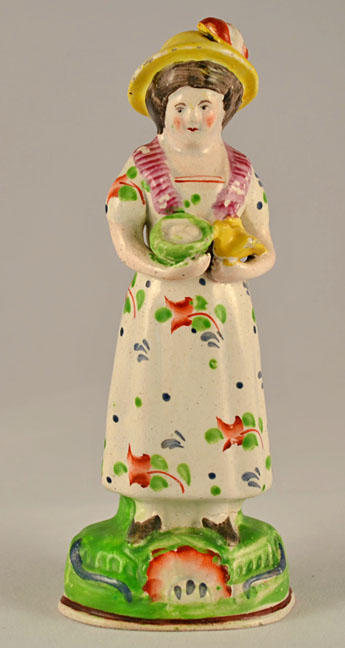
This past week I was contacted by a collector who wanted assistance with restoration to a sportsman. I do hope he will pair his sportsman with an archer. I must admit to having a fondness for archers, but fear not: I have not covered a table surface with a collection of those gallant ladies....yet.  There is something so appealing about these genteel figures, engaged in the one organized sport that was permitted to women in their day. 

Archery underwent a revival from the 1780s. Significantly, some clubs included women as full members, and their attendance as competitors and spectators added a social dimension to a sport that gave the fair sex ample opportunity to show off their profiles to best advantage as they posed with the bow drawn. The Woodmen of the Forest of Arden, the Teucerean Society of Archers, the Robin Hood Bowmen and other quaintly named archery societies became playgroups for the elite. Gatherings were grand social events, resplendent with pageantry, and highly regulated conventions governed the minutest details of dress and etiquette. Each society adopted its own attire, but a verdant green was the most common color for would-be woodsmen and their maidens.The lovely  figure below is dressed in green---note the VERY pretty enamels and  really interesting base mound, and just look at her expression.
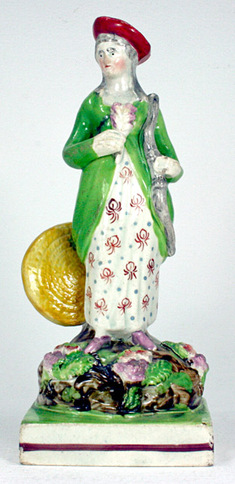
Archers on square bases can be run-of-the mill, so if you want one be sure to buy a really pretty example. The figure above would be a keeper. But what if you want a special archer?  What do you buy?  My first choice would be one of the "Sherratt" models.
And yes, I would pair this lady with a "Sherratt" sportsman. Above you can see two versions of the archer, and one sportsman. The archers have different bocages, but both have those typical "Sherratt" garlands on their bases, both have typical "Sherratt" bocages, and both are on bases "Sherratt" used.  Assembling a pair can be a fun collecting exercise....as long as Instant Gratification is not your thing. 

On the other hand, I might go for a very nice archer marked SALT. The Salt archer is, I think, one of the prettiest. I own one and I have never bothered to find her a mate. Frankly, I have never found a man good enough for her, and she is perfectly content just as she is!
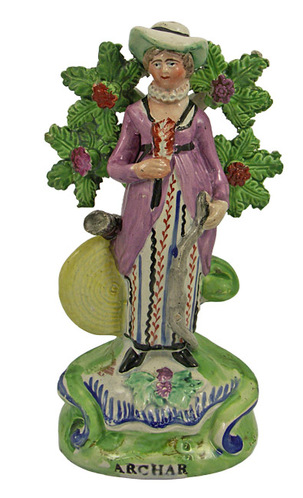
You can find all sorts of wonderful archers and their companion sportsmen, in pairs or in splendid solitude, at a very modest price. 
I have this image on file, and it always has me a little puzzled. Surely, surely that base has been cut down, perhaps because it was chipped? I would bet money on it, but I could be wrong.
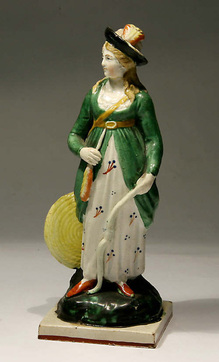
This is the most generic of archer figures, but, base issues aside, is she not charming?  Archers range from the classically beautiful to the cutely quirky. There is one to suit every collector's taste, and they are all quite affordable.  The books that Malcolm Hodkinson and I are working on will enable you to see a huge range of archers and to dream about the one with an arrow that pierces your heart.  We are thrilled to be able to share our knowledge with you--neither one of us wants to die with it all in our head.  The more pictures you share with us, the better our books will be. Having spent most of the day sorting through archer images and captions, I realize how imperative it is to get our images in place early in the game. If you are planning on helping, this would be a great week to get started.

And if you are going hunting for that archer or anything else, have fun!
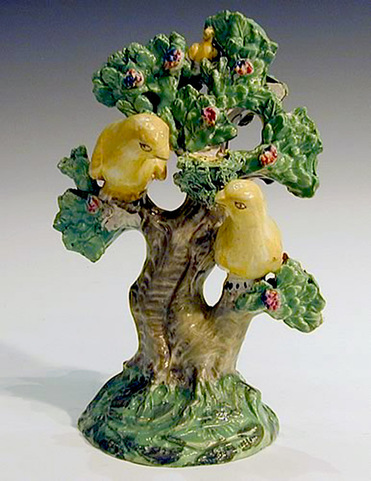
 
 
I have written about so many figures over the past three years that I cannot recall if I have shared the beauty below with you yet. In any event, it is well worth a second look. This grouping of a couple with birds is marked WALTON and it is the only example of its type that I have been able to record--and with a mark! Not only is it the lone survivor, it is in superb condition, and I photographed it in Brighton Museum's Willett Collection some time ago. Stop drooling....the point of this is to ask you please to LOOK at that bocage. If some of it were lost, that would be sad, but the figure would retain its haunting beauty. But start restoring it and would it look the same? I think not. Original has soul. Plasticy restoration does not.
Nothing quite beats a beautiful bocage, and I think the Willett Collection again houses the most stunning bocage I have seen. Yes, it is in my book, for those of you who recognize it. It really almost brings me to my knees when I think about this bocage.
We don't know who made Brighton's beautiful bird nesters, nor does it matter. I have noticed that figures on such vermicular bases are of a superb quality. It is tempting to attribute them to Walton, but the deeper you dig, the less that holds up.

The little figure of Tenderness below is in my collection, and this is another bocage I would rate A+.  You can't fault it.
Notice the figure is again on a vermicular base. If you look closely, you will see that the leaves are arranged in threes---something we never see on marked Walton pieces. You can learn all sorts of things by really, really looking. Leaves arranged in threes do not occur on marked WALTON figures....but this is all another story.

One thing that disturbs me when I see some collections is the number of totally restored bocage bearing no resemblance to the correct form. Each pot bank used a range of distinct bocage formats. The problem is that restorers and dealers don't know what they are and they stick on anything. I have seen several figures with early bocages attached to them. Early, yes. Original, no. At some point the figure lost its bocage, and bocage from another was attached in its place. When you look at that figure today, you can detect the reattachment and conclude that the original bocage broke off and that the original bocage was reattached. Not so fast! Beware reattached bocages!  You need to know how the bocage should look before you can determine what is going on. I know, I know. This is difficult but I hope that the new book will be helpful in guiding collectors.

The best advice I can give you is that you should buy from a knowledgeable, reputable dealer who will state all repairs/restorations on your receipt. And perhaps an even better piece of advice is to know what your figure should look like. This figure always has me puzzled. Is it right or isn't it right? I truly don't know.
The thing that always worries me is that I have another image of this figure scorched onto my brain, and it looks like this.
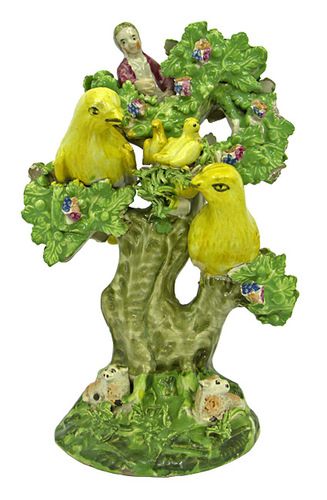
This perfect figure is another gem from the  Willett Collection. Note the man atop the tree. Did the other figure have a man in the tree once upon a time?  Was it easier for a restorer to repair damage by placing a bird in that spot instead? And, while I am thinking nasty suspicious thoughts, is there possibly a sheep or two missing off the base? It is so easy to touch over the area of loss....but for all I know, the first figure may have no damage at all. It may simply have been made that way. But if there is any restoration at all in the area of that little bird, it would set off alarm bells.

I hope that by sharing as much as we can of what we know, we will all elevate collecting to a new level. So thanks to all of you who have sent me pictures again this week, and please keep them coming.
 
 
Oh, how I wish I could step back in time, for just one day. Put me on Hot Lane Burslem, so I could ask all my questions. On one of my visits to Stoke, I sought out Hot Lane--the site of the Sherratt manufactory--and stood there waiting for the earth to shake, or for some visible sign of a message from the other side. But the quiet little road went about its business as usual. Ah well, I live in hope....but I think Enoch Wood is just the person I would want to visit because his life spanned the period in which my figures were made, and his journals attest to his great memory.

One of the many things we don't know about figures is how they were marketed and sold. It would be nice to know who bought them, but it would also be great to know what they bought. Were Elijah and the Widow always sold as a pair, or could you buy them individually? What of the Seasons and Elements? Could you buy just one?  I suspect that you could buy one of most things, but there were figures that you of course would only want as a pair. I think the potters were savvy enough to cater to all tastes....and for that reason I believe that mix and match was the order of the day. If you wanted to buy Spring, but not Winter, Summer, or Autumn that was just fine.

As I devour the pictures some of you have been sending me this week (thank you), I am struck by how very many figures that I had thought of as singles can actually be paired. They look fine as singles, but at the point of purchase you probably could have bought a pair. For example, we never think of dandies as figure pairs. Two figures on a base seem to be a pair unto themselves, but very many of the dandy models do indeed have another "side."  
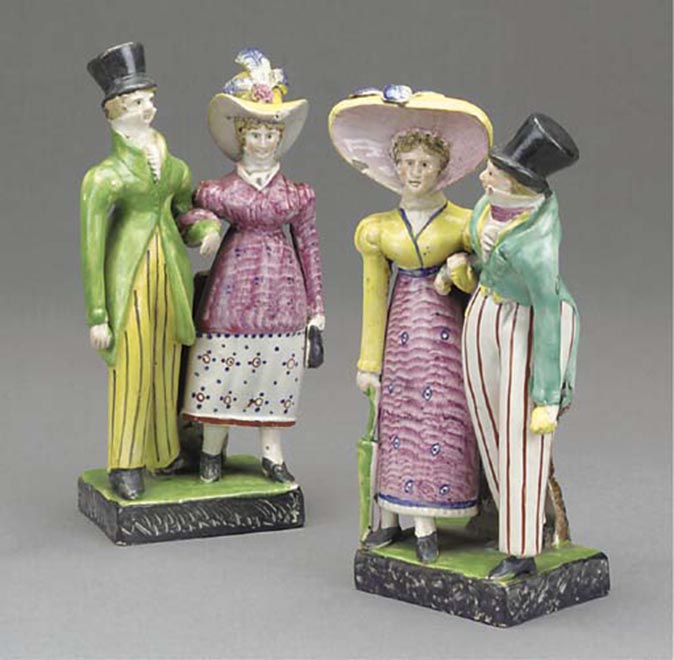
I know large dandies sometimes come in twos. The figure group on the dust jacket of my book would have had another to go with it--and you could buy it or not, as you liked.  I have noticed that some of the square-based dandies of a good size can be paired, like these two pairs above. These may have  been together always, simply because their original purchaser chose to buy a pair rather than a single. As I dig through my dandy archive, more pairs become apparent. I can't go so far as to say that EVERY dandy group has another to pair with it, but if we assemble enough examples of dandies, we may reach that conclusion. So please keep your pictures coming.

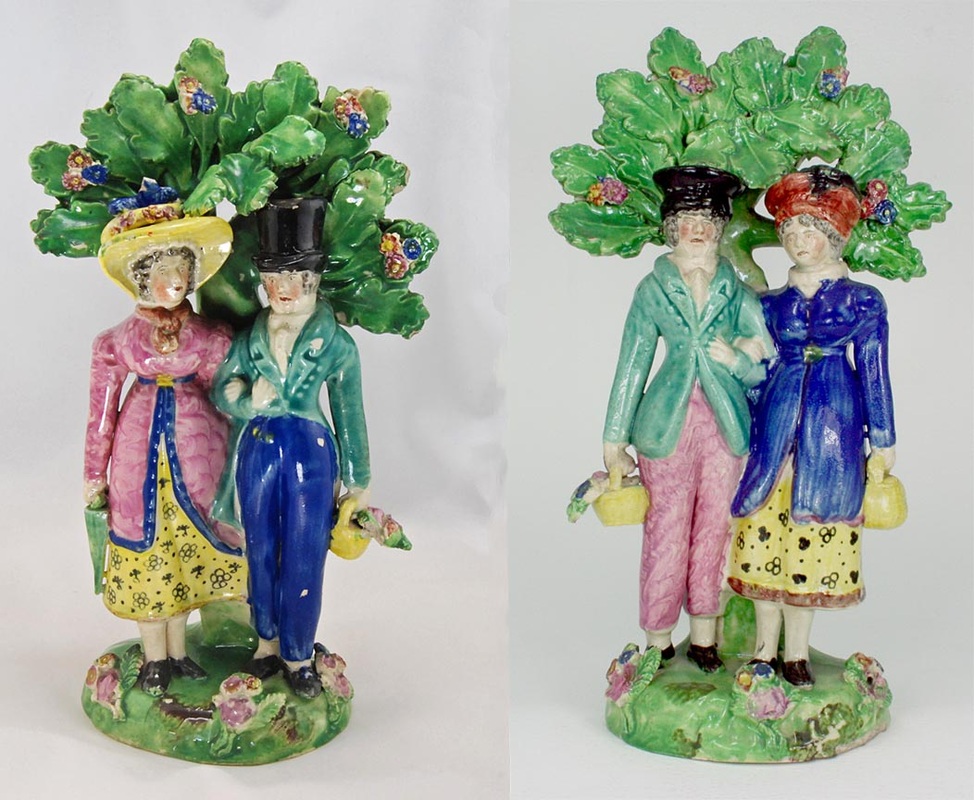
Above are two pairs of mid-sized dandies attributable to "Sherratt."  Tell me that they weren't made to stand together?  Allowing for minor color differences due to photography with different cameras in different countries, do these not look like they were painted on the same day by the same person?  (I know, I know! When I Photoshopped them together for you, I should have put them the other way around, so the two men stood on the outside).  I think these are drop-dead gorgeous, but then I am so partial to dandies. These pairs are both perfect, right down to the little flowers projecting from the baskets the men hold. So don't believe anyone who tells you there is no such thing as a perfect figure!

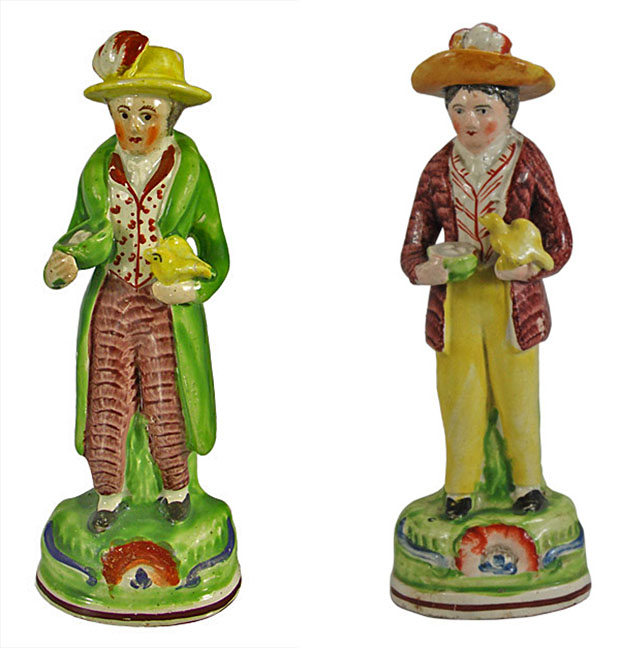
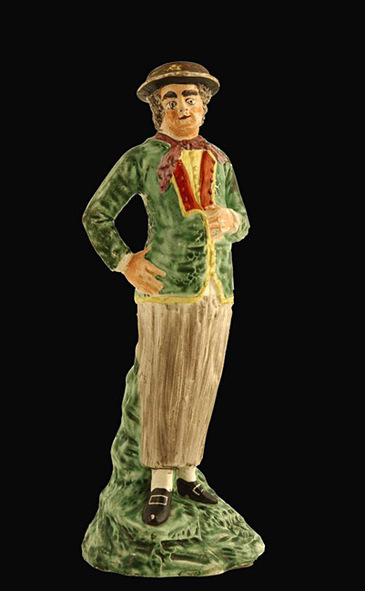
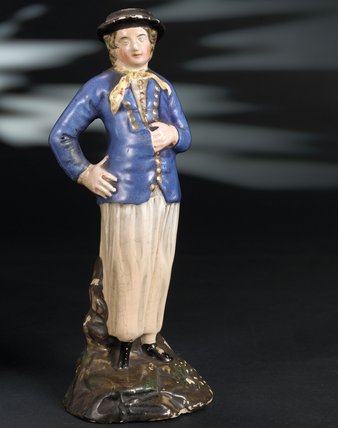
My current pairing dilemma centers around these two small figures.
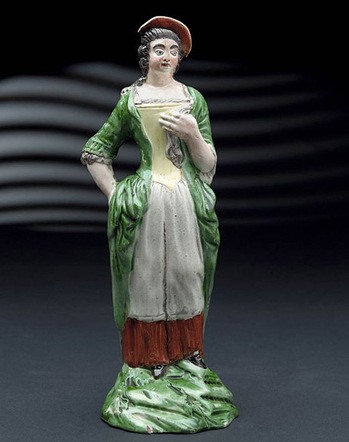
Yes, I know these are not a pair! I bought the man in the green coat first. I call him the Green Man and I haven't seen another like him. The fellow alongside came home with me a while later. I was fascinated by the way the molds evolved to reflect the change in gentlemen's fashion. I never ever thought that either of these figures might have a mate. After all, the figure world is full of singletons, is it not?  Then this week, this little figure whizzed into my email box.
Charming is she not? I wish she was mine....but then I would have a trio and I am not going there! Of course I am now looking at every figure as if I can see double. What does it pair with? Look at your shelves, think about it, and if you can't come up with the answers send me a picture. You just never know   what we may discover.
 
 
Thanks to those of you who have stepped forward to help with pictures for the next book. I am so appreciative. I know its not fun taking pictures, measuring heights, emailing etc, and some of you have gone to memorable lengths to help.....but the more of us participate, the better  the end result.  This book must reflect the collective state of what we know. That way, others can build on our knowledge in the future. 

I know some of you are intending getting your cameras out, but please will you ALL participate?  I need plenty of examples of ordinary things, be they chipped, damaged, or broken. So give me your tired, your poor, your huddled masses--they are all welcome.  People who read this blog are sophisticated collectors. We have all been around the block a few times, so we tend to shove mundane examples to the back of a shelf...but new collectors will be looking in these books to find just those figures. So send them all my way, please, please please. This would be a perfect weekend to get out your camera!
 
 
Once upon a time, Britannia really did rule the waves, dominating a vast-ever growing empire.  In the days before planes, trains, cars, and email, most forms of staying-in-touch required getting on a ship. So the navy--be it for mercantile or military purposes--was central to the country's functioning. Today, we don't give much thought to our navy, but in 1800 I expect everybody knew someone with a tie to the seas.

Can you imagine saying farewell to your loved one as he set off on a months-long ocean journey? Dangers at sea, illness on board....a zillion hazards could take a life in a blink.  And those at home didn't have even a photograph to gaze upon while they waited. Thoughts like this float through my head whenever I gaze upon a Staffordshire figure with a naval connection, and I am surprised there aren't more of them.  I came across this pair in the collection of the National Maritime Museum recently. 

Don't you want them? I do! You can tell he is a sailor by his neckerchief and other clothing. And she is holding a handkerchief to wipe away those tears of farewell.  If you have seen a similar pair, please tell me about them.  The only other example in the Museum is this sailor, from the same molds. Yes, original gilding, I think.
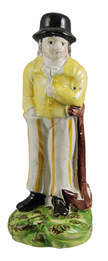
Earthenware figures of sailor often have striped trousers. I have this tiny sailor, one of my very early collection purchases.
He is only about 5 inches high, and I have recorded another example on a square base with a line painted around it.

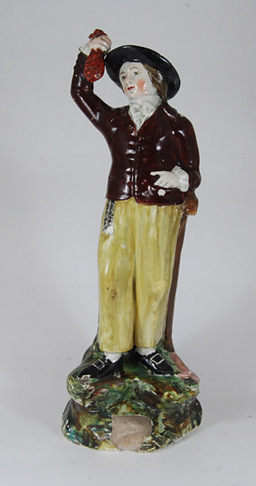
This lovely sailor is taller, about 9". I photographed him from the Willett Collection, Brighton, and I have not seen another.
Yes, he is holding his bag of coins--his pay at voyage's end--aloft. Is this not a fabulous glimpse of a time gone forever?

The big figures are grand, and we all love them. And yes, I like many of the classical figures too...in fact, I like too many things! But ultimately the most engaging figures are those that give us glimpses of life as it once was.  That's what hooked me on collecting--and it still does.