Who is He? 11/30/2008
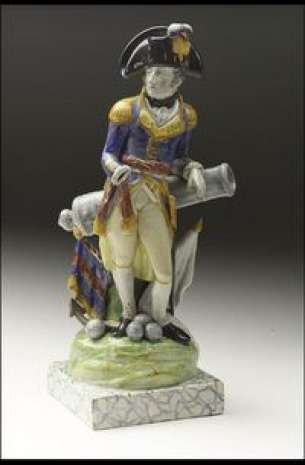
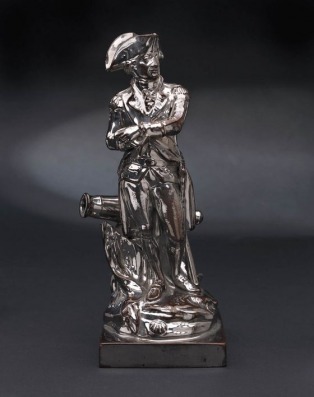
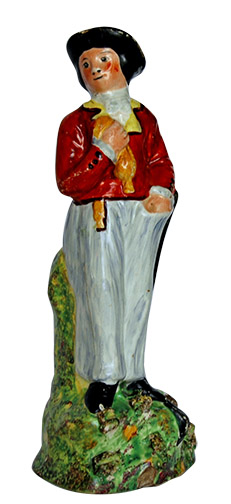
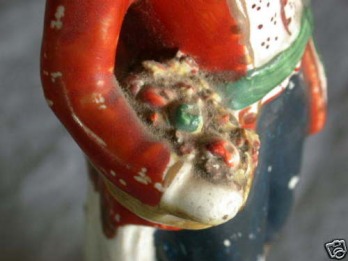
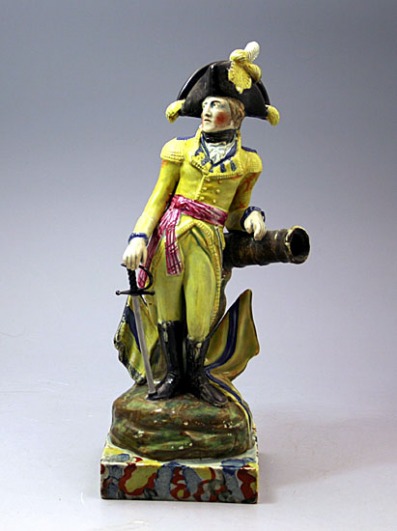
Don't you love the figure of an officer below? The first example I encountered belonged to a UK collector, an older gentleman. He loved his example--rightly so--but he believed it to be Admiral Rodney. I was not so sure. The title sounded more like a sales pitch to me, so I started digging around. ![]() From the stock of John Howard. H: 12 1/2". I found examples of similar figures in assorted books, each authors claiming it as a different hero (the Duke of Wellington, the Duke of York, Nelson....take your pick!) but evidence for a link is far from convincing. Best I can tell, the two figures in the National Maritime Museum are from similar molds parts, assembled differently. The silver luster figure is attributed to Wood & Caldwell, but I am uncertain whether it is actually marked so. That the figure is lustered is significant. The technique of silver lustering was done using platinum and it was first introduced commercially in 1805. So we know that the lustered figure was made some time after 1805. Note that it, like John Howard's figure, has two good arms. If the figure was intended to portray Nelson, surely it would have been made to show the Admiral's sacrifice of a limb more than 10 years previously? 1 Comment Spot the Difference. 11/23/2008
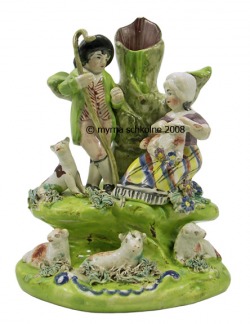
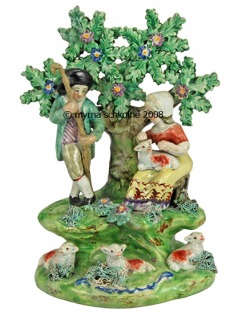
I am a self confessed workaholic, but one of the treats of going to London is the fact that at the end of the day my office cannot beckon. I always pick up the free newspaper that is shoved into my hands as I exit the tube, and last thing at night I do the Sudoku to help turn off my brain. The same newspaper includes another brainteaser: the reader is asked to spot 5 differences in two closely similar photographs. I must admit to finding this challenging because, unless it is a figure, the minutiae usually escape me. I will admit I was caught here. These two figures have no restoration (except the end of the shepherd's crook on one.) Both are marked WALTON. But one is made with a bocage; the other has a spill holder. Note another key difference. The top figure has a perky pooch placed to the left of the shepherd; the lower figure has no dog at all. In the spot where the dog should be there is a rough circular patch under the green paint. The only part of the dog that remains is a paw, also covered over with green. Fabulous Felines 11/21/2008
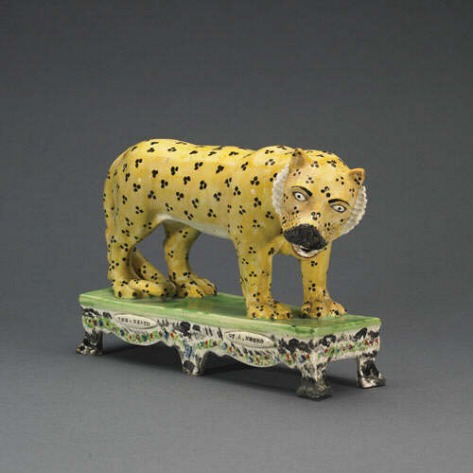
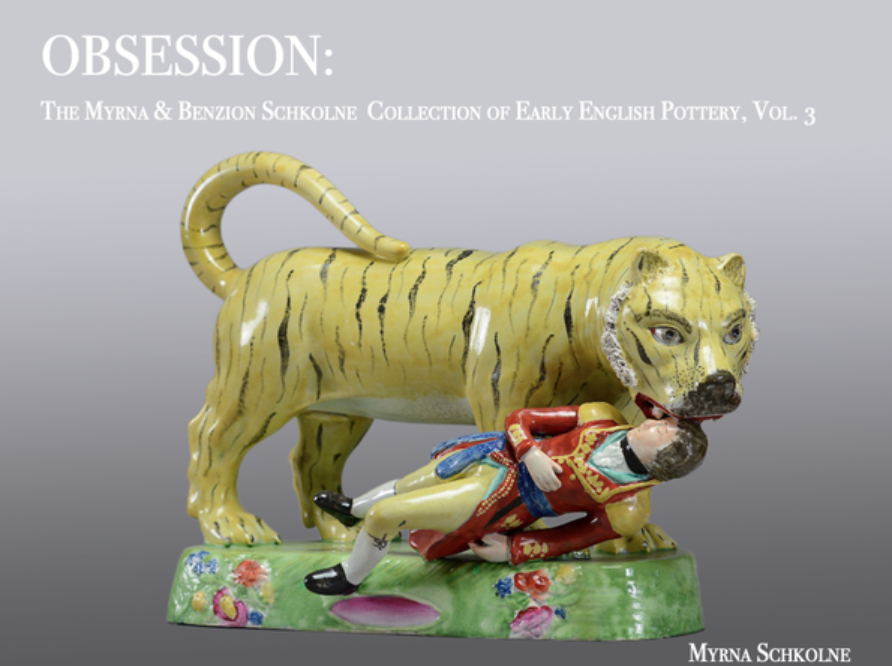
An intriguing and unrecorded figure is at auction at Waddington, Toronto, lot 69, December 3. At first glance, it seems familiar. A 14” wide feline formed as a tiger stands on a typical 6-footed ‘Sherratt’ base. Two plaques are on the base, but here comes the surprise. Rather than reading The Death of Munro, the plaques read The Death of a Negro. But where is the Negro? You might expect to find his mauled form suspended from the tiger’s jaws or slung beneath his claws. Instead he is nowhere to be seen. Waddington’s auctioneer Bill Kime suggests the Negro is instead in the tiger’s tummy! ![]() When I first saw The Death of a Negro, I assumed that the figure of a black man had been knocked off the base, a fate that sometimes befalls Lt. Munro in The Death of a Munrow. Yet Bill Kime assures me that there is no indication that a person was ever part of this vignette. Bill has looked very carefully at the base—he is so good at this—and there is no restoration to disguise the loss of a figure. Sailor Sale? 11/18/2008
Several years ago, my husband surrendered. He paid the ultimate price of living with a pottery addict: out went all our unneeded books because the shelves were needed for figures. The books had all been great reads once upon a time, but realistically we were never going to read them again. Of course, my reference library was another story. It remains, filling shelves that line my office. But beyond my office, shelves in the Schkolne household display figures, not books. ![]()
![]()
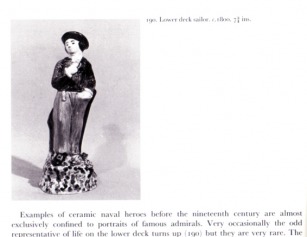
Oliver writes: Examples of ceramic naval heroes before the nineteenth century are almost exclusively confined to portraits of famous admirals. Very occasionally the odd representative of life n the lower deck turns up but they are rare. Restoration error, 18th century style? 11/17/2008
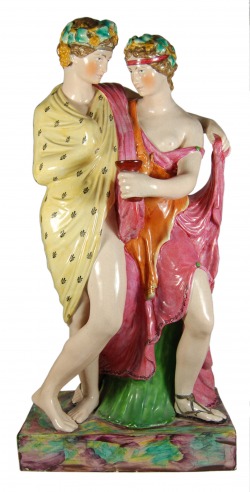
Ever noticed the impressive, large Bacchus and Ariadne that Elinor Penna is selling? Would you believe that this masterpiece owes its existence to a restoration error? No, the error is not in Elinor’s figure, which is correct. The problem began centuries ago. ![]()
Elinor’s Bacchus and Ariadne is modeled after a Graeco-Roman marble of Priapos and a Maenad. This marble had lost both figures’ heads and most limbs when it came to Britain from Rome circa 1770. Today we can confirm its identity as Priapos and a Maenad: a Graeco-Roman marble in Athens has Priapos’s head intact, and a group in Berlin preserves the maenad’s head.[i] But around 1770, something went very wrong. Faced with a headless, limbless trunk, an English restorer used his own initiative. He restored the marble incorrectly to resemble Dionysos (also known as Bacchus) and Ariadne —possibly he used a 4th century BCE bronze relief in the British Museum for "inspiration." The transformed marble was imitated as a smaller plaster and in bronze, which were in turn mimicked in pottery, giving rise to the pottery figure now known as Bacchus and Ariadne. [ii] Bath time 11/14/2008
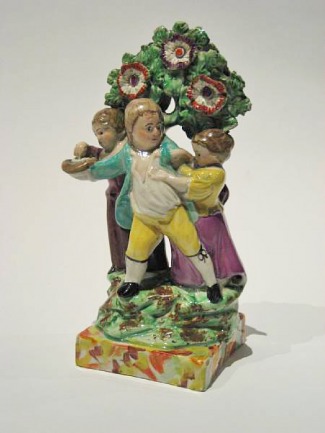
I can't stand the rain. Two dark, grey, soggy days--and I need a sunny day to bathe my new figure (see the Scuffle in the posting below). Bath time is one of the joys of new ownership...so let me explain. Gross, isn't it? And can you imagine the dirt that is pasted in all the nooks and crannies of a bocage? Sometimes it is so black and gooey that I know the figure must have stood near a fire place. Because I get to photograph other people's figures and view them magnified I really see the dirt. Sometimes, dirt is so apparent during photography that I carry a little dusting kit with me to try to discretely dust off a figure, very superficially at least, while my host or hostess doesn't notice. One charming English collector made no fuss. Before handing me each figure, she dunked it in a bucket of water...of course, I then had water drops to cope with instead of dust bunnies. Christmas? 11/12/2008
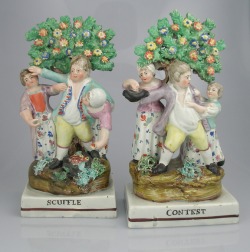
When Gary the mailman rang my doorbell today, clutching a parcel, I thought that this is what Christmas must feel like. No, Gary was not wearing a Santa suite and this Jewish girl has never had Christmas....but I felt all that childlike excitement that comes with an anticipated gift. So what was in the parcel, my gift for moi? Look for yourself. Isn't this a wonderful Scuffle??? Look at the colors and the fat, bright bocage flowers. They look like candies pasted onto the bocage. The glaze is so shiny...makes we want to lick it. (No, I don't do that! Nor do I tap with my teeth to check for restoration. I have seen others do this and I wouldn't want to put my mouth where theirs have been.) No restoration. Jut like I want it. The pair above are titled and have bocages--see my book for other examples, including an especially nice marked WALTON version. I wish I knew the source for the design of these figures. A few years ago Dreweatt Neate had an oak carving portraying the Scuffle that they believed was 17th century, so there is something more to this than a pretty picture. But what? I don't know. If you know, please share. myrna@schkolne.com Rumors of demise greatly exaggerated 11/10/2008
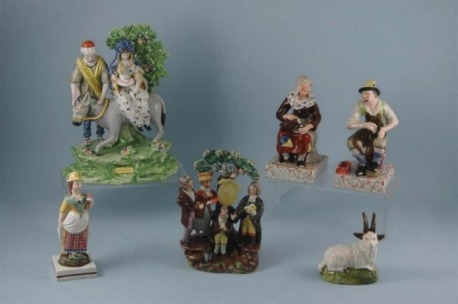
Rumors of the market's demise have been greatly exaggerated (my apologies to Mark Twain). Amidst all the financial doom and gloom, I feared the worst for Andrew Dando's selling exhibition that debuted in cyberspace this past Saturday. I set my alarm early to click on as the "doors" opened, and within hours lots and lots of the pottery figures had been sold. Bear in mind, we are not talking about junk sold at junk prices. These were great items, carefully selected, with prices commensurate with their worth. Seems collectors quickly flung their money down to secure them. Above is just one of the pages from Andrew's exhibition. The tall bocage figure (back left) is titled FLIGHT &. Presumably it was sold to pair with one titled RETURN, the subject being The Flight and Return to Egypt. Lovely to see this figure titled, and this bocage is particularly pretty and is one of my favorites. A gorgeous figure. It would not bother me that it is one of a pair. The other half looks so similar that it adds nothing. I love this figure and hope you do too. More importantly, I am sure it's new owner loves it. Yes, it is sold! Enough for a night! I really want to tell you that the sweet girl and the goat are unusual and each has merit...but more next time. So hard to stop when I am rambling on about figures. Pining for Portobello 11/07/2008
Tomorrow is Saturday, and it's a mere week since I went to Portobello Road and, although its famous antiques market is nowhere near what it was, I yearn to be able to go again today. My love of Portobello goes back to the early 1960s, when I was 10 years old and living in London. Portobello Road's bustling weekly market was just a few minutes walk away, so many a Saturday I would go along with my mother. In those days, the tables in the center of the road were bedecked with silver teasets and trays, and GBP1 was the going rate for Victorian silver. I bought my first little piece of pottery then, a ghastly thing that later made it to the local charity shop...but I caught the antiques bug on Portobello Road. Souvenir Lion 11/05/2008
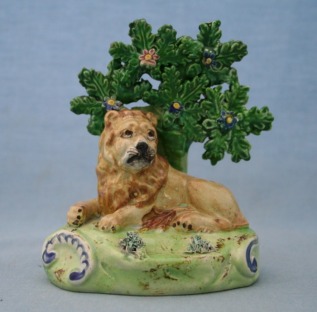
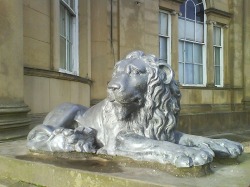
Returned from the UK late last night and it is great being back in my snug office with my dog, Maddie, at my feet. The UK was, as always, amazing--especially the London snow fall, the first October snowfall in London since 1934. Seriously, I could have done without the freezing cold and rain...but that's a London winter for you. I rushed down to Sampson Horne right away on my first morning, but found nothing new and things very much in transit between NY (where Jonathan and Christopher had just wrapped up a show) and Olympia (starting Nov 8.) Talk about a brutal way to earn a living. I simply don't know how our major dealers cope with getting themselves and their fragile treasures across the globe to cater to our tastes. ![]() Pearlware recumbent lion, marked WALTON. H: 4.75". Made in Staffordshire, circa 1820. Do you know how rare this little Walton lion is? Walton made lots of figure forms--I am compiling a list of known Walton figures and I am into the 80s with the list still growing. Some of the figures are a lot more common than others--but the mark makes them all rather desirable. I have seen tons of figures in the flesh, but I haven't actually seen a pair of recumbent Walton lions--only the odd pair in an old catalog. As for singles, I have seen just one, but not in the condition I would have liked--and at too steep a price. So I was thrilled to acquire my little fella from Martyn for a reasonable price. Will I ever find a pair? Probably not. And I don't care. I have a simply GORGEOUS single to enjoyt. ![]() Heaton Hall's lion, possibly the design inspiration for Walton's earthenware lion. | To Search the Blog:
|