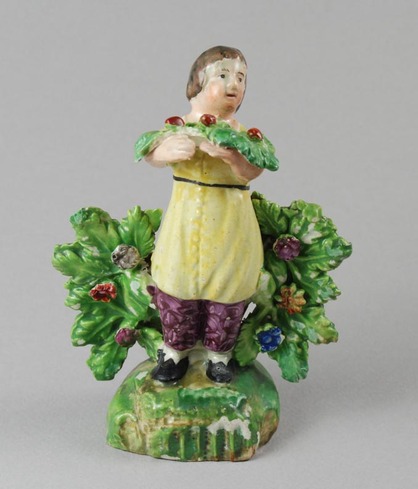
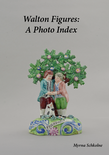
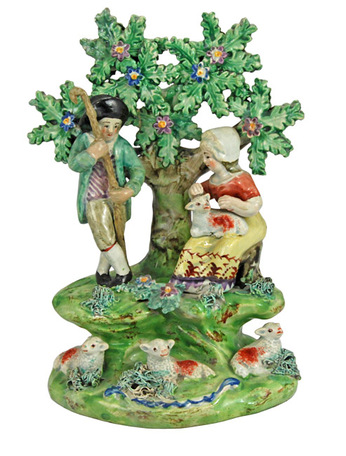
The group below, a shepherd and shepherdess with their flock, is marked WALTON. This comes as no surprise because the group looks like so many others that John Walton made. A mark is dead certain confirmation of attribution, but what do we do when we have an unmarked example in very much the same style? The gardening group below is a case in point. This example isn't marked, but is it not stylistically similar to the shepherd and shepherdess group above? This group is also very much in the style of other groups made by John Walton. Same intensity of color, same glazes, same type of modeling, same bocage. But none of that substantiates an attribution. Potters got their molds and materials from common sources. Because bocage molds were made in-house, the form of a bocage can frequently help us link a figure to a given maker. Unfortunately, this group has five-leaflet bocage fronds, and many potters used these generic fronds for their bocages. Thus, this bocage is no help in attributing this group. It must remain unattributed. So frustrating...but that is life.
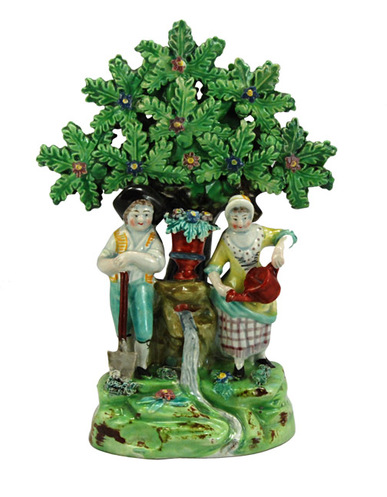
How about this one? Same group again, but with yet another bocage! This group again is very much in the style of John Walton. It uses a different bocage....but it is a bocage that Walton also used on rare occasions. Again, there is nothing about this group or its bocage that is exclusive to Walton. There is nothing that supports an attribution. The group also must remain unattributed.
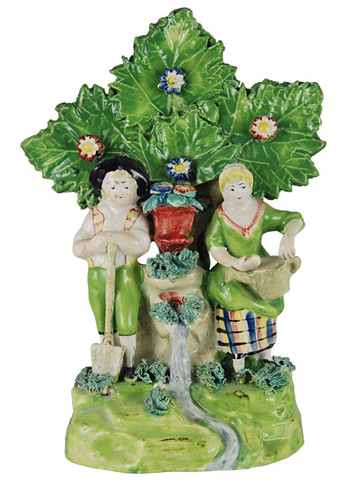
Let's keep trying. Here we have one final candidate for a Walton attribution. Again, this group uses a bocage that Walton used on rare occasions...but there is absolutely nothing about it that is specific to Walton. So this group too remains unattributed.
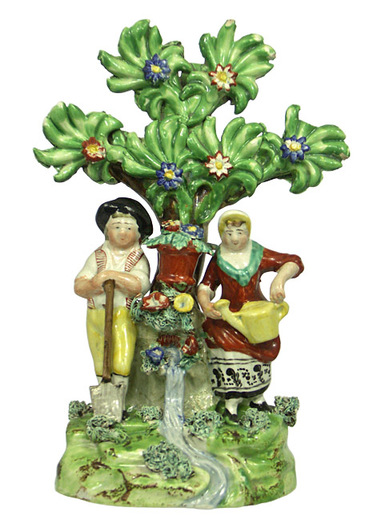
Come, come, Myrna. These groups all look so like marked Walton groups. Aren't you being too harsh? I think not. My pet peeve (or peeve of the week....I have lots of peeves) is the way the Walton name gets slapped on anything with a bocage. John Walton made more marked figure forms than did any other potter--in fact, he made over 80 figures and groups. If you could show me a gardening group like one of those above and with the WALTON mark on it, I would concede that John Walton just may have made the three gardening groups above. But until one shows up, there is nothing specific to link these groups to Walton.
There is only one feature on Walton figures that seems to substantiate an attribution. Look at the pink rosette in the base of this group, center front.
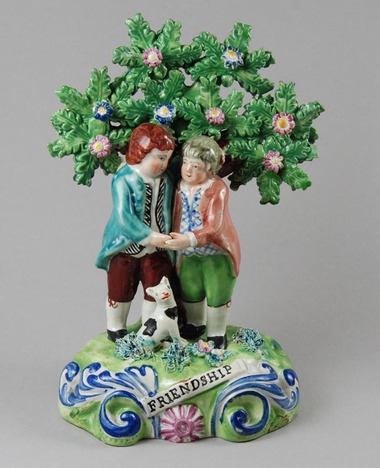
I have only seen this rosette on figures that have the Walton mark. To my mind, it is as good as seeing WALTON impressed in clay. Hitherto, each and every time I have seen the rosette, I have been able to find the WALTON mark on the figure.
While you are looking at FRIENDSHIP, above, note the little dog. Walton dogs always look like that, so if you see a little spaniel or some other pooch on a Walton figure, suspect restoration. I do think this group is delicious...but then I too am always a sucker for a great bocage.
As for the three gardening groups....I am not convinced they were necessarily even made by the same pot bank. But oh, how I would love to know.
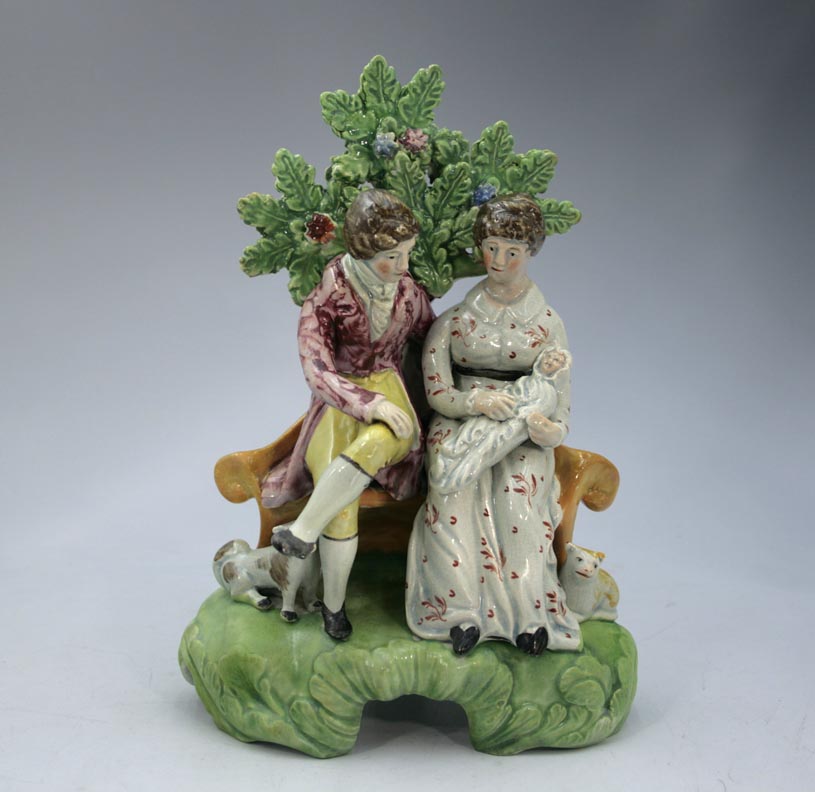
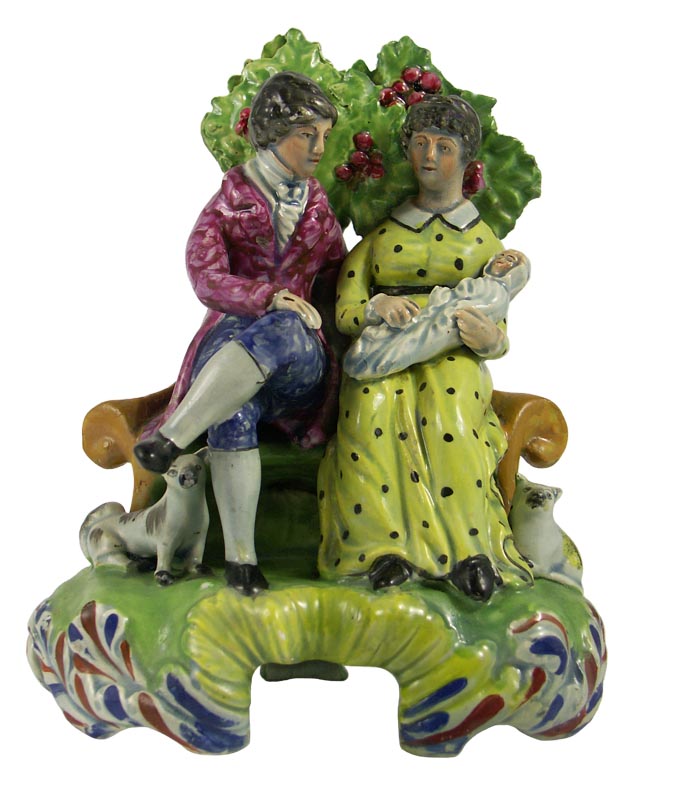
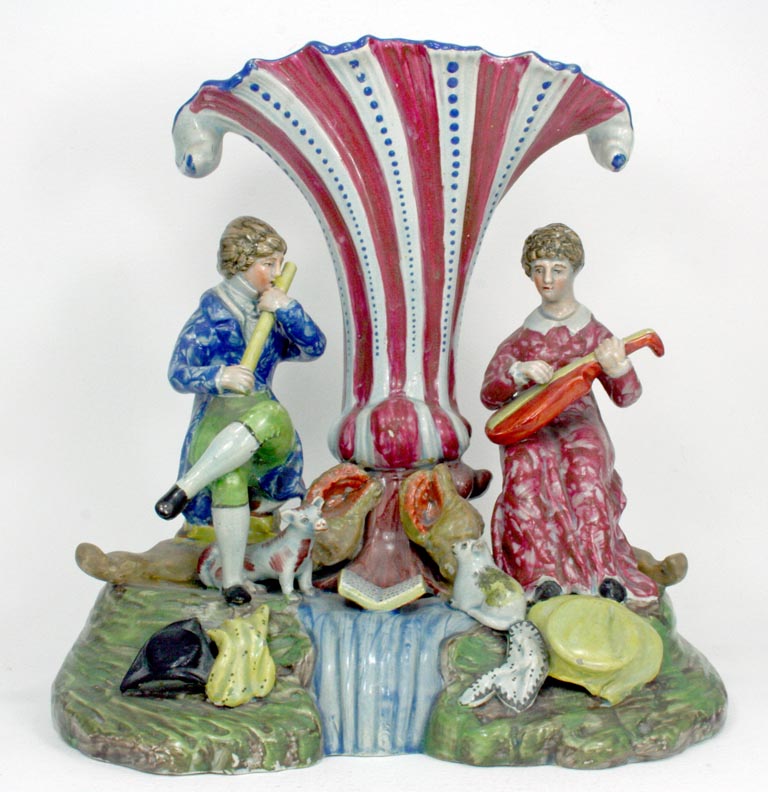
It is a holiday week on this side of the pond. Thanksgiving is here! As immigrants to the US, our family was introduced to Thanksgiving at a later stage in my life, but, once I mastered carving the turkey, the holiday became a firm favorite. Our family, like many others, gathers for a few days of family time each Thanksgiving, and, as my children live in three time zones, it is indeed cause for celebration. Family has always been at the center of mankind's existence, and it was no different in the early 1800s. One of my favorite families of that day is fabulously captured in clay. I call this group the Happy Family. Is that not absolutely charming? Formerly in the stock of John Howard Antiques. In the days before photographs, groups such as these must have held meaning that we can only guess at today. The pot bank that made this group made it with more than one bocage. The second example has a stunning holly bocage. I am pretty sure these two groups are from the same source because we routinely find these bocages on other identically composed figures and groups. Note that this scene of domestic bliss is accompanied by a dog and cat. Dogs are common on groups of our period, but cats are really quite rare. Remember, the cat was not yet considered a domestic animal, and much superstition surrounded cats. That all changed as the decades marched on, but around 1820 cats were not-so-popular.....yet this pot bank put a dog and a cat on all these family groups. This is yet another indication that all originate from the same source.
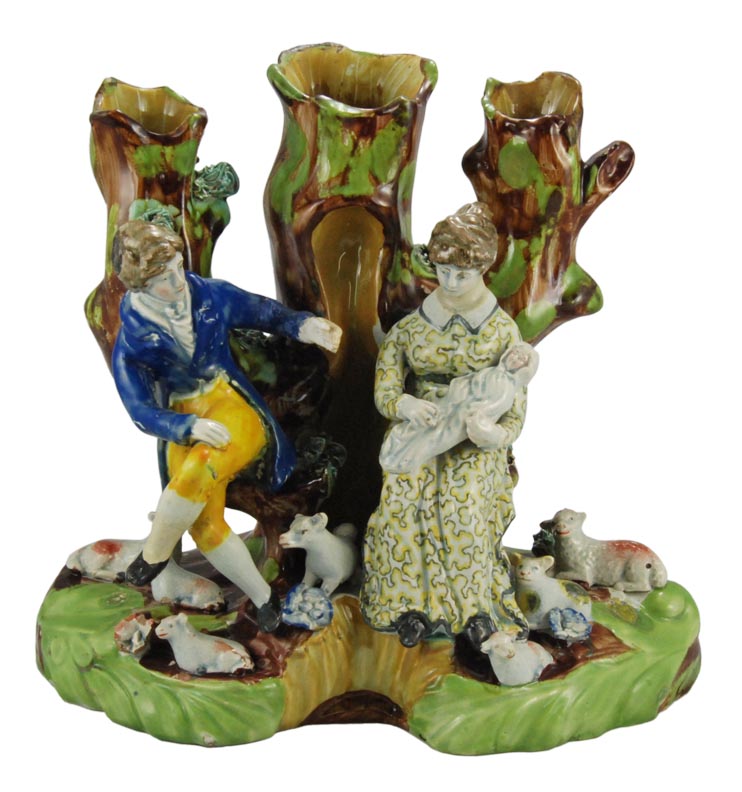
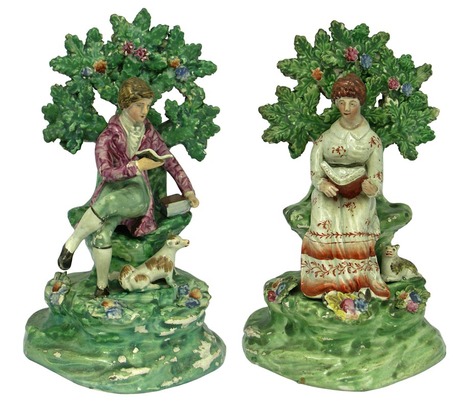
The same pot bank made this version of the Happy Family group, along with dog and cat, before a spill holder. Lovely is it not? Courtesy of Elinor Penna Antiques. The molds for these figures must have represented a significant investment, and our unknown pot bank was not going to let them go to waste. Taking matters one stage further, we see the same figures on individual bases. This time, the baby is left at home, and the man and lady are engaged in that most genteel pastime: reading. Note the cat and the dog, each with the same owner as before. BTW, it may surprise you to learn that the novel was quite a new literary format in the early 1800s and that novels were not considered appropriate reading material for refined ladies. It was feared that ladies would get all sorts of wild ideas if they read novels. Much better to read a religious tract of some sorts. Some forces are unstoppable...particularly when they are female....and so it was with women's literary tastes. The rest is history: the novel is now firmly entrenched in our culture.
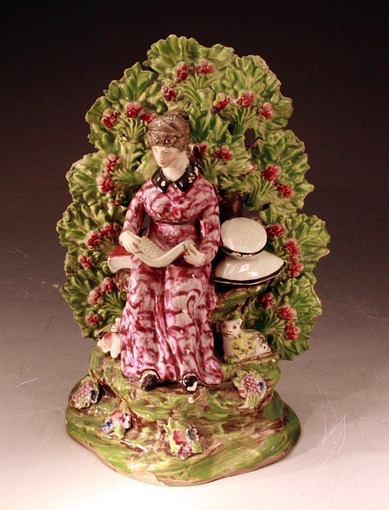
Remember the holly bocage we saw on our second Happy Family group? Well here it is again. It comes as no surprise to find it on a figure of a woman reading. This figure has the fullest, most lovely bocage. And of course, that faithful little cat is still by her side. From the past stock of John Howard Antiques. And here we have one more glimpse of our Happy Family couple. The couple from the Happy Family group are now playing music. The cat and dog are present, and the book that one of them was reading has now been cast on the ground. Their hats are there, but the baby is nowhere to be seen....but how much more can you put on one spill vase? I enjoy finding links between groups. When you start piecing together the details---similar bocages, figure molds, cats and dogs--you make a family of another sort: a family of related figures. And may all the little details come together perfectly for your family this Thanksgiving.
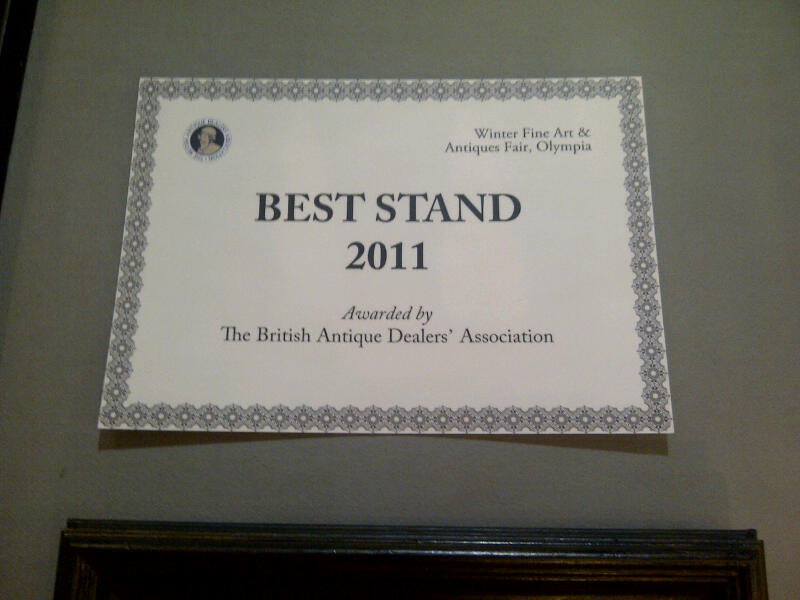
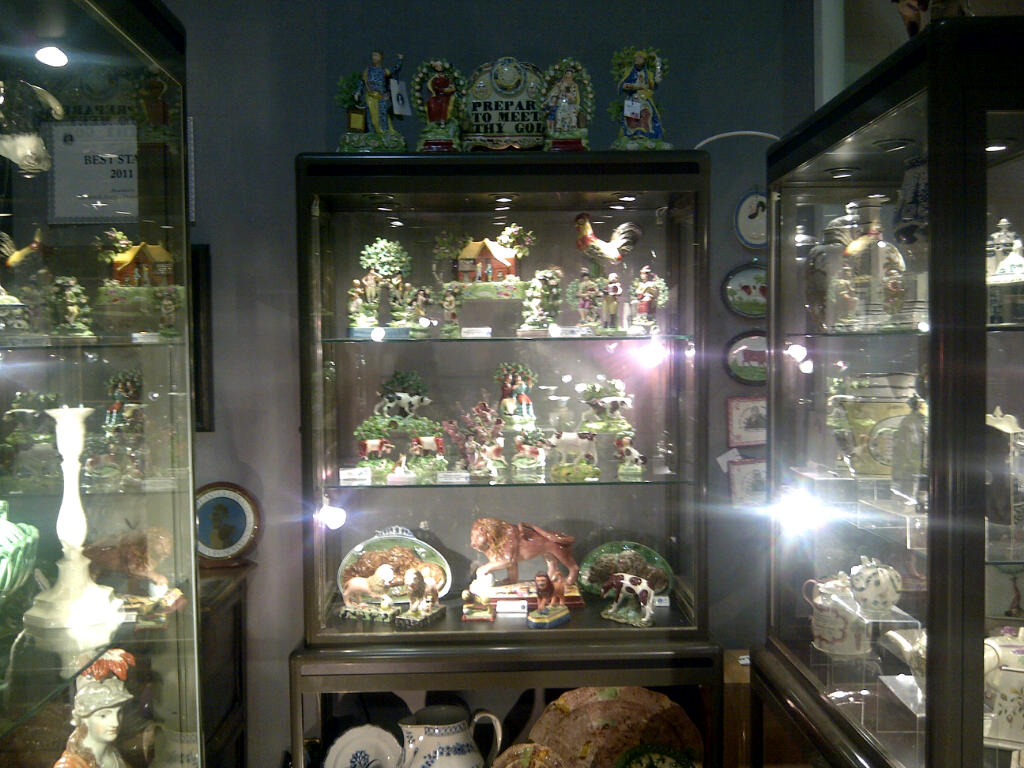
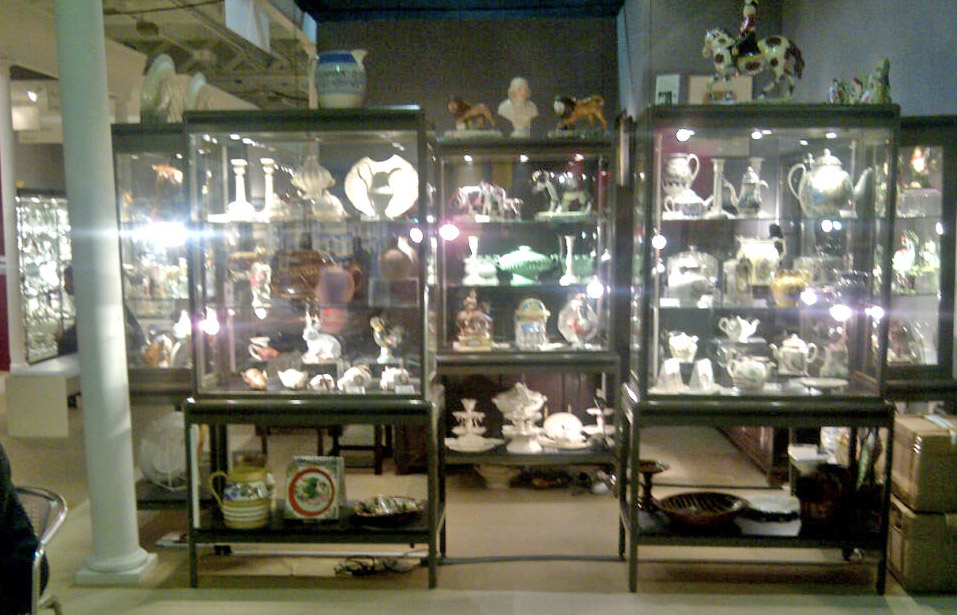
Just sent to me from the UK is a picture of this sign, spotted above a stand crowded with the finest English pottery at London's prestigious Olympia Winter Fine Art & Antiques Fair. The stand belongs to John Howard. Who else could pull this off? Congratulations, John! Collectors everywhere are proud of you, and thank you for shining the spotlight on our figures yet again. Thank you, thank you!
BADA awards are a very big deal in the antiques trade. Sort of like getting an Oscar. The award is peer-judged, and the competition is intense. This really is an achievement, and I wonder when last the award was given to a pottery stand.
My pictures can't do John's stand justice, but here goes. For those of us in the US, remember that John packs this whole show up and brings it to NY for us to enjoy in January. Or you can indulge any time by visiting the web site.
I have always had a 'thing' for elephants. Not in the cutsey way, with elephant knick-knacks scattered around the house. My admiration for these noble beasts is deep-seated and rooted in the fact that I spent my childhood on the outskirts of one of Africa's most important natural elephant reserves. One of my early memories was watching the elephants feed daily at a designated spot on the reserve. The surrounding countryside was citrus country, and zillions of unwanted oranges were dumped periodically for the elephants to graze. One day, one big fella just ate and ate and ate....I have never forgotten his insatiable appetite, and the way he glared at his two-footed observers with disdain. When I went back to the reserve recently, I was amused to notice a sign forbidding citrus fruit in the area. Apparently, the elephants' man-induced appetite for oranges has led them to running rampant through citrus groves in pursuit of that juicy delight....so an attempt is being made to wean them from orange juice. A twelve step program? Oh what a mess we humans make when we intervene.
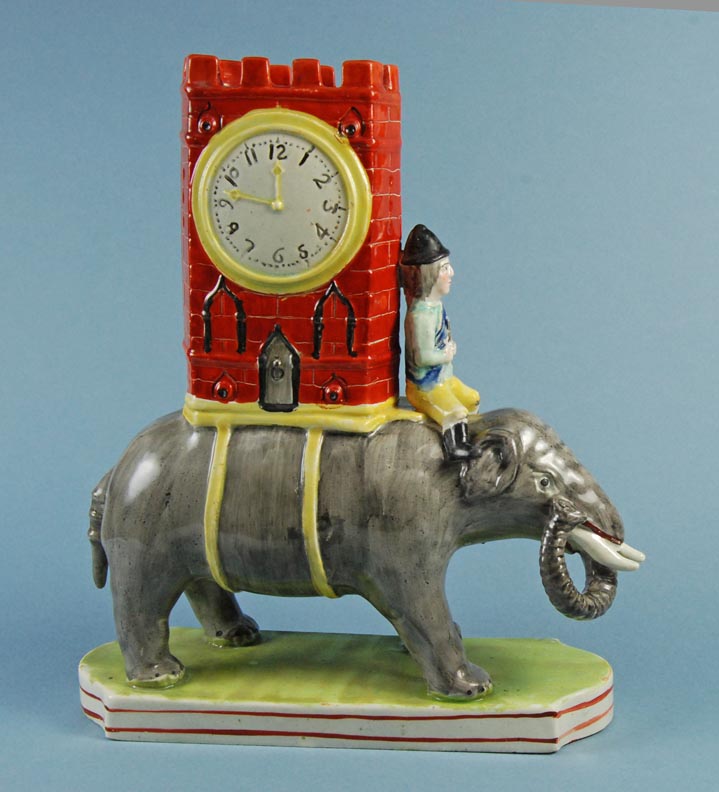
I have long admired the elephant with a castle on its back in the Willett Collection at Brighton Museum. The collection is my favoritest ever. About 25 years ago, I visited it with one of those then-new inventions, a giant videocamera. When raising my family dictated escape, I watched that video. The Willett Collection, which I have since visited very many times, is seared on my brain. The large elephant is one of my favorite objects, and he is pictured in my book. Over the years, I found another one....but he was an albino elephant. It just didn't do it. And then I found a third, in a private collection that I photographed. That elephant came to auction a while ago, but I couldn't do the necessary. Why did I hesitate? Well, firstly, the condition report had me queasy. And there was an opening on one side of the castle for a watch. The opening was on the elephant's "best" side (the side his trunk flips toward)....not what I had in mind. I had waited SO long, but I don't compromise. I can't own everything on earth. I want the things I own to be right for me.
By some miracle, not so long after I passed on this elephant, another one came to auction. Here he is. And yes, he is mine! When I glimpsed this elephant, I knew we were meant for each other. Love at first sight! The auction was way up north in Scotland....sort of near the North Pole! Because of the time difference, I got up in the wee hours of the morning to bid. The auction was fun to listen to because it was an old- fashioned, local auction. Things that I could just imagine sitting in a New York emporium with fat price stickers went for a song. "A malting shovel. Who would want that?" asked the auctioneer...but he knocked it down for a few pounds. "Nurse McGregor's bag. Imagine how many people she has seen in and out of the world with this" ....and so it went. Three lots away, bidding reached the major leagues. Something was knocked down for GBP68, and it took forever as the bids crawled up there. And need I tell you that I paid even more for my elephant, so the bidding took a long, long time.
Here's the surprise: when the bidding for my elephant ended, the room broke into applause. That's for you, said the very nice lady on the phone. Well, I thought you had to spend millions on an Impressionist painting to get applause at auction. Applause for a Staffordshire figure? Unheard of! The applause was followed by a round of laughter (probably as the seller danced a celebratory jig!) The room was very excited.
So why the excitement? Well apparently the elephant had been consigned as part of a TV series called The Antiques Road Trip, where people buy things cheaply and then see what they can get for them at auction. My elephant had cost the seller a whole GBP8. Of course he was ecstatic. But collecting is not a zero sum game. It is possible to have two winners, and on that day both he and I were happy. The show will be aired in January, so if you live in the UK you will see it. Meanwhile, you can see the elephant here first.
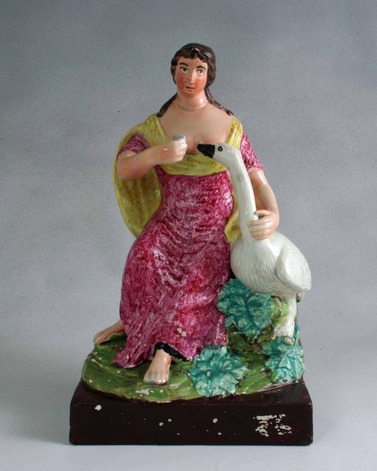
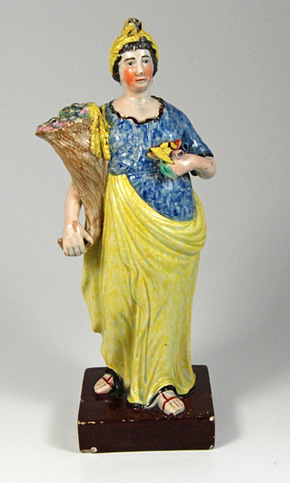
A couple of odd snippets are on my mind this week. First, did you notice this figure on Martyn Edgell's site? The figure portrays Leda and the swan. Greek mythology tells that Jupiter came to Leda, wife of the King of Sparta, in the form of a swan. As a result of their union, she laid an egg from which the heavenly twins Castor and Pollux hatched. This myth was prominent in Renaissance art, but I don't know the precise design source for the figure. I am confident that the base is a lovely brown rather than black. The figure is closely related to a small group of other figures, all portraying classical subjects, that occur on brown bases. The figures form a true family in that they all look related. Here is Ceres from that same family of figures.
See what I mean? These two ladies look like they might be sisters. And the group shares other characteristics....but that is another story.
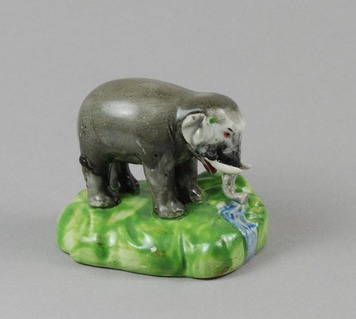
The relationships between figures are fascinating, and sometimes bocages and bases provide the clues to the linkages. This small elelphant, a sweet tubby baby, was recently in John Howard's stock. It was made without a bocage, and it was made by Enoch Wood. Height about 2.5". How do I know Enoch Wood made this figure? Well, I know of three other good examples-a pair(which you can see in my book) and a single. Both have bocages that link to excavated Enoch Wood shards. Now I know potters copied each others' bocages, but these bocages are consistently found on only Enoch Wood figures, so I am quite confident that the three baby elephants with bocages are all by Enoch Wood. This made-without-bocage baby is from the same molds and the underneath of the base is formed similarly. So he too earns an Enoch Wood attribution.
If you are yawning, let me assure you that this is invaluable knowledge. Note I said that I know of three other good examples of this elephant. I do know of one more, but the bocage bothered me. Pretty as it looked, it just didn't sit right. One bit was obviously restored, but the rest was good old bocage that had been reattached. So what was wrong? The "good old bocage" was of the type that Ralph Salt used. Enoch Wood never used that bocage, so there was a problem!
One last image that has come my way that must be shared is this little vendor, formerly in the stock of David Boyer and Ivan Mears. What could be more charming? This figure occurs titled FRUIT BOYS (see my book) and also on other bases with other bocages....but here everything comes together perfectly. And best of all, that very vulnerable bocage is unbroken. Nice to think that this little fella has been loved for almost two centuries!
Andrew Dando's not-to-be-missed Exhibition runs from the 5th-12th. Don't forget to go to the website early in the game! Clicking here will do it. Happy shopping.
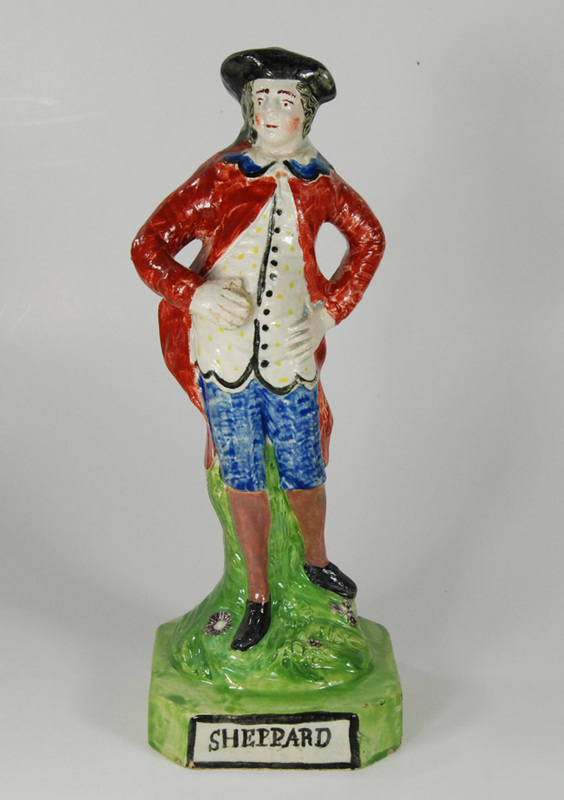
Every figure tells a story, and these tales really have me hooked. I must dig and dig until I can hear each figure talk. Along the way, I may find a design source, and when it is all put together I can often date the figure with greater precision—and that knowledge helps date other figures. All this takes time. It’s what I ponder when I can’t sleep at night. The latest candidate for this thought process was a figure titled SHEPPARD, and, if you will bear with me, I will explain how SHEPPARD inspired that 20th century hit song Mack the Knife.
SHEPPARD? I know spelling was not our potters’ strong suit, but this is no shepherd. Rather, the figure represents Jack Sheppard, the colorful criminal who rose to fame in London in the early eighteenth century. Jack was born in 1702 into a life of great poverty and hardship. Despite this, by 1722, he was a model carpenter’s apprentice with 5 years of his 7-year apprenticeship behind him. But then young Jack discovered strong drink and the love of a far-from-virtuous woman…and he was set on the road to ruin and immortality.In 1723, Jack took to burglary. He was arrested in 1724 and imprisoned. He escaped, and was arrested again. The pattern was set, and Jack was arrested four times and he escaped four times—always with daring bravado that captured the public imagination. After the fourth arrest, Jack was chained and shackled to the floor in Newgate prison’s most secure area, but he broke his chains and escaped through six iron-barred doors. Two weeks later, on November 1 1724, Jack was arrested for the fifth and last time. This time, he was weighed down with 300 pounds of weights and kept under round-the-clock observation. His importance was such that the king’s painter, James Thornhill visited to paint his portrait. But on Nov 11 1724, Jack Shephard was hanged. Two hundred thousand people turned out to give their hero a rather celebratory send-off. How times have changed!
Jack Sheppard continued to live in the hearts of the public as a folk hero. His story inspired ballads and pantomimes that appeared shortly after his death. Importantly, his character inspired Macheath in John Gay’s The Beggars’ Opera (1728).. The Threepenny Opera, a twentieth century updating of The Beggars’ Opera that debuted in Berlin in 1928 and in English in America in 1933, included the song Mack the Knife. Mack the Knife made the hit parade in 1956 and it has kept on trucking…well, I think we all are old enough to have heard it.
So why would we have Sheppard, a hero of the 1720s, depicted in a Staffordshire figure made circa 1825? I admit to being a bit puzzled. The most obvious nineteentn century reincarnation of Sheppard was in the novel Jack Sheppard by William Harrison Ainsworth, published in 1839….but this figure looks no later than 1830 to my eye. What could have inspired the creation of a figure in Jack Sheppard’s honor around that time? And then a revealing factoid came my way: A melodrama titled Jack Sheppard, The Housebreaker, or London in 1724, by W.T. Moncrieff was published in 1825. Performances of this play must have inspired the creation of the figure.
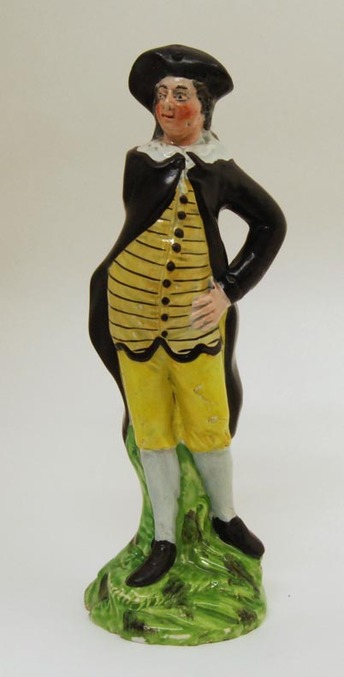
Moncrieff’s melodrama could not have been wildly successful for I know of only this one example of the figure of Sheppard. It is a lovely figure, very bold and dashing at a swaggering 10-3/4" inches tall. Sadly, Sheppard himself was a puny runt, but how was our potter to know that? So if you are a potter and you don’t know what Sheppard looked like, what do you do? No problem! After all, nobody else was any wiser…so our potter could take his pick of the molds at his disposal. I have a figure in my archive fashioned from the same molds used for SHEPPARD.
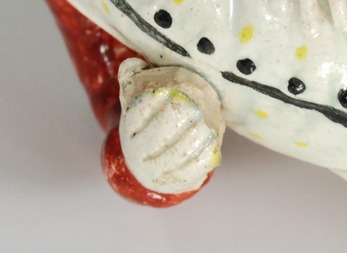
I photographed this 9-3/4" figure in the Potteries Museum. Clearly he has lost his arm, but I didn’t note the loss of the base, so perhaps he was made thus. I really wish he had retained his arm because I want to see what was in the now-lost hand. The figure of SHEPPARD is clutching a very definite round object. Unfortunately, some deviously evil person has chiseled around this object. The nicks look just as if they were made by a chisel, and perhaps a wicked child had nothing better to do on a gloomy day and decided to start on his life of crime by bashing away at SHEPPARD.
The object could not have broken clean off, nor could it have been very much larger than its present size. I know the latter because there is no indication that the object ever touched the jacket. My guess is that it was intended to be a money purse. So the mystery is almost solved. If you can add to this, please let me know. Meanwhile, Jack Sheppard lives on in our century: a 2002 television drama Invitation to a Hanging and Neal Stephenson’s Baroque Cycle novels (2003, 2004) all derive from Jack Sheppard’s story.
|