Ridiculous 12/30/2009
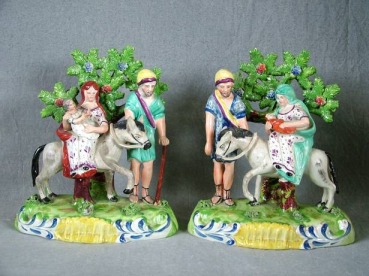
I am getting crankier with auction houses that just can’t get it straight. In the ‘good old days’—only about 3 or so years ago—Bonhams Knightsbridge's Staffordshire sales were the highlights of the year for collectors. Gareth Williams and Beth Sandersson, the team behind the show, knew their stuff and both buyers and sellers trusted them. So sellers kept sending in choice wares, and buyers, knowing that they could rely on the condition reports, kept buying and buying. I think the trouble was that the slick- set in London was into modern ‘stuff’ and Gareth was SO good at what he did….so Bonhams gave him the task of building that ghastly market. Gareth moved onto a new world. And Bonhams decided that Staffordshire figures at modest prices just weren’t worth too much time in London, so the bulk would be lumped into Bonhams Oak Sales at Chester. Beth moved over to Bond Street—and Staffordshire was relegated to a novice team in Chester. The auction offerings at Bonhams Chester get progressively bleaker and, given the consistently distressing cataloging, that is perhaps understandable. Each catalog compels me to correspond with the "specialists". Next sale is Jan 13 and Bonhams Chester seems to be down for a Christmas break that extends till after new year, but perhaps someone is browsing the web and can tidy up the online catalog before it goes to press. Here are my thoughts. (Clicking on the underlined words will link you to Bonhams.) Lot 35 a figure representing Grief, modelled as Andromache stood before an urn, grieving over the ashes of Hector, Might I suggest this figure is Charlotte at the Tomb of Werther? Click here and scroll down to read why. While porcelain collectors seem to understand the difference between Andromache and Charlotte, old pottery books have confused the issue. But Bonhams' own data base has this right. In fact, Bonhams Chester cataloged this figure form as Charlotte mourning Werther last January and in 2008 . Why the change of heart? ALSO Lot 35 a figure of a classical female figure holding two doves, a large fish and putti stand beside her, mounted on a square pedestal base, This figure is known (to most of us!) as Venus. The two doves she holds are her attributes. The “fish” at her side is clearly dolphin. The putti (and I can only see one, making it a putto, I believe) is Cupid. Lady+2 doves+dolphin+Cupid=Venus. Get it? Lot 31. A rare Wood & Caldwell bronze glazed figure of Fortitude, circa 1790-1810 Why 1810? As Wood and Caldwell were in partnership from 1790 until 1818, would it not be more correct to date the figure 1790-1818? Lot 37 . A pair of Staffordshire pearlware figure groups depicting the 'Flight in to Egypt' and the 'Return from Egypt', possibly Sherratt. Well, if I was a betting person, I would have wagered these figures were WALTON. That’s because I have never seen a pair like this that was NOT marked Walton on the rear. However, there are look-alikes of quite a few of the 100 marked Walton figures, so these may well be unmarked Walton figures. Walton-type would be a fair attribution in the absence of a mark. BUT HOW COULD ANYONE ATTRIBUTE THESE FIGURES TO SHERRATT?? This stretches my brain to the point of pain. There is not a single feature on these figures that might link them to the group of figures dubbed “Sherratt”. Lot 39 A Staffordshire 'The New Marriage Act' figure group Circa 1825. I hope Bonhams looks at this figure again to ensure that it is not a much later reproduction because it lacks the vitality in modeling associated with early figures. I spent many hours compiling emails to Bonhams Chester a few months ago to ensure recataloging of a reproduction bull baiting group, which had been described as early 19th century! I don’t want to go through that ever again. Lot 42 A Staffordshire pearlware figure of Elijah and the Raven. Circa 1820-30. … together with a Staffordshire figure, modelled as a classical female figure seated upon a barrel, a water jug at her feet, decorated with painted enamels and mounted on square plinth base, 24cm high. The figure paired with Elijah is not some random classical female. Instead, it is the Widow of Zaraphath. Together, these figures are possibly the most common Staffordshire pairing. I am amazed at the number of “ordinary” Toby jugs described at “Wood type” and see no basis for linking some of these to Wood. I notice Bonhams online catalog comes with a caveat: “The above is information about lots that are currently entered in Bonhams' sales. This information is provided here for convenience only and in all cases the printed catalogue and saleroom notices take precedence.” So much easier to get it right the first time…especially when online catalogs are valuable contributions to our knowledge base, and especially when you are Bonhams and not some rinky-dinky provincial auction house. Above all, I hope the catalogers at Bonhams Chester resolve to give the figures I love the respect and attention they deserve in the new year. Dr Syntax Stopped by Highwaymen 12/26/2009
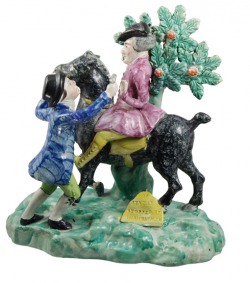
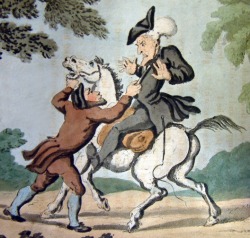
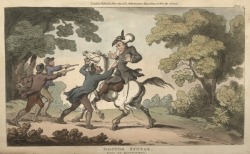
Doctor Syntax—a gangly, black-frocked cleric and schoolmaster with a protruding chin—was one of the early nineteenth century’s most popular literary characters. He was the brainchild of Thomas Rowlandson (1756–1827), the eminent caricaturist and watercolorist. Traditionally, a book’s text inspires its illustrations, but in the case of Doctor Syntax, the text was written in verse form to accompany Rowlandson’s artwork. The result bestowed literary immortality upon William Combe (1742–1823), a hack writer whose prodigious writings were otherwise destined for oblivion. Doctor Syntax was successful because Combe’s verse and Rowlandson’s lively drawings appealed to the English love of the absurd, and Staffordshire’s figure potters capitalized on the comic theme by producing their own interpretations of the eccentric clergyman. Doctor Syntax was a peripatetic clergyman who set off "in search of the picturesque"--finding pleasing vistas was an appropriately refined pastime in those days. Along the way, he has a series of adventures, which are portrayed in Rowlandson's illustrations. Strangely, the familiar Staffordshire pottery group of Doctor Syntax playing at cards bears no resemblance to the book plate illustrating that adventure. Instead, our potters used their own imagination. But a rare group titled Dr Syntax Stopped by Highwaymen mimics one of the book plates titled Doctor Syntax Stopt by Highwaymen. ![]() The engraving is fabulous, is it not? The full scene is shown alongside. Delving into source prints has taught me to love old prints...not as much as I love figures, of course, but prints too capture fabulous moments frozen in time. What makes this particular Staffordshire figure group so special is the presence on the base of the highwayman. I have seen three other examples of this group--yes, it is a very rare group--and in each case the highwayman had been knocked off the base and lost. I bought this figure group at a Boston auction a few years ago, quite reasonably priced. Last year, I lectured in Boston. In the question session, someone asked me why they have no early Staffordshire figures in Boston. Ha! They just aren't looking for them. After my lecture, I went to a local antique shop and bought a perfect little figure for less than the price of my hotel room, and flew home with a sweet souvenir. Fascinating Factoids: In 1809, the artist Thomas Rowlandson, who had gambled away his fortune, produced a series of aquatint engravings of a traveling clergyman-schoolmaster on a tour in search of the picturesque. The publisher Rudolf Ackermann thought them ideal for his new Poetical Magazine, so he asked William Combe, languishing within debtors’ prison, to write accompanying prose. The collaboration was unusual: Combe and Rowlandson did not meet, but each month Ackermann supplied Combe with one drawing, and the writer produced the required lines of verse. As a result, The Schoolmaster’s Tour was published in serial form from 1809. The almost 10,000-line doggerel was immensely popular, and in 1812 Ackermann published a revised version, The Tour of Doctor Syntax in Search of the Picturesque, as a book, complete with thirty Rowlandson aquatints. In 1820 and 1821, Combe and Rowlandson completed the Doctor Syntax trilogy with The Second Tour of Doctor Syntax in Search of Consolation and The Third Tour of Doctor Syntax in Search of a Wife. In 1822, an unremarkable sequel, The Adventures of Johnny Quae Genus, the Little Foundling of the Late Doctor Syntax, was Combe’s swan song on the Doctor Syntax theme. Doctor Syntax’s three tours remained popular reading for decades longer. Today their prose is no longer in vogue, but the beauty of Rowlandson’s aquatints has not faded with time, and neither have those other captivating memento of the saga: earthenware figures of the peripatetic cleric. Read chapter 19 of my book, People, Passions, Pastimes, and Pleasures: Staffordshire Figures 1810-1835, to learn about Doctor Syntax and see large color pictures of other Syntax figures, Where have all the Fine Figures gone? 12/22/2009
I am having a tough time scrounging the Internet looking for 'sightings' to report. Where have all the good wares gone? Collectors and dealers alike are having trouble finding fine early figures. Those who own them know they are better than gold...and they are holding on tight. I don't want to keep hitting on the same few dealers with good stuff because the blog will start reading like an infomercial, but in reality if you want a great figure right now, you need to go to a great dealer. In my search today, I came across this figure. Described thus. "This fabulous piece of antique English Staffordshire pottery is one of the finest examples of an early Staffordshire pearlware figure group we have offered online for some time. Musicians is a good quality early - circa 1795-1810, Staffordshire pottery figure group of a couple on a typical stylized grassy knoll. She is seated with a mandolin and he standing playing a penny whistle, the whole on a characteristic hollow raised plinth base. A quality transitional piece decorated with bright semi-opaque overglaze enamel colours. Stylistically this unmarked piece resembles and is influenced by the work of the Ralph Wood family of Staffordshire potters. One for the connoisseur and only the best and most discerning collectors of best antique English pottery and antiques!" Antiques Expert Hamilton Bear. Condition: Very good. As with most antique pottery figures some restoration is to be expected. Here the outstretched hand/arm of the penny whistle player has been restored. This appears to be the extent of any large area of restoration. This does not spoil the aesthetic qualities of the piece from any conventional display/viewing angle Please study all images carefully forming part of this description before you buy ... When an online listing cautions that images are part of the listing and must be studied carefully, a red light goes on for me. Am I expected to SEE something that hasn’t been described? In this case, it is what I am not seeing that bothers me. Where’s the bocage? Have a look at the back and you will see the crude patch job on the stump where it broke off. You can also see the rough patch where the now-gone bocage rested against the back of the man’s coat. Also, I believe the 'penny whistle' was once a horn. And lastly, this figure is probably by Enoch Wood, cousin to Ralph Wood….but then the Ralph Wood name is so much more prestigious. Below is a version of the figure in the form it should take. Interestingly, there is a pair to this figure--the man to the other side of the woman of course, and different instruments in their hands. Again, a fine single is perfectly lovely to own...but by 'fine' I mean it should at the very least include its bocage! Note the rectangular base with stepped edge. Several other figures, also believed to be by Enoch Wood, are found on similar bases. For decades, collectors have attributed a range of distinctive colored glaze figures to the potter Ralph Wood II. Examples occur marked with Ralph Wood’s name, so similar unmarked examples were thus also readily attributed to Ralph Wood II. But in 1991, Pat Halfpenny disputed this belief in her book on earthenware figures. Pat thought that :
Along the way, Wynne points out that
I am left with a few thoughts.
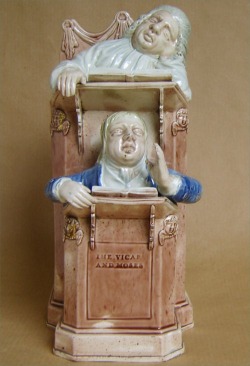
If you have found this boring rather than fascinating, I cannot be apologetic for the blog entry. We need to take our figures seriously. They are not just pretty knick-knacks but are fascinating time capsules that tell us much of the world as it once was. Above, we have Aurea Carter's Ralph Wood "Vicar and Moses." Nice to have an impressed number 62 on this figure. Ralph Wood figures often have impressed numbers in the bases. These are not thought to be mold numbers because, although the same number occurs repeatedly on the same figure form, you can also find identical figure forms with different mold numbers! A bit of a mystery. To see Ralph Wood’s fabulous elephants in both enamel and colored glazes, see the blog entry for Nov 08, 2009. Formidable Figure 12/14/2009
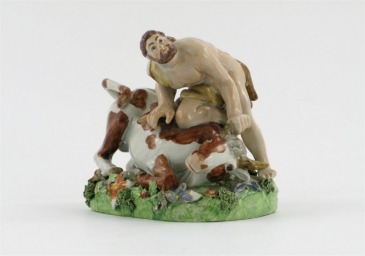
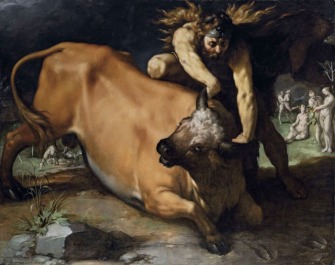
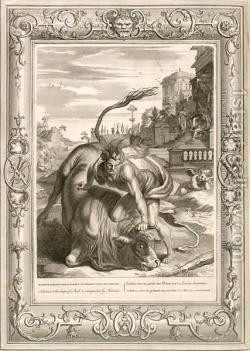
Staffordshire figure collectors in search of the "cute" tend to turn away from classical figures. Lacking a "cute" gene in my body, I despise cuteness with an intensity. I find charm rather than "cute" in the myriad engaging figures that reflect life as it once was in the early 19th century. Yet the longer I collect, the more I am drawn to figures with classical subjects. Recently, Andrew Dando sold this superb figure of Hercules and the bull at his Exhibition. The figure tells the story of the Roman mythological hero Hercules, who personified courage. He wrestled Achelous for the love of Deianeira. Although Achelous assumed the form of a bull, Hercules prevailed. The ancients, with no email to take up the day, instead found hidden meaning in their mythological tales. They explained the fight of Hercules and Achelous as Achelous being a river that in rainy seasons overflowed its banks. When the river swelled, it made another pointed channel--thus Acheous's head was horned. The struggle is shown in classical art with Hercules pressing his knee into the bull's back and holding its horns, just as on the Staffordshire figure. This pose differs from that in representations of Hercules fighting the Cretan bull, which was one of the twelve labors meted out to him as punishment for slaying his children. Cornelius van Haarlem's "Hercules and Achelous" (1590) is perhaps the best known of the classical renditions of this scene. The 8-foot long painting surpassed an estimate of $1 million-$1.5 million to sell for $8 million and change at Christies last year. The picture had just been returned to its German owner after the East German policed seized it in 1984 for "incorrectly filed taxes" and dumped it in Berlin's Bode Museum. Either a print of the painting or a derivative art work, such as Bernard Picart's 18th-century engraving below, inspired our Staffordshire figure. Our Staffordshire figure is attributable to the Wood and Caldwell manufactory, and thus we can date it to between 1790 and 1818. Cursory research has me thinking that no earlier models were made by England's porcelain factories, but who would want one? Only pottery can capture the strength of this struggle. Perfect Christmas Gift? 12/10/2009
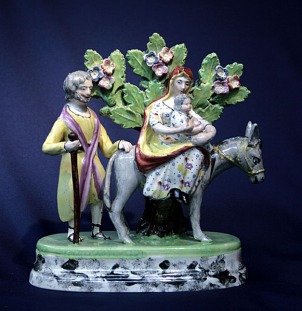
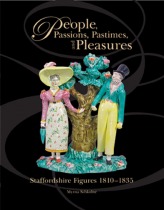
If you celebrate Christmas--and most of the world does not--you are probably racking your brain for perfect gifts for those you love. For the Staffordshire figure collector, what could be more ideal than figures depicting the holy family's flight to and return from Egypt? The Flight and Return have been depicted as mirror images in art for centuries. The Return is depicted on the 8th century Ruthwell Cross, and in the 12th century the St. Alban's Psalter depicted both scenes. By the 19th century, these were common depictions in even cheap wood cuts used to decorate penny broadsides and chapbooks. Both scenes occur in crudely colored cottage prints published early in the century by P &P Gally. Seems that these popular images translated into commercially successful model for early 19th century potters, and several had a go at fashioning them. John Walton even made two versions of the Flight and Return: one pair sport bocages, the other have spill vases instead. Walton actually titled his figures, which is a nice touch. See my book for an example. Despite the popularity of these figures in their time, today it is quite difficult to find an attractive pair in good nick. Again, I would not mid owning a fine example of either the Flight or Return, unpaired. Either one stands very well on its own. If an important Staffordshire figure would bust your budget, consider an alternative gift that will give a lifetime of pleasure. My book is an appropriate gift at any time of year for collectors of all faiths, ages, and sexes. But above all, whatever your faith--or lack thereof--have a happy holiday season. Additional Factoids: My book can be purchased from leading ceramics dealers Nick Burton, Andrew Dando, John Howard, Elinor Penna, Sampson Horne. Reference Works stocks the book for European distribution. www.referenceworks.co.uk In the US and Canada, order at www.hotlanepress.com. Signed copies available on request. Amazon has copies in stock. Pearlware figures made by Samuel Hall 12/06/2009
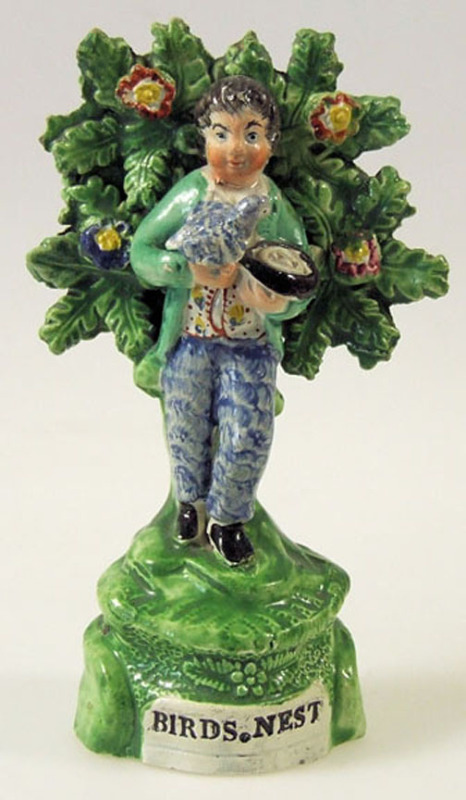
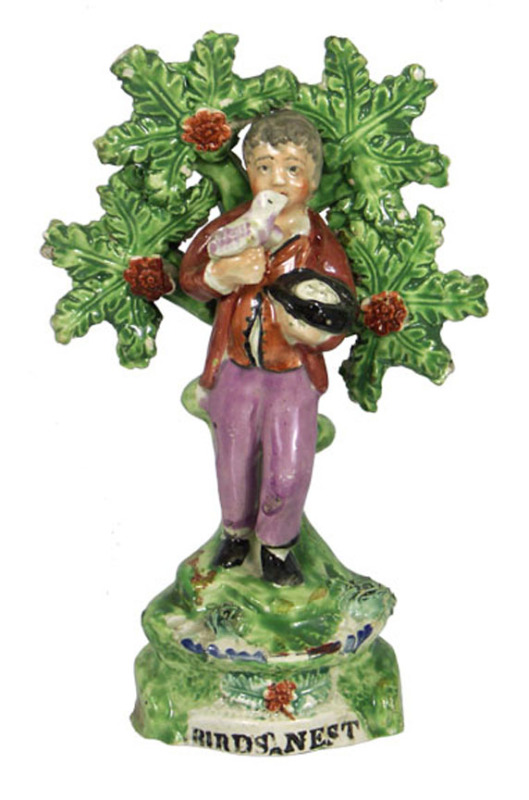
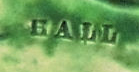
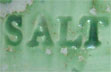
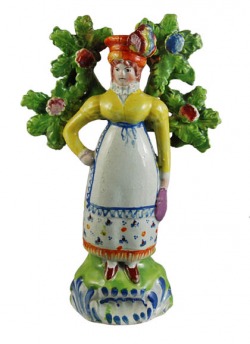
The maker’s mark HALL is one of the rarer of the already rare Staffordshire figure marks. I believe it belongs to Samuel Hall, who was born in 1784. He is first listed in Pigot’s 1818 directory as a potter at New Hall St, Shelton. By 1822, Hall apparently was proprietor of his own earthenware toy manufactory (“toy" being the contemporary word for "figures”). Directories for 1830 and 1834 confirm that Samuel Hall focused on figure manufacture, but by 1834 his output included “china” figures—probably Parian— in addition to earthenware one. By 1846, Hall had relocated to Marsh St, Shelton, where he manufactured china wares only. In 1854, a final directory entry records Hall as a Parian manufacturer. He seems to have retired shortly thereafter—he does not appear in successive directories—and died on Dec 29 1863, aged 79. Quite a ripe old age for that time. Despite Samuel Hall’s longevity and his proclivity for marking his figures, very few marked HALL figures survive. I have recorded 16 various models. When they sport bocages, the bocages are in one of three ‘styles.’ Clearly, Hall must have produced lots of figures to justify three bocage forms. Unfortunately, the bocage form that occurs most frequently is the commonest of all bocage forms and the figures are rather unremarkable. Anyone could have made them. Possibly a host of unmarked figures with Hall-type bocage were also made by Hall, but we may never know. So which of these BIRD NEST boys was made by Hall? Click on the image to enlarge it. The figure on the left is marked HALL. The one on the right is marked SALT. Both marks are impressed into the clay. The HALL mark is found impressed directly into the body--as in this case-- or on a clay tablet applied to the body. The letters are upper case, with serifs. The name is usually painted over. Samuel Hall should not be confused with John and Ralph Hall, who potted from circa 1800 and are best known for transfer printed dinner wares made for the export market. The Halls operated at both Swan Bank, Tunstall, and at the Sitch Pottery, Burslem. In January 1822, they dissolved their partnership. John Hall, along with his sons, continued at Burslem but was bankrupt by 1832 and died in 1838. Ralph Hall continued at Tunstall beyond this date. There is no indication that Ralph and John Hall potted figures. Grecian & Daughter 12/02/2009
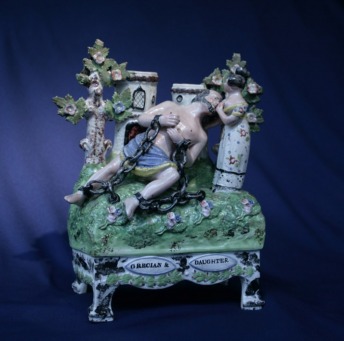
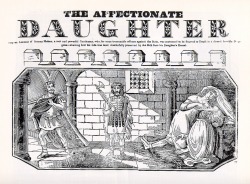
Not a figure for everyone, but still a most interesting thing: GRECIAN & DAUGHTER,currently available from John Howard. The figure is one of the rarer "Sherratt" style figures, and this one appears to be in rather good nick. In this case, the floral garlands on the base, the bocage, and the distinctive marbled table base all add up to a "Sherratt" attribution. I have only seen "Sherratt" versions of this figure, and all have been on footed marbled bases. I tend to think this was one of "Sherratt's" later bases, probably used from around the mid 1820s. So what inspired this rather unusual pearlware figure group that is a far cry from the normal bucolic Staffordshire scence? Well, this one goes back to the classics...and forward to contemporary theater. The story of Roman Charity, as told by the ancient Roman historian Valierius Maximus in his Nine Books of Memorable Acts and Sayings, tells of Pero, who secretly breastfeeds her imprisoned father, Cimon. Cimon has been sentenced to death by starvation. The scene is depicted in art as early as the 1st century CE--actually it is in a fresco from that period at Pompey. Later, other famous artists mimicked the scene. Notably, Peter Paul Rubens painted Pero breastfeeding the chained Cimon. Fast forward to the 18th century, when Arthur Murphy lifted the plot of Cimon and Pero to provide a stage role for the ailing actor, Mr. Barry. Dubbed The Grecian Daughter, the play was first performed at Drury Lane in February 1772, with Mr. and Mrs. Barry in the roles of Evander and Euphrasia, the Grecian and his daughter respectively. Although it was not a particularly popular play, the paucity of tragic fare kept it going on provincial stages and even on the London stage till about 1815. The play was "revived" in 1830 for Miss Fanny Kemble. I am guessing that this revival inspired John Howard's pearlware figure group! Fascinating Factoids:
|