In the 1500s, the Tudor king Henry VIII dissolved the monasteries. Traditionally these had taken care of the poor. King Henry’s son, young King Edward VI, seeing that the dissolution of monasteries had deprived children, decided to do something about it. So he granted land and means to create Christ’s Hospital to care for indigent children. This was not a hospital as we know it today but an institution that cared for children while teaching them the three Rs. The original intake was 380 pupils. The school/hospital opened in 1552. Today, Christ’s Hospital has the largest school campus in the UK. It is still co-ed and philanthropic.
From inception, Christ’s Hospital students were easily recognized by their uniform. In Tudor style, it comprised a long blue coat, knee-breeches and yellow socks, as well as bands at the neck. The uniform quickly earned Christ’s Hospital the name "Bluecoat School". While the name “Bluecoat School” initially referred to Christ’s Church, in subsequent centuries philanthropists established other Bluecoat schools with traditional bluecoat attire.
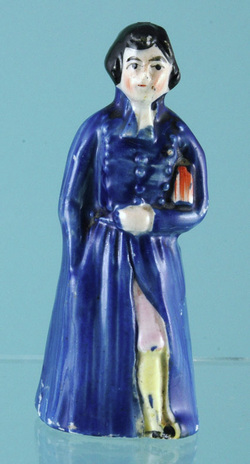
 Pearlware Bluecoat School boy. Circa 1820. The pearlware figure above portrays a traditionally attired Bluecoat schoolboy, circa 1825, and it was made in Staffordshire. I know of only two examples of this little figure: one here, and one in Andrew Dando's stock. Truly a rare glimpse of the past.  Factoids:- Although there are still Bluecoat Schools throughout England, today Christ’s Hospital boys are the only ones to wear the Tudor style uniform on a daily basis. Look for yourself!
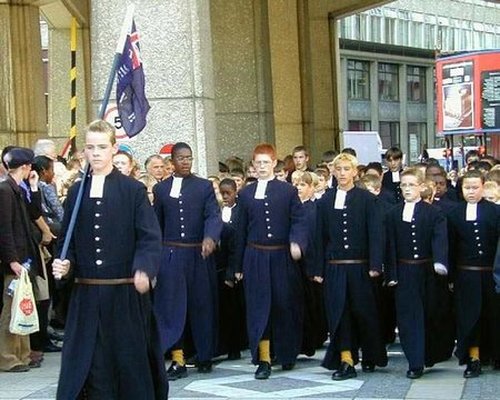
- What do girls wear at Christ’s Hospital today? Blue coats? No, girls wear complementary attire that includes a skirt.
- Yellow stockings were allegedly adopted because they discourage rats. Let me know if you test this out!
- A similarly attired Staffordshire figure was made in the Victorian era, titled “Colston Boy Bristol” In 1710, a Bristol philanthropist, Edward Colston, established Colston's School as "Colston's Hospital". This school was modeled on Christ’s Hospital and students also wore a long blue coat, knee britches and yellow stockings. Of course, the Victorian figure can't hold a candle to the earlier pearlware model.
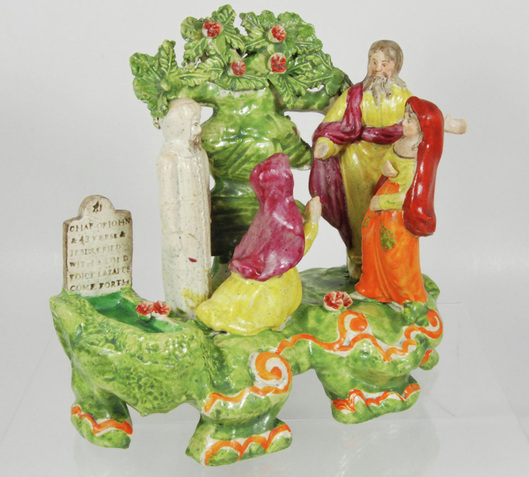
My husband tells me that the photo of the Raising of Lazarus in last week's blog posting is poor. He complains that it is difficult to see all the figures on the base and that I should have taken the picture from a different angle. Well, he just may be right! So I have added another picture. Check it out below.
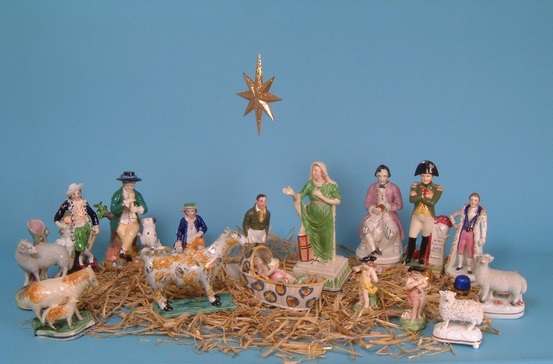
For those celebrating Christmas, this weekend, Merry Christmas! Andrew Dando has shared this fabulous Christmas scene he assembled a few years ago. In other words, these figures are all sold, but there are more in stock!  Thanks to Andrew and Janice Dando for allowing us to share this nativity scene formed from stock some years ago. For those of you not celebrating Christmas, enjoy the down-time.
The Dando nativity scene reminds me of a centerpiece I did for a bridal shower. I used a large silver platter and covered it with green moss. The moss, courtesy of a floral supplier, looked as if it had come out of our garden, but it had been sterilized so no worms would appear. I put assorted courtship groups and other figures on the moss and tucked tiny daisies in random places. And I put flowers in little florists tubes in all the spill holders. The result: a magical glimpse of the past. No centerpiece could have been more charming or more unique.
So if you find yourself with nothing to do--or if you need an impressive and inexpensive (assuming you have the figures!) centerpiece--go ahead and play with your pottery. Seriously, don't tuck your figures in closed cabinets. Put them where the light can shine on them and you can see them and enjoy them. Maximize your pleasure. It's all part of enjoying life.
I find old catalogs invaluable and I was aware of the figure of the Death of Lazarus in yesterday's blog posting (below) because of a 1987 Sotheby's catalog. It's a good reference and if you want it you can find it on eBay periodically. Today it is for sale on eBay at a reasonable price. To see the listing, click here .
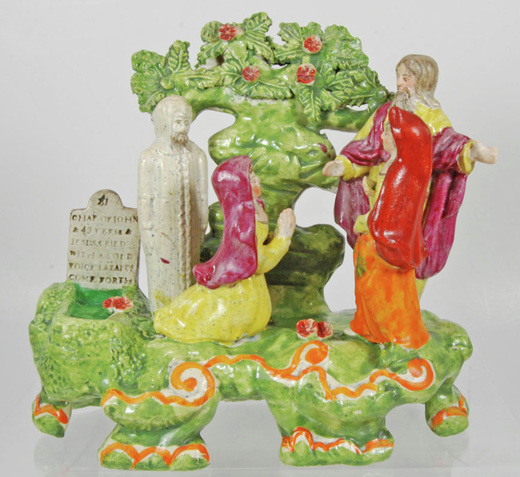
This Staffordshire figure group portrays the tale of the Raising of Lazarus, as recorded in the Gospel of John. Lazarus, a follower of Jesus, lives in Bethany. Jesus arrives in Bethany to find Lazarus had been buried in a tomb four days earlier. Lazarus’s sisters, Martha and Mary, are heartbroken. Jesus goes to the tomb and calls for Lazarus to come out. Lazarus emerges, wrapped in grave-cloths. And our figure group shows a very shocked Mary and Martha standing with Jesus, looking at Lazarus, still in his shroud.
 Pearlware bocage figure group of The Raising of Lazarus. The tombstone is impressed 11 CHAP OF JOHN 43 VERSE JESUS CRIED WITH A LOUD VOICE LAZARUS COME FORTH Believing this tale is for those of faith rather than for those demanding rational explanations. But whatever your take on events, you have to admit the Staffordshire figure group depicting Lazarus’s emergence from his tomb is a hoot. I don’t usually like religious groups so I was amazed that this one appealed strongly. “Of course you like it" said a friend. “It’s totally daft with Lazarus shivering in his nighty.” Daft. That was the second time in a week I had heard that word applied to Staffordshire. Not a word we use too much in the US, so both times I heard it from the UK. Note the blog comment from Kevin Low on our Dec 7 posting showing large deer and a teeny musician. “That's what I love in a figure, more than anything, it's the daftness” he wrote. I think Kevin hit the nail on the head. I love the daftness of this figure and I love the coloring. Yellows and reds are always so pretty. This is a particularly rare figure. I have four examples on file. Two are totally dismissible because the tombstones and bocages are modern replacements. The third is in the Potteries Museum, Hanley, and, although complete, the colors are very nasty (a brown base is not a pretty site.) The only other example I know of had sold at Sotheby’s NY in 1987, and the catalog notes it has a Mannheim provenance. This month, 23 years later, that very same figure came my way, still with a Mannheim label beneath. Three observations:- The figures on this group are arranged differently to those on the other three examples—but not one of the figures has been off the base.
- The clay used to make this figure had an impurity that fired blue, so there are little blue specks visible on the surface. Not unattractive. Just daft!
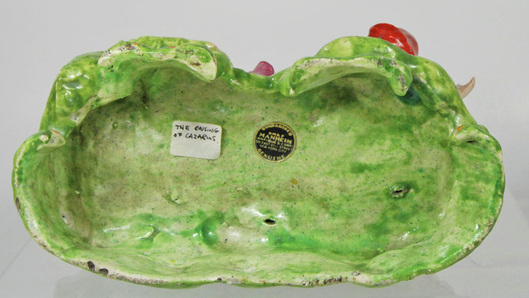
- Beneath, this figure is painted green. I have never before seen a figure group painted beneath. This looked totally correct to my eye, but to be sure I tested with paint stripper. The green doesn’t move, confirming my belief that it is as made.
 The figure from beneath. The hole on the midline serves as an airhole for the bocage trunk. The hole on the right was caused by an impurity in the clay imploding outward. It was packed with two centuries of dirt! Sticking a pin through from the bottom led to a small opening on the top of the base. When the cavity was cleaned out, it had green enamel on the interior. Clearly, it happened in manufacture.Note also the blue speckling in the clay apparent throughout--and probably the reason the potter decided to enamel beneath.
In lieu of a blog posting, I have added eight figures to the FIGURES tab in the last 24 hours. Things are quiet on the pottery market as we head into the holidays, but the year will get off to a bang with the New York shows and, in particular, the New York Ceramics Fair. If you are going, let me know so we can get together. If not, my camera will bring back glimpses of what is always a fun event.
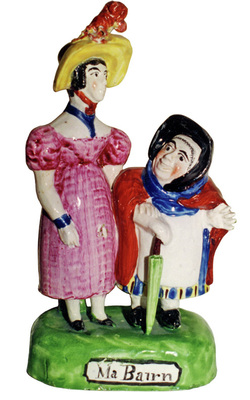
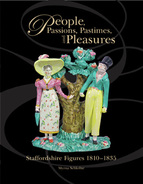
I spend a lot of time trying to find design sources for figures. When I find one, it is a huge personal triumph. Today I got lucky. But first the figure. This odd figure appears on page 87 of my book People, Passions, Pastimes, and Pleasures: Staffordshire Figures 1810-1835. It is titled MA BAIRN (My Child in today's dialect) and depicts a proud mother with her rather ungainly, lanky child. Odd subject, is it not? Clearly it pokes fun at the concept of maternal pride.
I took nearly every photograph in my book, with the exception of three. The photo of MA BAIRN is one of them. Ivan Mears called the figure to my attention when he knew I was seeking the unusual. He and David Boyer had sold the figure, but they did have a photograph, which they kindly allowed me to include in my book. I knew the collectors who had bought it, but one of them hated it so they sold it. The figure eventually landed up in one of Jonathan Horne's Exhibitions--he too recognized it as a rarity. From there, it made its way into a US collection and thence into a California museum. Now it languishes on a museum shelf--not necessarily on display. Nobody who looks at it really knows what it is. How I wish it had come back on the market instead.
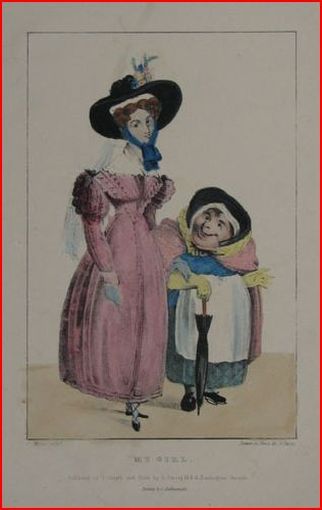
Yay! Today, I found the source print for Ma Bairn on Grosvenor Prints' site.
This satirical lithograph is titled MY GIRL. Its companion is titled, of course, MY BOY. Printed by C. Hullmandel, published by T. Smyth, and sold by A. Parsey of the Burlington Arcade, it is undated. Oh for a date! But in the absence of a date, the lithographs are believed to be circa 1830.
I wonder if MA BAIRN, like its design source, was made to pair with another figure. Meanwhile, there is bound to be another MA BAIRN out there, and you just never know when it--and its companion-- will turn up!
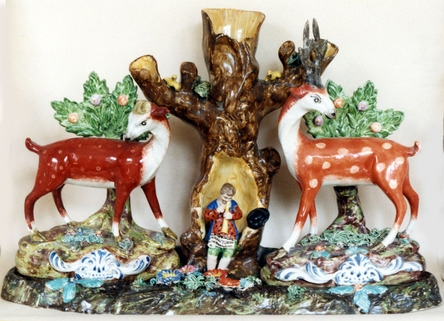
A jaw-dropping addition to John Howard's stock is this large pearlware spill vase with two deer on its base.
At 10" high and 15" wide, this group has quite a footprint. Because of the size, such large groups can look deadly dull--unless the enamels are brightly beautiful. John's figure glows. Unlike most I have seen, this one makes the grade with ease. I love that the spill holder has little bits of vegetation on it and that the bocage is pretty-pretty. The whole thing comes together with charm, and that's how I like my pottery. The teeny shepherd-piper is dwarfed by the large deer, adding to the daftness that is Staffordshire. You will find a similarly formed group in my book, People, Passions, Pastimes, and Pleasures: Staffordshire Figures 1810-1835. That group was photographed from the collection of the Fitzwilliam Museum, Cambridge, UK.
A word of caution. I have seen double-deer spills made in such a way that the deer can be lifted off the base. In other words, each deer was potted separately from the rest of the figure form and then put into position at the end of the manufacturing process. This makes perfect sense, if you think about it. This large group was vulnerable in the kiln and if a deer was damaged, you lost the whole thing. But if you made the deer separately, you could replace a damaged deer with a perfect example.
 In this pearlware group, the deer have been made separately and can be removed from the base with ease. In figures made thus, today you can still replace one deer with another! I have seen spillholders devoid of deer. WIth a little patience, two deer can be found to fill those empty recesses....and I have seen this happen too. So watch out for this fatal flaw if you are ever tempted by a group with removable deer. Meanwhile, if you want to buy yourself the perfect holiday gift, John's deer have no such problems and are in remarkably fine condition.
I have been looking for one of these for a long time: a small cow marked SALT. Somewhere out there, a pair of these exists. You can see a pair among our recorded Ralph Salt figures here. Meanwhile, this little cow will be a place holder of sorts in my collection. Perhaps one day I will find a pair. I love little figures. They look great alongside their bigger brethren and they can be so interesting. I have finally made my travel plans for the New York Ceramics Fair in January. I must admit, I don't relish the thought of January in the Big Apple. It can be horrifically miserably cold--but the last few years have been positively balmy and I am hoping that holds. The Preview is Tues evening, Jan 18th and the show runs till Sunday. If you are planning on coming and need Preview tickets, please let me know as I can probably get you some. Also, if you are free for lunch on Wednesday or Thursday, shout and we will get together at the show.
|