Some higher power made me a pottery collector as a punishment. My eternal torment arises from the fact that pottery is inevitably damaged and I am a perfectionist. I don't like damage, and I hate restoration, so I have to decide what I will tolerate before I part with my money.
Think I am bad? Recently, a lady contacted me because she was interested in buying a figure but it had a few tiny paint splatters where the original paint had missed the mark. This, I explained, was the norm...she should check for bigger issues. In talking to her, I realized I need to establish guidelines for what I personally find acceptable. This should help me resolve my torrment at buying time!
Rule #1: Of course, perfect is best. Yes, there are perfect figures. Don't fall for the sales pitch "you won't find a perfect figure because these things are 200 years old." Figures without any (or any significant) damage exist. Admittedly there are not too many and they demand a price premium. For perfect, score 10. By perfect, I mean good enamels and glaze too. Having the form intact but the enamels yucky just doesn't cut it.
Rule #2: If it is ALL THERE, score 9. In other words, if a figure has been off the base and restuck, that's fine because I am looking at hardly any restored material. If a head has been off (drastic to the mind!) and restuck, that's fine too. Strictly speaking, replacement of original material is a 'repair' rather than a 'restoration.' My friends Nick Burton and John Howard have often tried to help me out of my confusion when faced with a damaged figure by saying "Myrna, its all there." Each time, those words have snapped things into perspective. Now they have become my Guiding Light:)
Rule #3: For minor restoration, score up to 9. In other words, minor enamel touch up, a restored ear, horn, a bocage tip or three on an otherwise perfect figure....these things happen and if you can't live with the damage, a sympathetic restoration is OK.
Rule #4: Deduct points liberally for major restored parts. The larger and more focal the restored part, the more points you deduct. Of course, the rare the figure, the more tolerable the restoration. I find a totally restored bocage entirely unacceptable, however rare the figure. Who wants to look at all that modern material. Similarly, a restored head just kills the figure for me.
Rule #5: Significant overpainting is a no-no. Score below 5--i.e. a reject. We tend to dismiss overpainting as "just touch ups of flaking to the enamels." When it is just touch-ups to visually distracting flaking, that is fine on an otherwise desirable piece. But when the repainting starts to cover much of the figure, you are looking at a sizable amount of modern material, albeit over an old form. Not attractive, not what I want.
At this point, I almost need a computer model to weigh rarity, restoration, repair, overall quality......but thinking about these issues each time I buy makes me use my head, rather than just my heart. And it helps me maintain a consistent standard for my collection.
Think I am bad? Recently, a lady contacted me because she was interested in buying a figure but it had a few tiny paint splatters where the original paint had missed the mark. This, I explained, was the norm...she should check for bigger issues. In talking to her, I realized I need to establish guidelines for what I personally find acceptable. This should help me resolve my torrment at buying time!
Rule #1: Of course, perfect is best. Yes, there are perfect figures. Don't fall for the sales pitch "you won't find a perfect figure because these things are 200 years old." Figures without any (or any significant) damage exist. Admittedly there are not too many and they demand a price premium. For perfect, score 10. By perfect, I mean good enamels and glaze too. Having the form intact but the enamels yucky just doesn't cut it.
Rule #2: If it is ALL THERE, score 9. In other words, if a figure has been off the base and restuck, that's fine because I am looking at hardly any restored material. If a head has been off (drastic to the mind!) and restuck, that's fine too. Strictly speaking, replacement of original material is a 'repair' rather than a 'restoration.' My friends Nick Burton and John Howard have often tried to help me out of my confusion when faced with a damaged figure by saying "Myrna, its all there." Each time, those words have snapped things into perspective. Now they have become my Guiding Light:)
Rule #3: For minor restoration, score up to 9. In other words, minor enamel touch up, a restored ear, horn, a bocage tip or three on an otherwise perfect figure....these things happen and if you can't live with the damage, a sympathetic restoration is OK.
Rule #4: Deduct points liberally for major restored parts. The larger and more focal the restored part, the more points you deduct. Of course, the rare the figure, the more tolerable the restoration. I find a totally restored bocage entirely unacceptable, however rare the figure. Who wants to look at all that modern material. Similarly, a restored head just kills the figure for me.
Rule #5: Significant overpainting is a no-no. Score below 5--i.e. a reject. We tend to dismiss overpainting as "just touch ups of flaking to the enamels." When it is just touch-ups to visually distracting flaking, that is fine on an otherwise desirable piece. But when the repainting starts to cover much of the figure, you are looking at a sizable amount of modern material, albeit over an old form. Not attractive, not what I want.
At this point, I almost need a computer model to weigh rarity, restoration, repair, overall quality......but thinking about these issues each time I buy makes me use my head, rather than just my heart. And it helps me maintain a consistent standard for my collection.
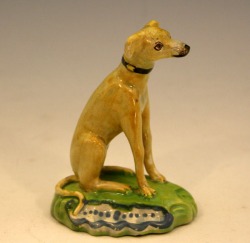
Small pearlware dog, courtesy John Howard
John Howard's rare pearlware pooch is ALL THERE. Restuck when it was knocked off the base. As uncommon as this figure is, I have an example too.
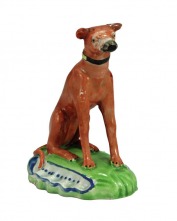
Another example of this rare dog. H3-1/2'
My dog has not been off the base, but he does have a restored ear. Restoration to ears is almost inevitable and not too distracting. Obviously, I would rather both these figures were perfect, but given the great quality (typical of this pot bank), both deserve perfect 9's.