Obadiah Sherratt 2: Feather Bases. 05/29/2009
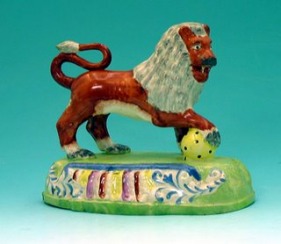
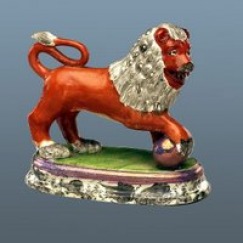
Is this Staffordshire figure in the 'Sherratt' style? This time the question is an easy one. The distinctive feather base supporting this striking lion is a dead give-away. It is a definite 'Sherratt' pointer. The same base is found on other 'Sherratt' figures, including courtship and christening groups, and Doctor Syntax, shown here--note the lustre used to decorate the feathering in this case. 'Sherratt also made feather bases in an extended size to support longer figures, such as bull baitings and "Prepare to Meet Thy God" groups. Longer versions usually have swirled designs impressed into the elongated area to the left and right of the feathering. Why? To make it pretty, of course! BTW, the gorgeous lion is 7 inches high and was once in the Woodstock, UK, showroom of John Howard. It quickly found a new home. The enamels on this particular pearlware figure appear to be particularly spiffy, as befits the King of the Beasts. What of 'Sherratt' lions generally? They come in several shapes and sizes, but the favored pose is that used for many ceramic lions of this period: paw resting atop a ball, mimicking the pose of Florence's famous lions. John Howard's lion can be found astride other 'Sherratt'-style bases. Sometimes he is paired with another lion--but never a lioness. A similar 'Sherratt' royal beast, with more liberal use of lustre, is illustrated below. Collecting Advice I don't know of any outright reproductions of this 'Sherratt' lion...yet. The most likely damage is to the tail, so expect some restoration there. Above all, buy a lion with an engaging expression. Your relationship will last a lifetime! Obadiah Sherratt: Part 1 05/25/2009
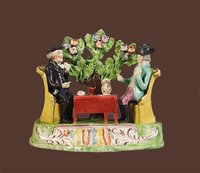
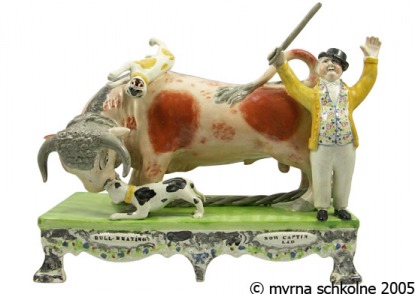
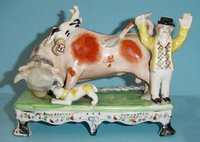
This bull baiting group is in the 'Sherratt style." It is just over 13" wide and 11' tall. The plaques read BULL BEATING (could this be a telling mis-spelling of bull baiting?) and NOW CAPTIN LAD (presumably the man's encouraging words to his prize bull). A bull baiting group such as this was the first Staffordshire figure to earn a Sherratt attribution when Herbert Read, writing in 1929, commented on "the excellent bull-baiting groups...attributed to Obediah [sic] Sheratt." Mr. Read did not explain how he reached his conclusion, and almost 80 years later we are no nearer knowing whether Obadiah Sherratt did in fact pot the bull baiting group that catapulted him to fame! The bull baiting group shown here is small and does, in fact, correspond to the measurements Anthony Oliver gives. Note the difference in its modelling compared to The Real Thing. I have a part-time career writing to sellers who advertise figures like the little one above as The Real Thing. You would be amazed to know that I have written to eBay hopefulls as well as prominent auction houses and dealers. Some of the Kent reproductions are quite nicely done, but cruder versions have since been churned out in Asia....and they make my skin crawl. Tweet 05/21/2009
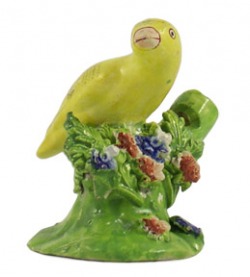
I am on Twitter. Look for MyrnaSchkolne (that's right, NO space between first and last names and watch the tricky spelling of Schkolne). If you follow me on Twitter, you will be able to see when I have updated the blog, added an event, a showcase item, or anything else of interest. I hope this will give you an easy mechanism for keeping up to date quickly, and as of tonight I promise to do my bit and tweet (I think that's what it's called) dutifully. And from an era when 'tweet' had a different connotation, I bring you this Staffordshire pearlware bird whistle, c.1820. Cats 05/19/2009
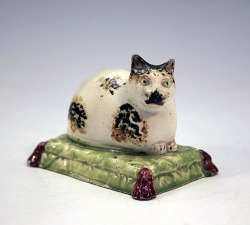
Have you noticed how very many Staffordshire figure groups have a little dog tucked somewhere on the base? Dogs are commonplace in early 19th century Staffordshire figure groups. Stand-alone models in all shapes and sizes abound. But the same can't be said of cats. Ever wondered why? This cute cat currently graces the stock of John Howard, Woodstock, UK. Width: 3" To give our cat story a happy ending, let me add that in the Victorian era cats were increasingly considered hearth side companions and small family members. In 1871, England's first cat show gave legitimacy to these long overlooked companions...but the potter who fashioned John Howard's cat must have known this time would come. Basking in the sun 05/15/2009
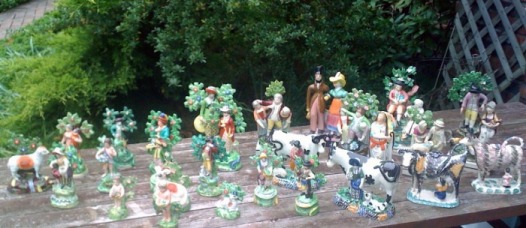
Thought I'd share this happy photo, which dealer Elinor Penna sent me yesterday. These Staffordshire figures looked so happy basking in the sunshine that Elinor HAD to reach for her camera (or was it her cell phone?). Almost like looking at the past, isn't it? And aren't the colors just dazzling in the sunshine? Cows with Pink Tails? 05/12/2009
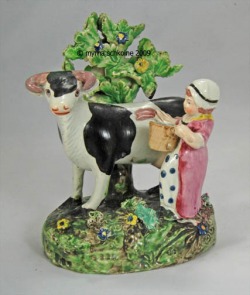
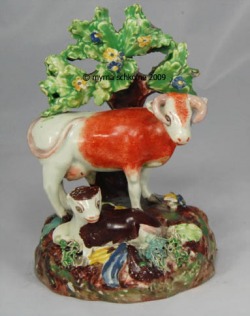
Today, two cow groups on the shelf in my office set this city girl pondering about the color of a cow's tail. Googling revealed that most cows do indeed have tails that match their bodies. Yet these two Staffordshire cows have pink tails! I suspect you've noticed that both cow groups have identical bocage leaves and flowers. They, along with other pearlware figures that share these and other attributes, belong to a group believed to have originated from the same small potbank. We may never know the name of the mystery potter who produced these Staffordshire figures, but contemplating the characteristics they share is part of the fun of collecting. Bodacious Bovines 05/08/2009
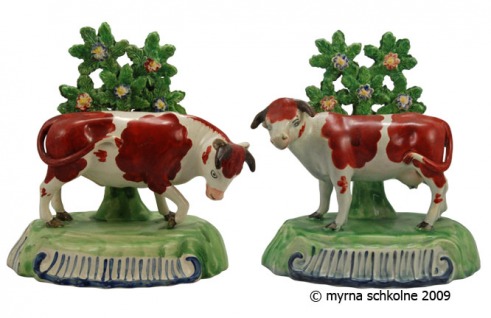
I love Staffordshire figures of sheep. I own a flock that grazes away the day on its own shelf. And on occasion, the same flock is scattered across our dining table when we entertain. Candlelight on pearlware bodies....divine! But Staffordshire cows on the other hand, usually leave me cold. Their bulky forms, frequently posed looking down as they graze, is generally unexciting. Athere is an exception to every rule, and wonderful examples do exist. It just takes some hunting to find them. ![]() Pair of pearlware Staffordshire figures of cows. H: 7-1/2". From the stock of Elinor Penna. Recently, I was tickled to find this spiffy pairs of cows among Elinor Penna's stock. These are quite uncommon models, and well sized at about 7-1/2" each. Certainly not the run-of-the-mill bored bovines-with-calves that our potters produced in abundance. I found a single (the cow facing to the left) in Saffron Walden Museum when I visited in 2005, but this is the first pair I have encountered. Again, finding the rarities is what makes collecting fun. Man on barrel 05/05/2009
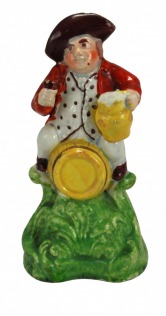
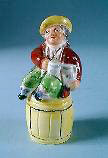
I found this unusual little figure for sale at the Staffordshire Figure Association meeting last September. The dealer/collector sale is great fun each year--more figures than you'll see at any other venue-- and you never know what you will find. (BTW, now is the time to register for the 2009 meeting. See details on the Events tab.) ![]() Enamel-painted pearlware Staffordshire figure of a man on barrel. I have no idea as to this figure's potbank of origin, but he is a jovial fella, great enamels, and I have never seen another like him. ![]() Enamel painted pearlware figure of a man on a barrel. Made in Staffordshire, circa 1820. Photograph courtesy of Andrew Dando Antiques. Not knowing what will turn up next is what makes collecting fun! Benjamin Franklin 05/01/2009
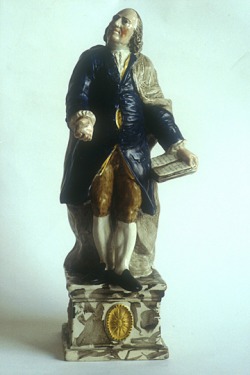
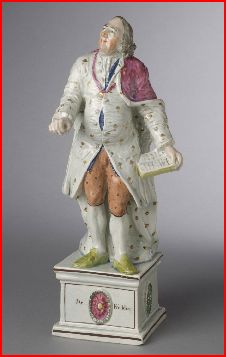
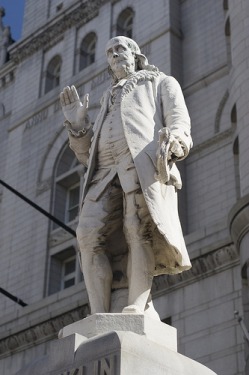
My knowledge of American history is pathetically sparse because I came to this wonderful country as an adult. But even I have heard of Benjamin Franklin! And I am particulary interested in him because of two rare Staffordshire figure of this Founding Father. The first is in in Brighton's Willett Collection. ![]() Staffordshire figure of Benjamin Franklin in the Willett Collection, Brighton Appropriately, there is an even more gorgeous example in the Philadelphia Museum of Art, and it is titled Ben Franklin. I glimpsed it two years ago at a distance across a roped-off room--sadly, the only English pottery figure on display in that museum on that day. ![]() Staffordshire figure of Ben Franklin in the Philadelphia Museum of Art. As I work on my next book, I am trying to tie Staffordshire figures to their design sources. I have been able to find quite obscure sources for some figures, so I assumed Ben Franklin would be easy. Think again! ![]()
Fascinating Factoids |