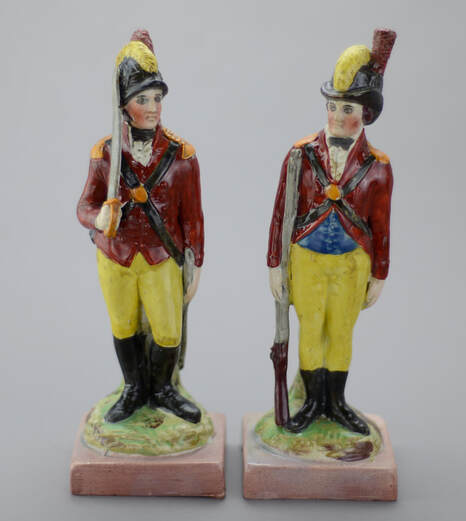
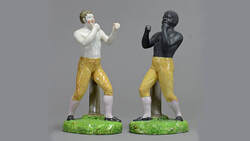
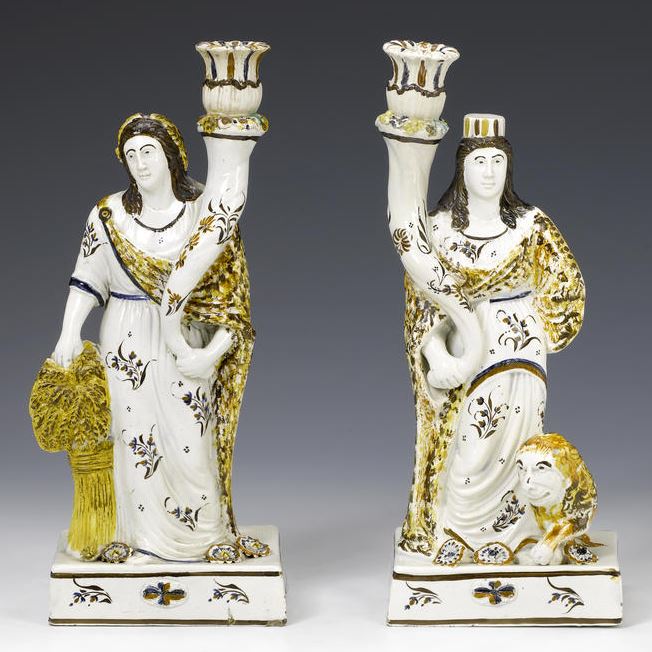
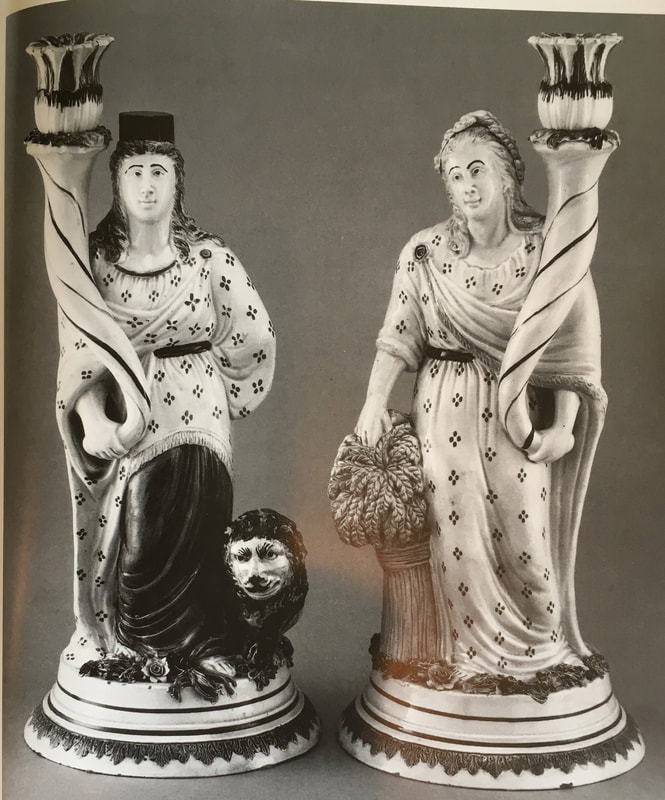
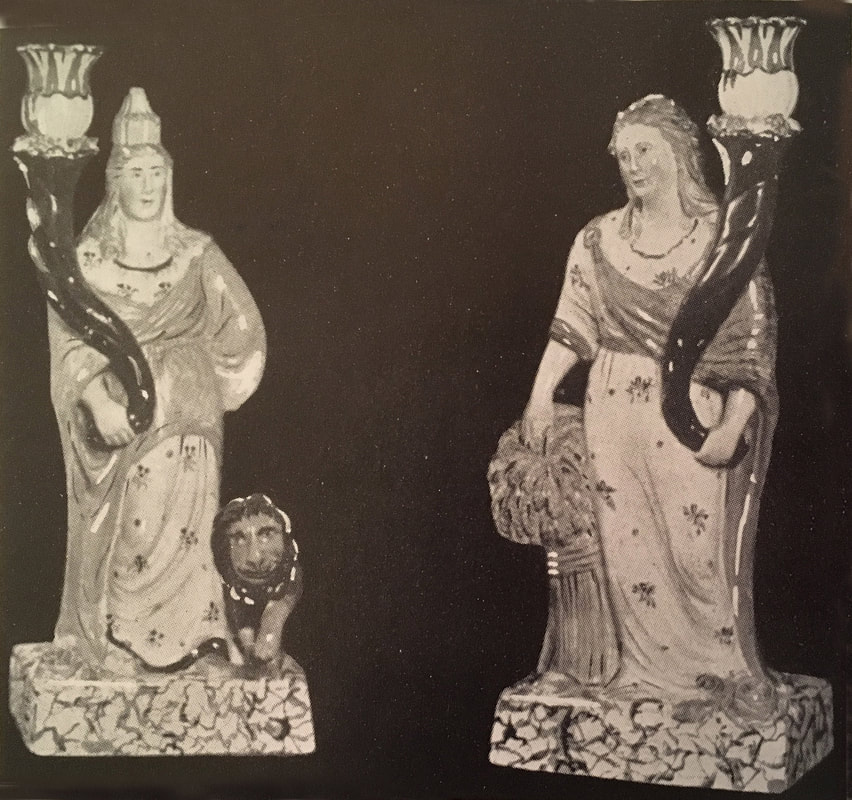
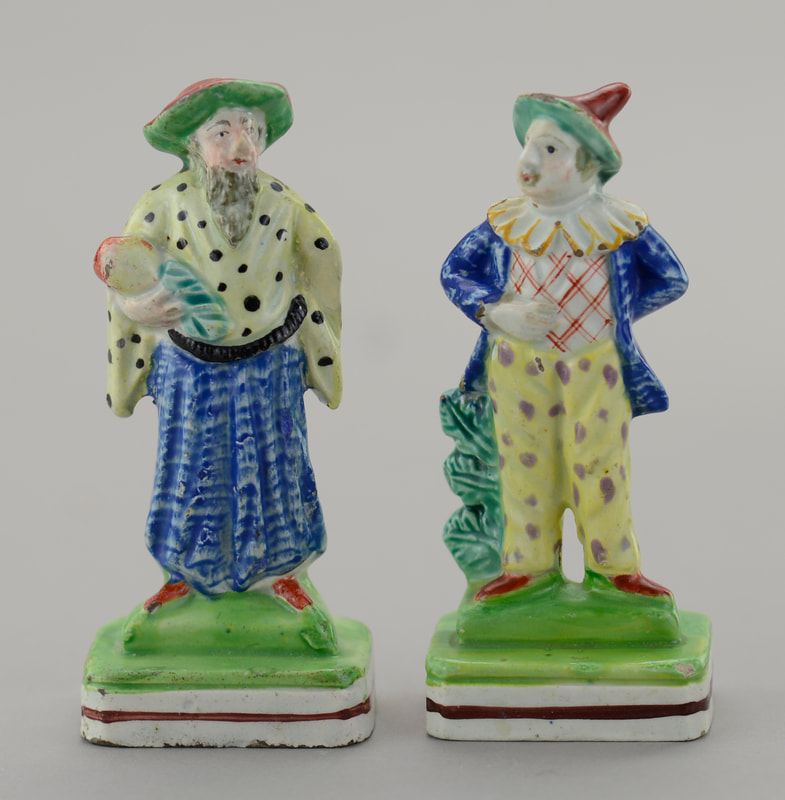
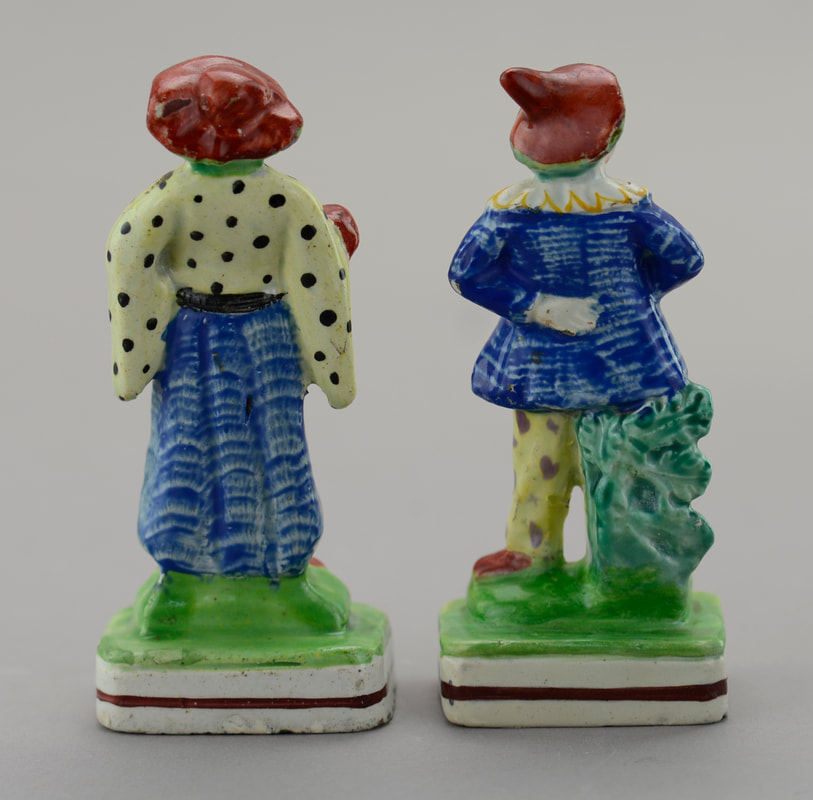
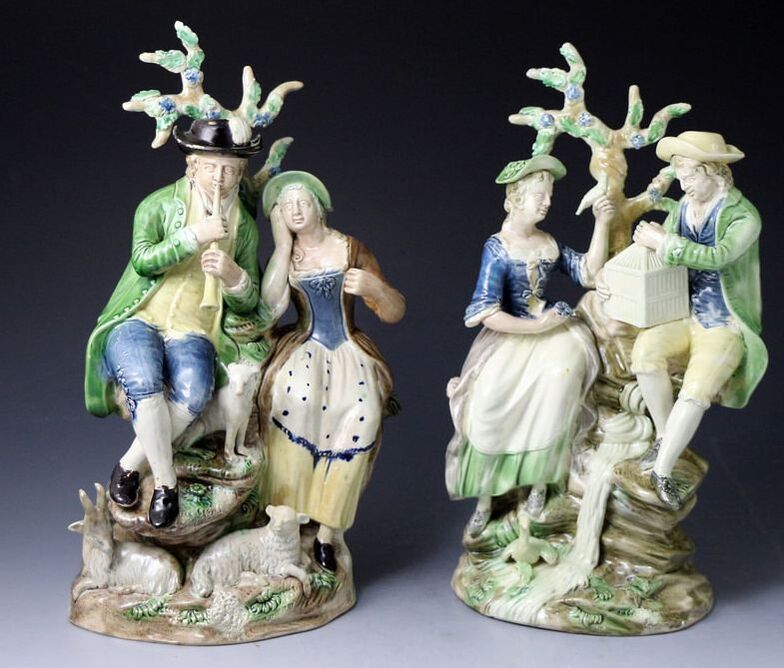
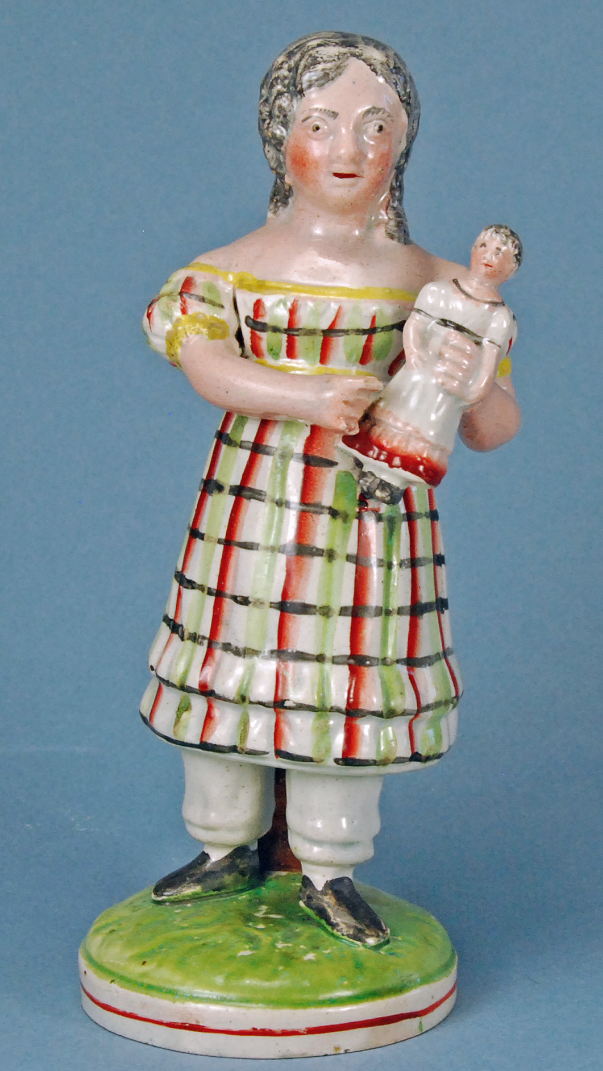
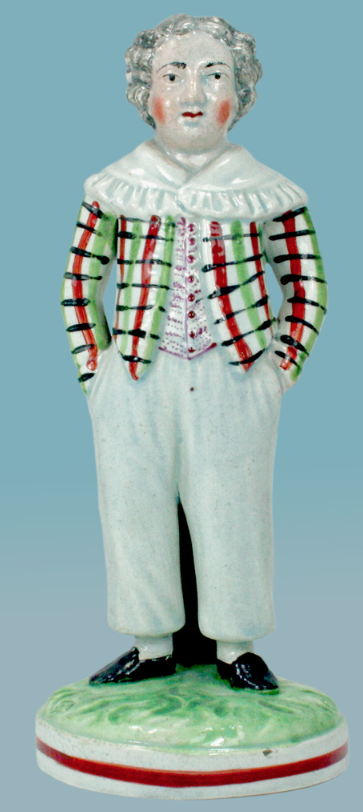
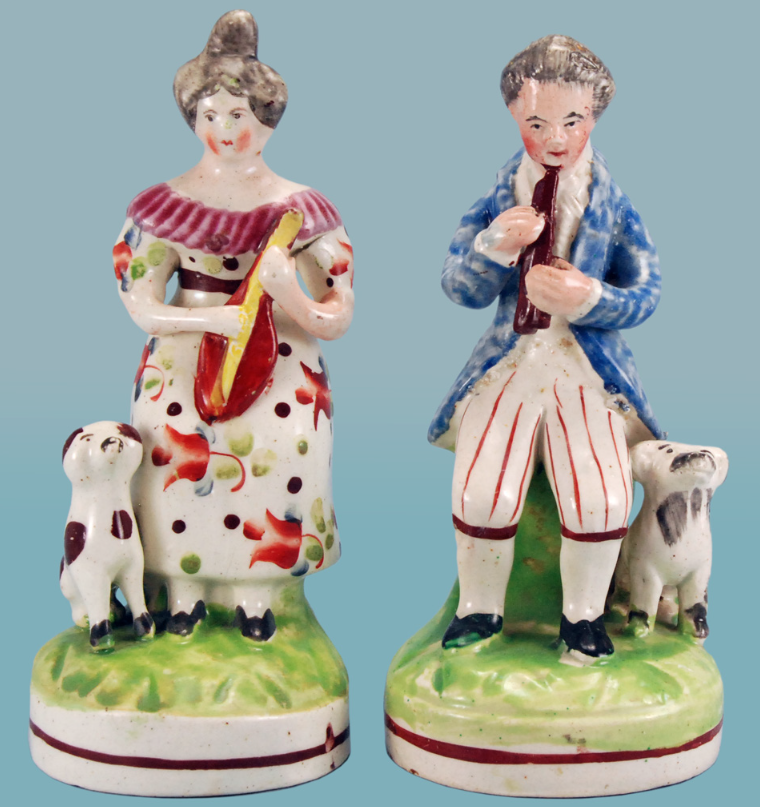
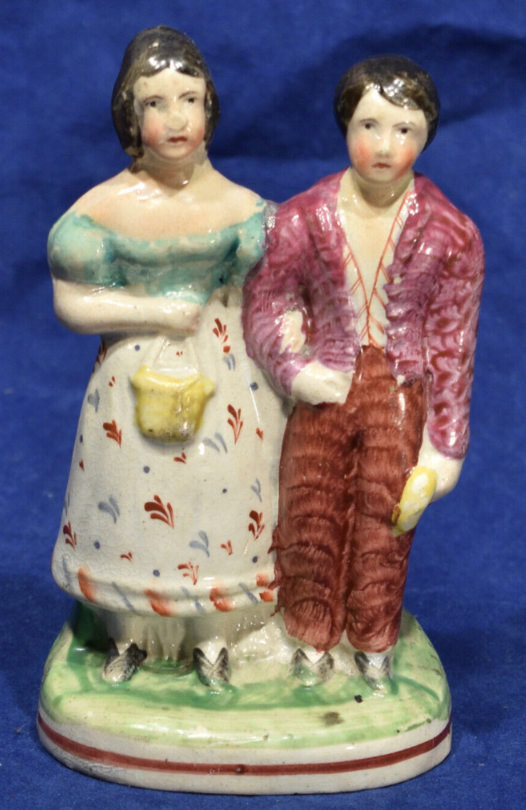
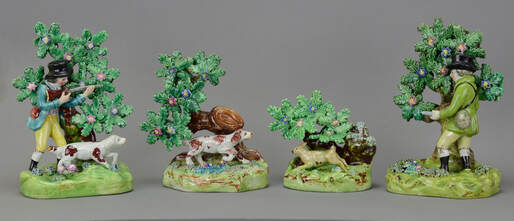
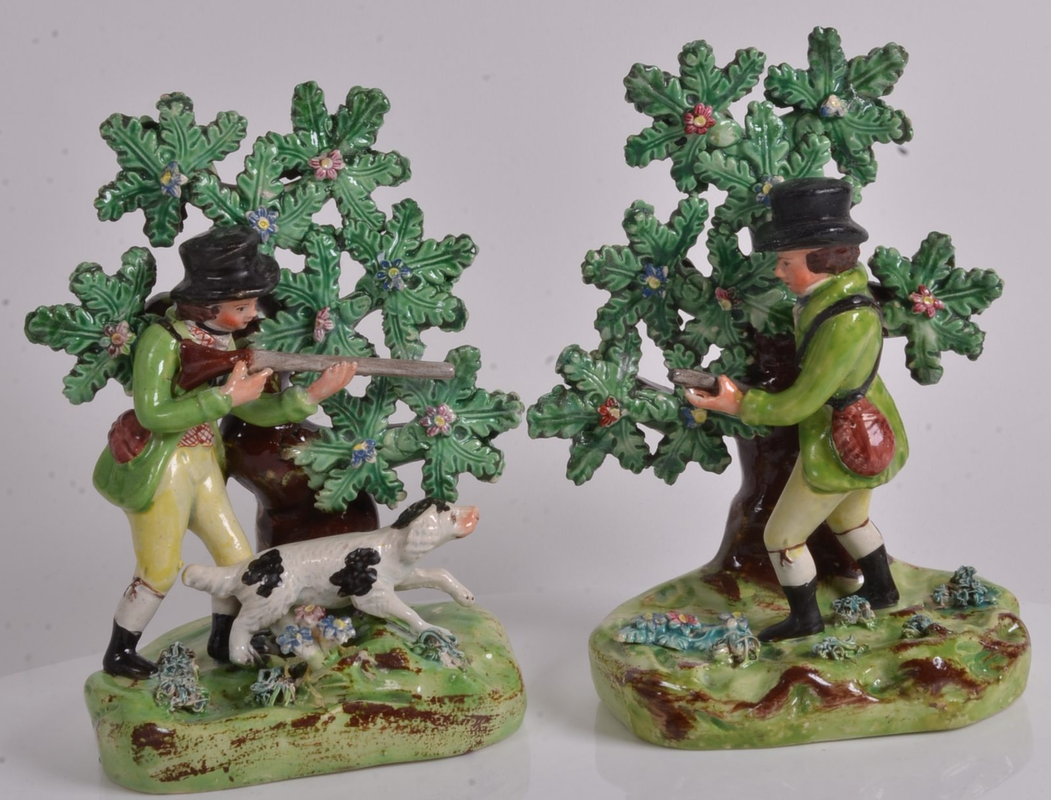
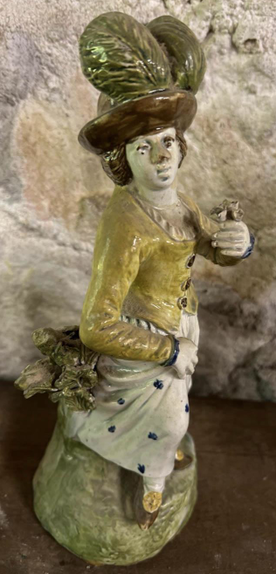
The term "Pratt ware" is frequently tossed around incorrectly. Correctly used, "Pratt ware" refers to pottery that is decorated with oxide colors that are applied UNDER the glaze.
  • The figure would be assembled and fired
  • The color would be applied and allowed to dry before dipping the figure in glaze and then firing it for the second and final time.

Because the final firing was a glaze firing, it required a very high temperature, and only a limited palette of colors could withstand such temperatures. These colors are all derived from metallic oxides and are yellow, brown, green, orange, blue, black, and puce. And because the colors are UNDER the glaze they retain a brilliant sparkle and an intensity. Quite remarkable to see them looking as fresh today as they did 200+ years ago.


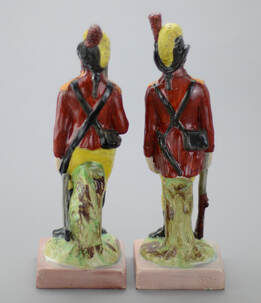
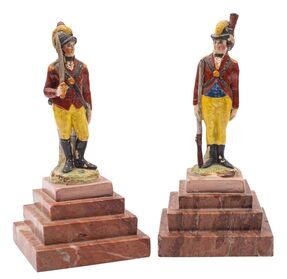
Because Pratt ware utilized a less costly technique--only 2 firings required--we see Pratt colors on many useful wares such as jugs and on relatively few figures. On the whole, Pratt decorated figures are crude....but not always. You can get some splendid examples.   One man's 'crude' is another's 'naive'. When this sweet little soldier came up for auction a few years ago, I thought it fell into the latter camp. Fabulously naive with Pratt colors that glowed. Almost looked wet, like a lollipop that had been licked. 
Picture
The Perfect Man: our Pratt Ware soldier with a fatal flaw.
Yummy is he not? And apparently PERFECT. A friend of mine loved the figure and I dubbed him The Perfect Man. Not a nick on him, standing to attention, and silent. My friend (a man!) bid a very generous price to secure this little fella. But when the parcel arrived from the very reputable auction house, surprise: our Perfect Man was far from perfect. His head had been off and reglued. The auction house refunded the price, but a dream was shattered. There is no perfect man.

Most figures we see are decorated in enamel colors. These are applied ON TOP of the glaze. 
  • The figure would be assembled and fired
  • The figure would be dipped in glaze and fired again.
  • Enamel colors that could withstand the highest temperatures would be applied first, and the figure would be fired yet again. The temperature reached would be significantly below that required for the other two firings.
  • Enamel colors that could only withstand even lower temperatures would be applied and the figure fired again at an even lower temperature.
So why go to all this trouble of at least 3 firings? Well, enamel colors allowed the use of a full color palette, including soft pastel tones and all the shades of green, blue and everything else. Name it and you could use it. It was a more expensive technique and was used for most fine figures because the colors could be painted on with great precision. And if mixed and fired correctly, the colors still retain a shine....sometimes they can rival the brilliance of Pratt Ware. I have seen the same figure decorated in Pratt and enamel colors. Neither is earlier than the other. But Pratt was quicker and cheaper to utilize.
Picture
Pratt Ware Cat
Picture
Enamel-painted Cat, from the stock of Elinor Penna.
Paragraph.
 
Jim Crow 03/05/2010
 
Last posting looked at a classical figure. This time we move to the other end of the Staffordshire figure spectrum and look at a figure that very much reflected its times. While today the term "Jim Crow" has repugnant racial discrimination connotations, in the 1830s Jim Crow was the talk of London.
Picture
Rare Staffordshire Figure of Jim Crow from the stock of John Howard
Thomas Dartmouth Rice (1806-1860) is the man who gave us Jim Crow. Born and raised in New York, Rice trained as a woodcarver but he prefered the life of an itinerant entertainer. By 1828, he was earning his keep in the USA as a prop man and small-part actor. Between acts, he performed a shuffling, jiggling dance to the tune of a black American slave work song. The routine cruelly parodied the crippled movements of a slave named  Jim Crow, who worked in the stables behind the theatre although his limbs were gnarled with arthritis. Rice performed his Jim Crow routine in blackface, thus creating a stereotype for black minstrelry that was to quickly become wildly popular.

Rice’s debut as Jim Crow at the Adelphi Theater in London on 7 November 1836 was so successful that other plays were adapted to create a role for Jim Crow. Rice and Jim Crow became an international sensation and people of all classes capered to the ditty and printed images of  Jim Crow proliferated.

Picture
A hand colored engraving of Jim Crow, circa 1835, sold by Dramatis Personae.
Figures of Jim Crow are very rare. I have known of only one model (and only two copies of it)---until John Howard found his Jam Crow figure, shown here. Misspelling is common on Staffordshire figures because the potters were barely literate, so it is no surprise to find "Jim" endearingly spelled  Staffordshire style!
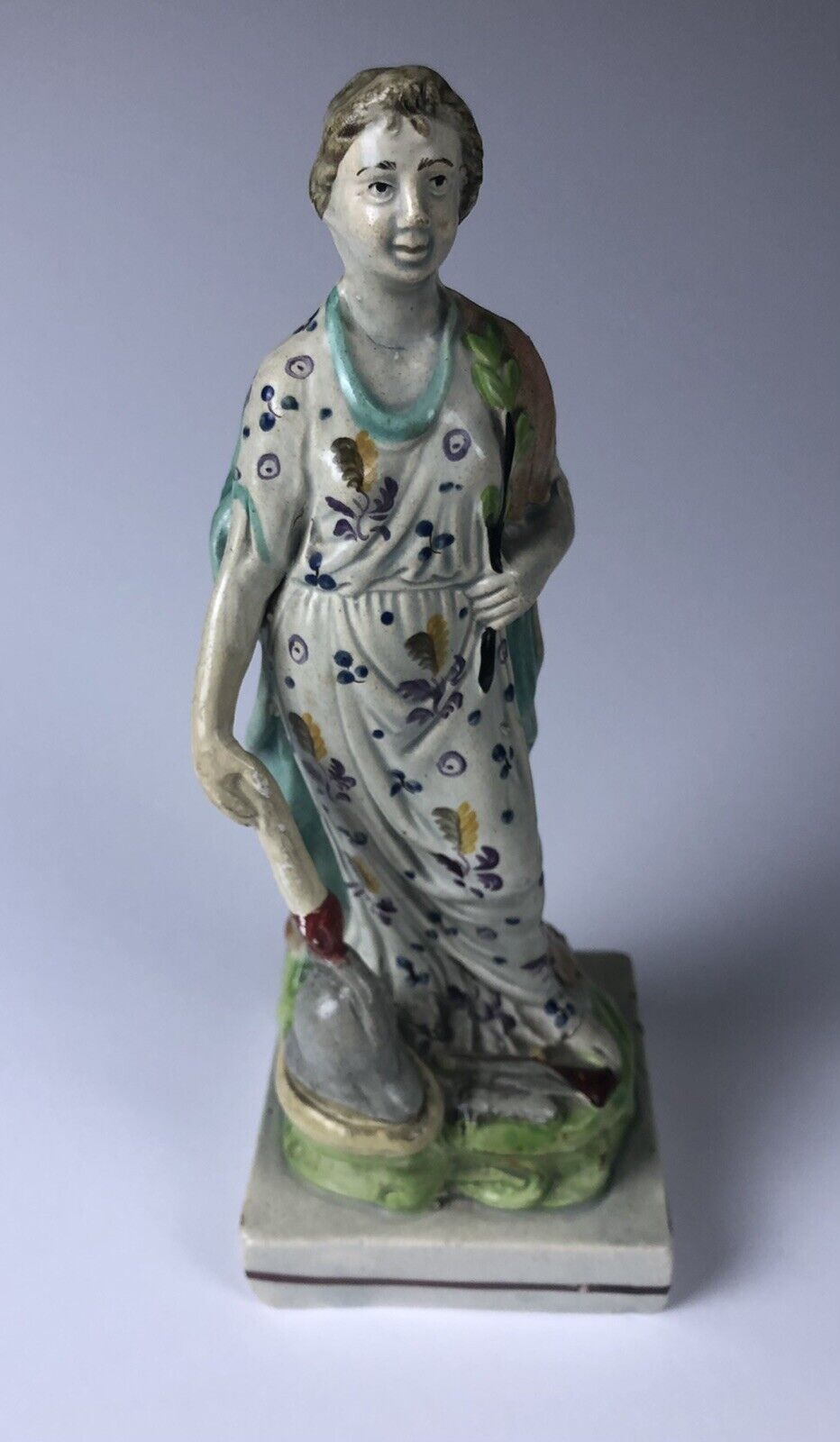
 
A muse? 03/01/2010
 
The older I get, the more I like classical figures. When well executed, they have such grace and charm. And, at times, they can be brain teasers.
Picture
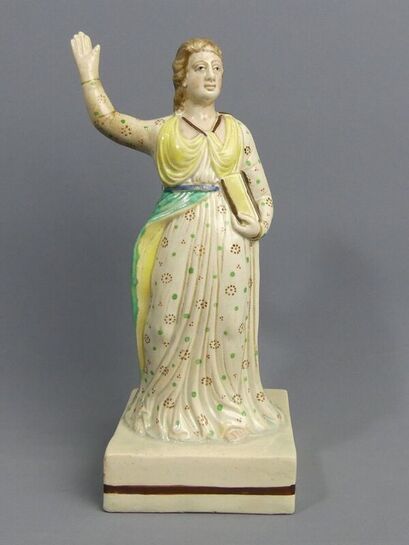
Staffordshire figure depicting Melpomene, H: 15cm
This figure popped up recently. I had never seen it before. Turns out she is   Melpomene, the Muse of Tragedy. Melpomene's attributes were the horn and tragic masks.I have never seen this base form before either.

So how do I know this figure is Melpomene? A clever friend of mine did the work by doing what I should have done: he referred to James Hall's Dictionary of Subjects & Symbols in Art. This is a great reference, and I do use it often. Hall tells that Melpomeme is one of nine muses, each with her own sphere of influence over learning and the arts. 

Classical figures compel me to learn about the classics, and this makes them especially intriguing. And now that I know there are nine muses, I shall be watching for figures depicting the remaining eight, not to mention other figures on this same base. I giggle inwardly when I am dubbed an 'expert' on early Staffordshire figures. In reality, I am a student, forever learning.  And that's so exciting.


FREE at last! 02/26/2010
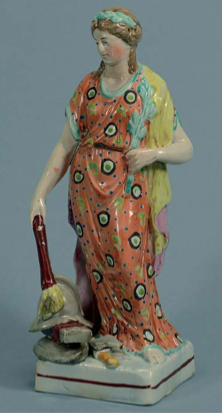
 
Bloggers from far-flung countries who have postponed buying my book because the postage was too steep, I have good news. Postage is now FREE on books mailed to just about any country. Click on the BOOK tab at the top of this page if you want to order. Payment via the PayPal system allows you to charge the purchase to your PayPal funds or to a credit card of your choosing.
Picture
My favorite book! And now free postage on books mailed globally.
 
So what is.... 02/25/2010
 
"So what is a stirrup cup?. I hope you don't mind me asking you."

This question was posed to me by a lady as I sat sipping a drink in the little restaurant area of the New York Ceramics Fair. Stirrup cups were big at the fair this year. A handsome example adorned the cover of the fair catalog, and several dealers had lovely examples on display. This lady, who apparently pops into the fair each year and presumably buys on occasion, had looked at all the stirrup cups on display....and had been too intimidated to ask what purpose they served.
Picture
Stirrup cup, probably Scottish, from the stock of John Howard.
A stirrup cup is usually shaped in the form of the head of a hare, a fox, or a dog.
It was the "parting cup" given to departing guests, ready to leave with their feet in the stirrups. It was also the vehicle for serving a drink (usually sherry or port) served prior to a traditional foxhunt.

So there it is in a nutshell. But the lady bothered me. Why had she hesitated to ask one of the very knowledgable dealers ? The bunch at the fair are particularly friendly and enthusiastic about their stock. Perhaps she had been rebuffed in the past. So get over it. I have had my share of put-downs....and now I just love it when someone tries. I have all the pat answers ready.  Never hesitate to ask a question. It's the only way you will learn.

Another factoid that not everyone knows is the purpose of a spill holder, sometimes called a spill vase
Picture
Charming spill holder group from the stock of John Howard.
Remember, these were the days before the invention of friction matches. So how did you light your candle? Well, you used a spill that was stored in a spill holder. A spill was a narrow roll of paper or strip of wood (rather like a chopstick). You set it alight from something that was already burning (another candle or the fireplace), and carried the flame over to whatever you needed to light next. When you were done, you might put your spill back in the spill holder, or toss it away. In any event, your supply of spills was always ready for use in one of the many spill holders you kept around the house.

While I am no Martha Stewart, I use my spill holders for more decorative purposes. I put fresh flowers in them. The flowers are placed in those little florists tubes that hold water. They can last for quite a few days...and they look so pretty when you entertain. Of course, if you want a place to store your chop sticks, you now know you should go out and buy a spill holder!
 
John Forster? 02/21/2010
 
You don't see this inkstand often. This example was formerly in the stock of Aurea Carter.
Picture
Putto astride dolphin inkstand sold by Aurea Carter.
The inkstand below appears similar, but I wonder why it lacks a quiver to serve as a quill holder. Was it made that way? Was the quiver broken off? This illustrates the importance of knowing what a figure should look like before committing to buy. What is NOT on the figure is often as important as what is.
Picture
Putto without quiver for quill holder.
Then again, I have recorded another version of our putto--with a quiver on his back!
Picture
Putto with quiver on his back.
Could be that all three versions of the figure are correct. Trouble is you don't know if you are buying from an unreliable source. Aurea's putto would have come with full details of restoration, if any....and that is the advantage of buying from a reputable dealer.

To complicate the issue further, I have seen two putto inkstands where the putto wears a hat. Yes, a hat. Isn't that what every putto needs? The head/face is from a different mold, best I can tell. One of these inkstands is in the Earle Collection (item 664 if you have the book.) The other is quite important because it has written beneath it "John Foster made this at Hanley August the 29 1820." Like the Earle putto, this fellow was made with hat and quiver (quiver now missing.)

We know John Forster made one putto astride a dolphin on a summer's day in 1820--yet we know of not a single other item he made, and he must have made a fair number. Of course, I will always wonder if he made the look-alike figure in the Earle Collection. But who was John Forster and what else did he make??? Our figure potters were small operators. Sadly, the identities of many of these men has, like their fragile wares,  vanished into the mists of time.
 
Tweet 02/17/2010
 
A long time ago, I picked up this little bird whistle in London for a song. It was in the stock of a fine porcelain dealer, who didn't think too much of  pottery, obviously. My husband didn't know why I was buying this diminutive object (it is just over 2" tall), but that didn't stop me. It has remained a much loved item in our collection--or at least I love it lots.
Picture
Staffordshire pearlware bird whistle. H: 2-1/8'.
Can you imagine how easily a small item like this whistle gets lost, broken, discarded over the centuries? It is no surprise that the years marched by without my seeing another. But at the New York Ceramics Fair this January, I was amazed to find its identical twin in the stock of James Labaugh Antiques. Yes, it cost a lot more than mine had, but it was worth it. A real little gem.

I do have one other bird whistle, bought at the 2009 NYCF from John Howard.
Picture
Staffordshire pearlware bird whisltle. H: 3-1/4 inches
Charming isn't it? And the glaze and enamel colors are as brilliant today as they were two centuries ago. Amazing to think how much trouble once went into making a whistle, how much concern there was for its beauty. Today, a whistle is merely a utilitarian object, usually churned out on a production line in some distant country. Have we really progressed over time??
 
 
I will be traveling till Fri Feb 26. I have prepared Blog posting so I stay on schedule from afar....but answering questions with photos attached may be difficult. If it can wait, please email your questions after Feb 26. If it is urgent, go ahead and I will do my best to get back in touch. And yes, I expect to see Fabulous Figures on my travels.
 
 
I repeatedly comment on the pleasure of tiny figures. And I have often said that you can buy a perfect figure for a modest price. Have a look at the little reading boy that Andrew Dando has just put on his site. It fits the bill. Why haven't I bought it? Well, I would have...but I already have one just like it.
Picture
Charming early 19thC reading boy, currently in the stock of Andrew Dando.
Also, great news is that Stephen Smith is developing a fabulous site devoted to Sunderland lustre plaques. If these interest you--and they should, even if you are not a lustre collector you will find them fascinating--click here to visit.
 
Inspirational 02/13/2010
 
The world is awash with reproductions, and I don't normally have anything positive to say about them, but these you will find interesting. In November, I got an email from Karen Thompson, a ceramics student at the Royal College of Art in London. Karen is studying for her MA and had a project requiring her to recreate a piece from the Victoria and Albert Museum's holdings. She chose that fabulous Staffordshire figure, 'The Death of Munrow'. Karen was struggling with the modelling because she had no images of the rear. I supplied some pictures...and recently the results popped into my email box. What a surprise! Karen had modeled 'The Death of Munrow' AND a response called 'The Death of Sainsburys', which is intended as a comment on Sainsbury's food chain and the predominance of supermarkets.
Picture
The Death of Munrow, created by Karen Thompson in 2010.
Picture
The Death of Sainsburys, created by Karen Thompson in 2010.
I think Karen has done an extraordinary job of creating three dimensional objects from pictures. Most importantly, along the way she fell in love with Staffordshire figures.
Picture
The Death of Munrow. Made in Staffordshire circa 1820.
The Victoria and Albert Museum has a great 'Death of Munrow' in its holdings--pictured above. It was a gift from a well-intentioned donor. Most museum holdings are in reserve, which means the public never gets to see them. Please DON"T leave your Staffordshire figures to a museum. The odds are they will live in a dark room. They will never bask in the sunlight or be caressed by loving hands. I guess if the Victoria and Albert had its 'Death of Munrow' accessible, Karen would not have had to ask me to help with pictures. I am so pleased that I could help, because almost two centuries after its creation, my 'Death of Munrow' has inspired the love of Staffordshire figures in yet another potential collector.

Karen's work can be seen on her website by clicking here.