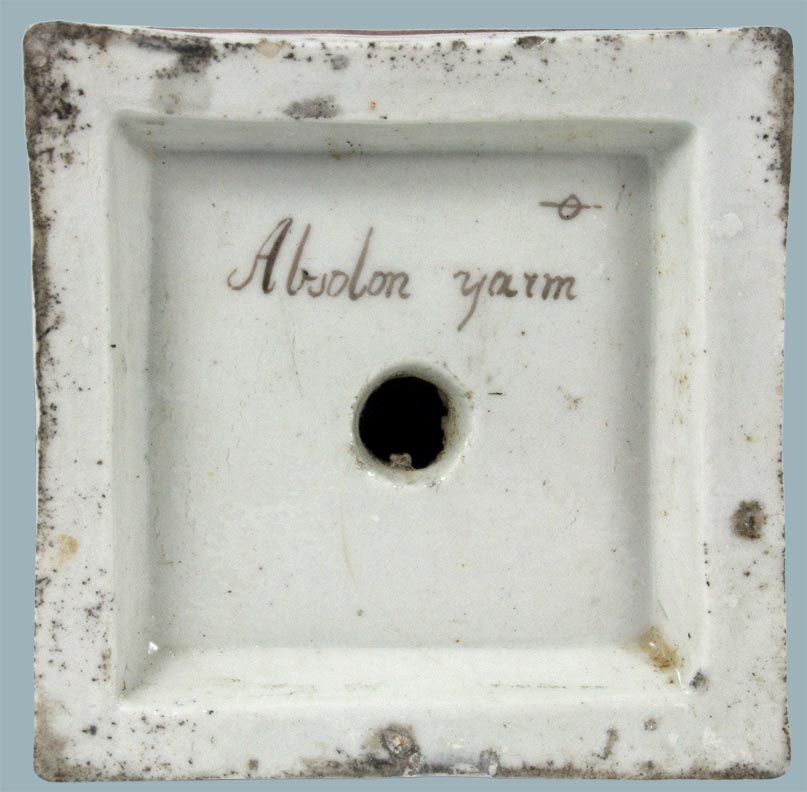
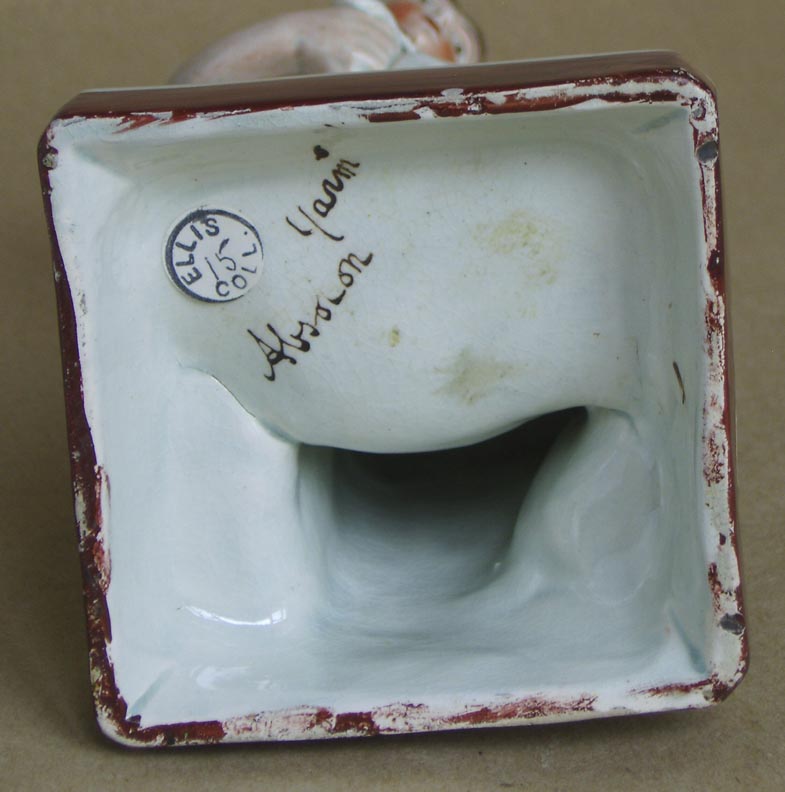
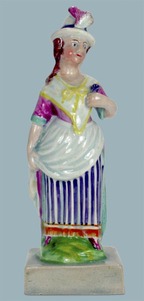
We are used to most of our figures being unmarked, so on the rare occasion that we flip a figure over and see a mark, we conclude this is a maker's mark. And this figure of Autumn is marked quite clearly beneath. "Absolon yarm" is painted on the bottom of the base in beautiful copperplate script. The maker's mark? Not so fast! In this case, the mark is that of a very well known painter, William Absolon of Yarmouth. William Absolon established his painting workshop in Yarmouth in 1790, and he both painted and sold pottery and porcelain figures. He owned a muffle kiln, so he would have bought this figure of Autumn in the white and painted it for resale. Perhaps you could even choose your colors. In those days before decorators, I am sure nobody was tacky enough to insist that the jacket color match the wall paper!
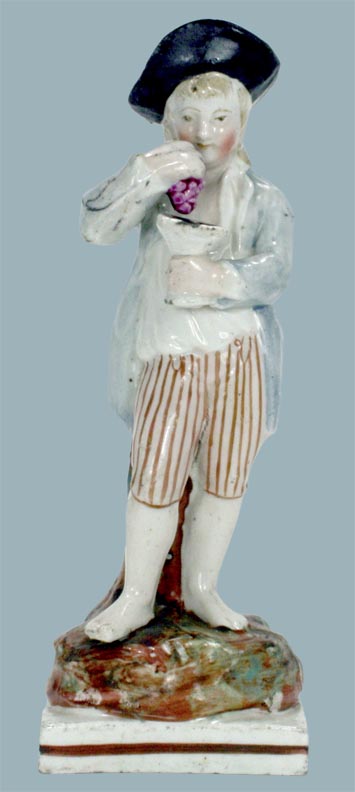
William Absolon's mark is also recorded beneath the bases of figures Venus (British Museum AN9656290001), Hope, and a figure emblematic of Water. The figure of Water is below.
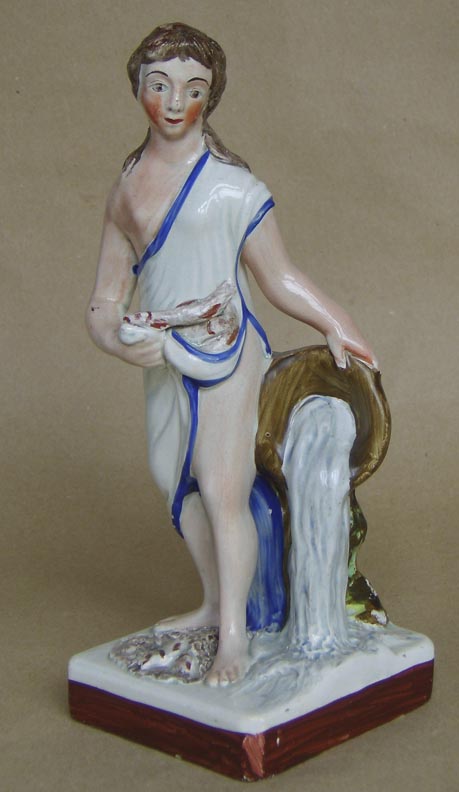
I have recorded several of the other Elements painted in just the same manner as Water, but none is marked. I can't help thinking that they all just may be Absolon's work. All are painted with similar base colors and just the edge of the clothing tipped with color.
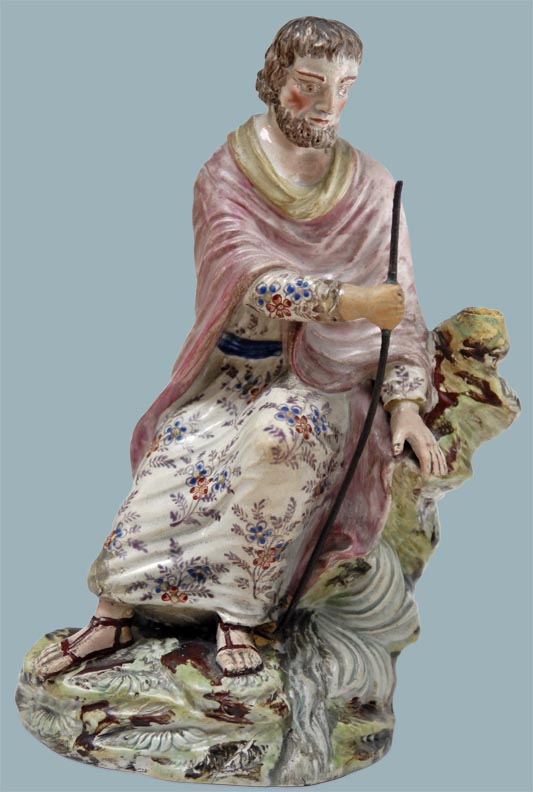
I have also recorded this figure of St Peter that is painted in just the same manner. At the risk of stating the obvious, notice the two-tone base edge. Also, the clothing is again tipped with color. There is not mark of any sort on St Peter, but I can't help thinking that William Absolon painted him. For the record, this is quite an unusual figure of St. Peter, and it was made without a bocage.
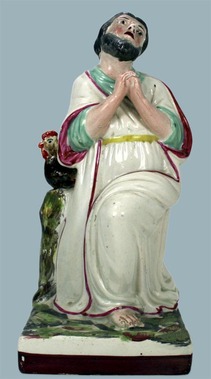
One day, science will be able to tell us the "DNA" of paints and glazes, and perhaps we will then be able to link figures by the composition of those materials. Until then, we must speculate. How frustrating. But meanwhile, please tell me if you see any more figures with Aboslon's mark or with this distinctive painting style.
I have never fully addressed the topic of eBay head on in this blog, but here goes. eBay is a necessary evil. You can buy perfectly lovely items from legitimate dealers who use eBay as yet another way to move stock---and in many cases you can buy those same items for a little less by going directly to the dealer's web site. Also, there are fairly knowledgable, well-intentioned amateurs who attend auctions and try to make a living by reselling on eBay, and you can buy nice items at fair prices from them....but know that if these figures were really special, the trade would have swooped them up at auction. Once in a blue moon, something extraordinarily special comes on eBay. It happens. Somebody is clearing out an estate or just doesn't know what they have. But don't think it will sell for nothing. On the contrary, know that others like me watch eBay for just this moment--and the bidding can be fierce.
Most items on eBay are the tired, run-of-the-mill pieces that aren't good enough for dealers' stock. Things like figures of the Seasons on square bases, mundane classical figures, and figures devoid of bocages and other important elements. These figures may be academically interesting, but they have minimal value. Where else to try and move them on, other than eBay? You can buy a lot of these figures inexpensively on eBay. You will build your collection quickly, and the figures may be interesting for one or other reason, but basically the figures are of little merit. You are buying junk, and if you want to sell it, the ONLY place to do so will be on eBay.
All this is fine. I buy on eBay, but only rarely. And some of us don't mind shelves of broken, valueless figures. But what burns me about eBay is that so many items are misrepresented. I pulled a few this week for you to look at.
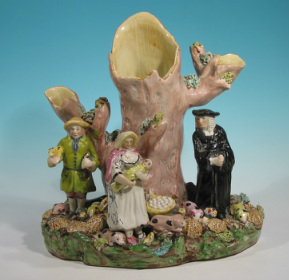
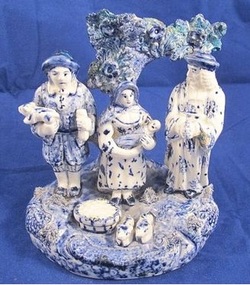
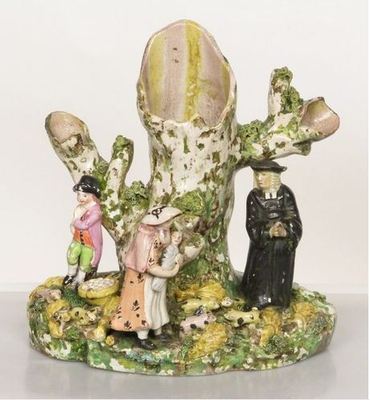
First, a tithe pig group (item 170844645654 while the listing lasts). Clearly the enamels are bad, and the seller lists the flaws in detail, including the fact that the figure on the left has been "broken and detached." This tithe pig group starts at under GBP1, but in my opinion it is not worth even that. The boy on the left has apparently been glued onto the base....but the problem is, he doesn't belong here! There should be a farmer (who, along with his wife, is offering the tenth child to the parson). This is what the group should look like. The fine example, above, is from John Howard's Sold Stock Archive. Once you have seen The Real Thing, could you possibly want the eBay offering in your home?
The second item is described as a "pearlware mummer figure, v v rare." (Item 16080387316 while it lasts.). Currently this item is at GBP51....and rising, with a good while to go.
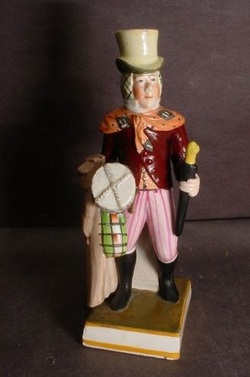
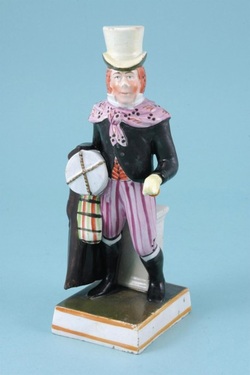
Actually, this figure represents the great comic actor John Liston in his role as Lubin Log. The seller says the head has been off, the hand and arm are restored, and the maroon coat is a suspect color....but nothing came off when it was scraped with a penknife, so the seller says it is OK. OUCH!!
Figures of Lubin Log are obtainable in very good condition at a very modest price. Why would you want to buy this one? And why would you want to buy anything from a seller who is so unskilled at detecting restoration that he has to scrape with a penknife to assess enamels?
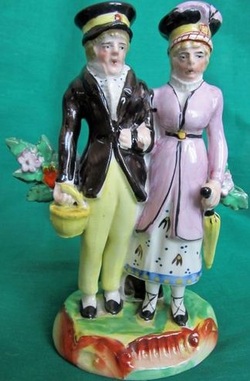
The fine figure of Lubin Log on the left is just one of the many that Andrew Dando has had in the past. These figures fall into the lowest price tier I am using in the price guide for my new book. Note that Andrew's figure does not hold an umbrella. That's right, Lubin Log is not meant to have an umbrella....something the eBay seller clearly didn't know! Third, is a tithe pig group (item 110881937786 ) described as "19th century." This beastly thing is reproduction. It is certainly not an early figure. The problem is that I am not sure if it was made in 1979 or 1899....so I can't argue whether it is or is not 19thC. I hope the buyer decides to toss it. The same can be said for this figure, described as "antique small Darby and Joan" (item 380440629920.)
This pair are offered as dated mid/late 1800s, but I think they were made in the 1900s....there just is no way of knowing the exact date. The seller has two pairs of these nasties on eBay. Bidding on this one starts at GBP145. I could go on forever just about THIS week's eBay offerings, but you get my point. Beware! I know sellers are often ignorant rather than dishonest, but please be careful on eBay. Consider money you spend a consumption rather than an investment. And if you are unsure, ask me.
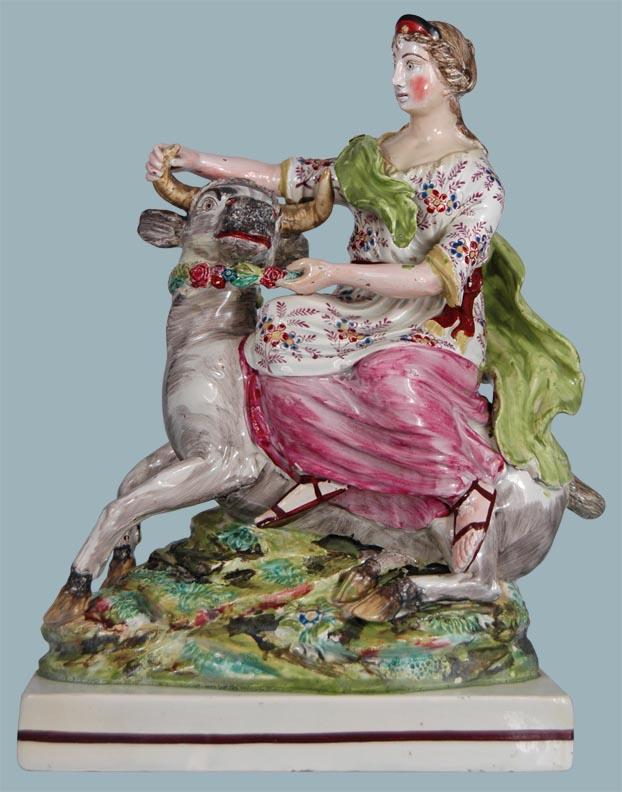
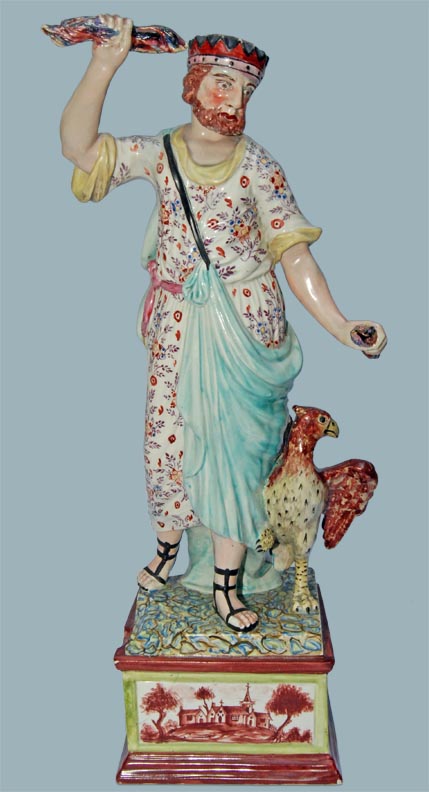
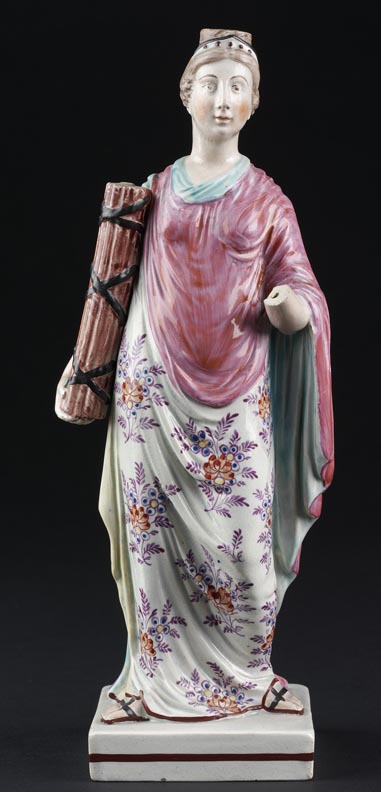
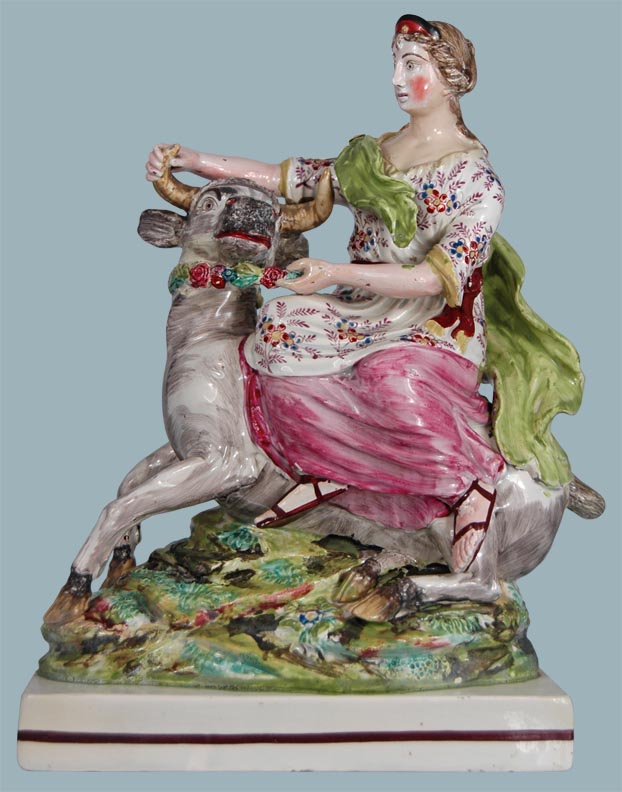
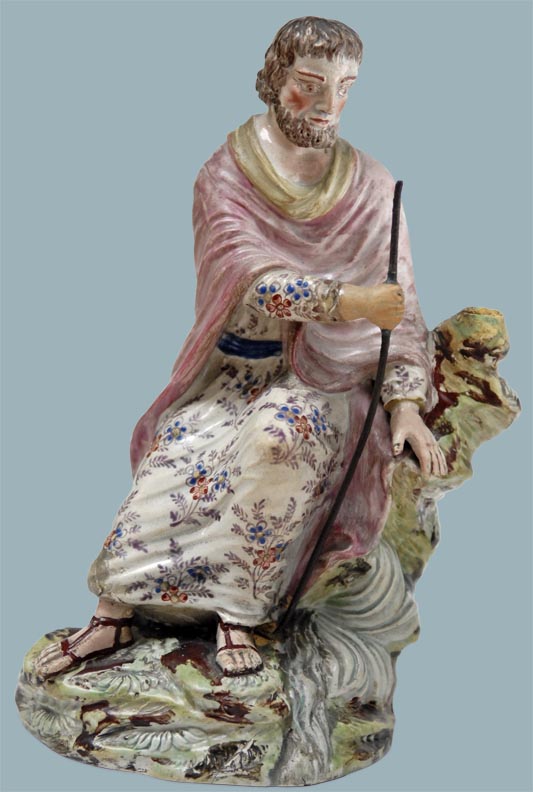
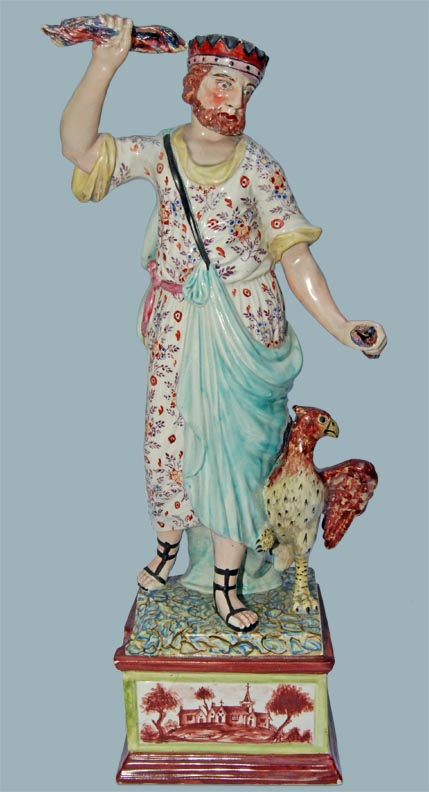
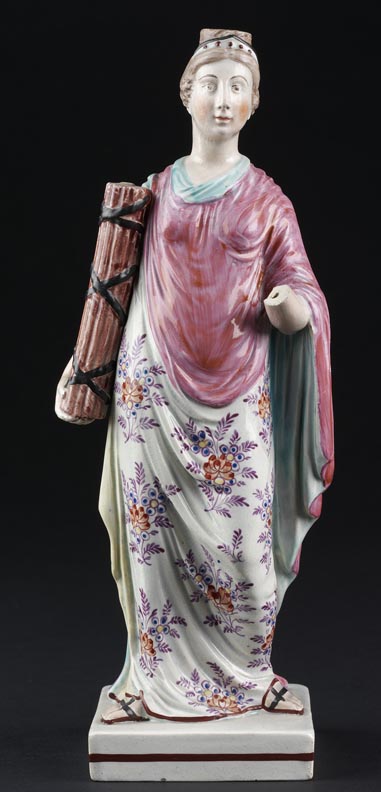
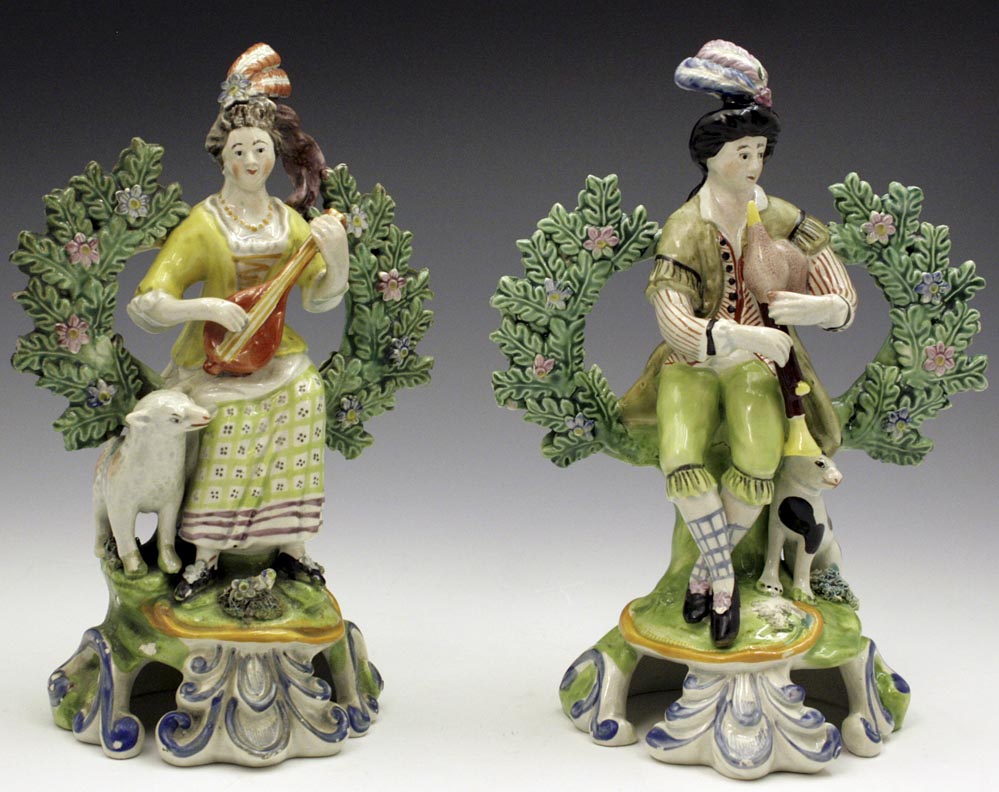
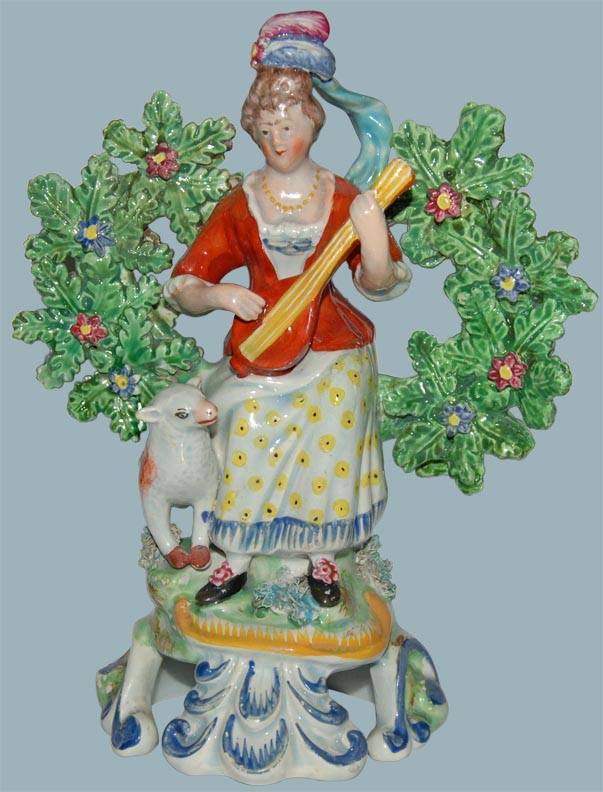
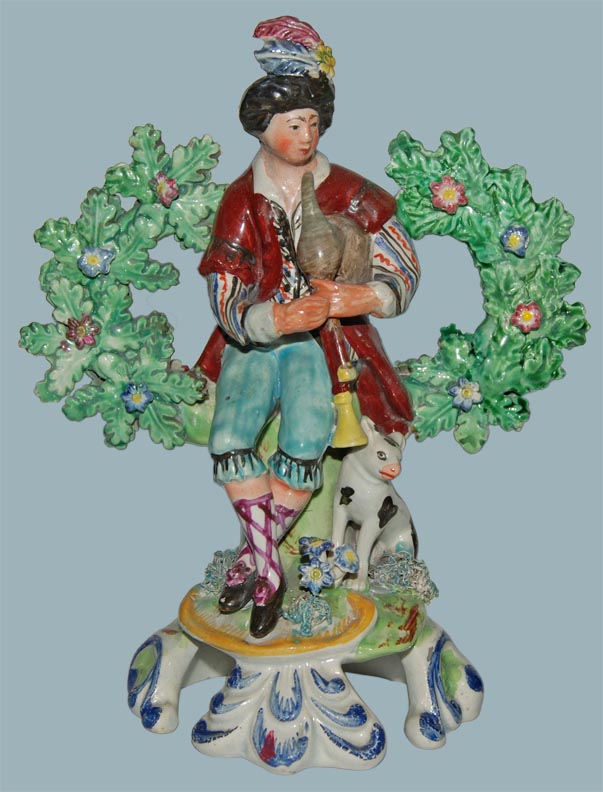
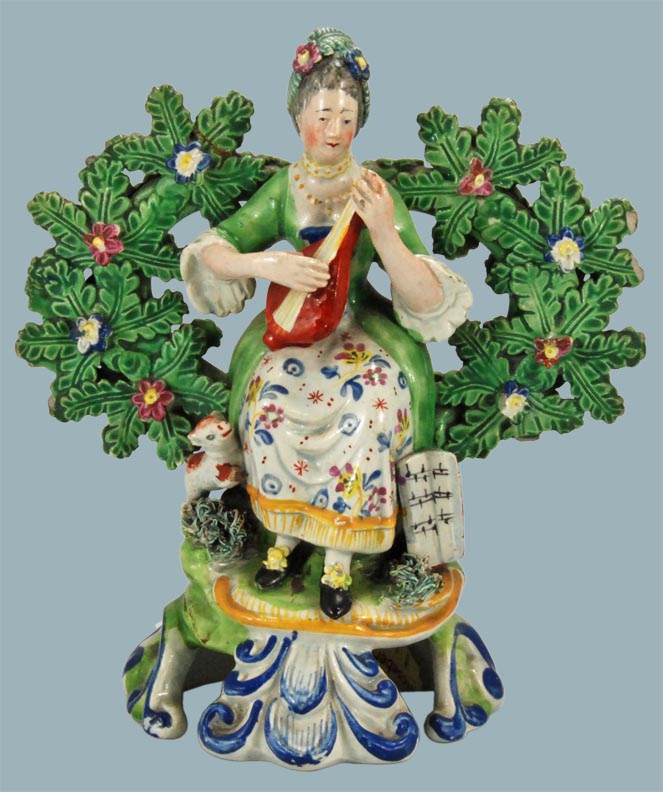
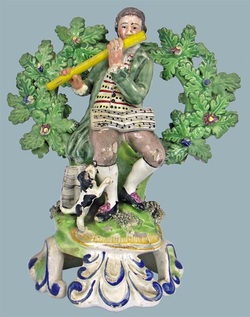
Last week, we looked at four related musicians. This week, we have four seemingly disparate figures that again have something in common. The first figure is Elijah, and I have not seen another example of this figure decorated with enamels. I have seen an Elijah from these molds in underglaze colors, but definitely not enamels. The second figure is Europa and the bull. You will find her discussed in the blog of 5.3.2011. She is the only example of this figure that I have seen. The third figure is Jupiter, and he stands upon a plinth base with transfer prints on each of the four sides. I have not seen another figure on a plinth decorated in this way. The fourth figure is a figure emblematic of Liberty in the Victoria & Albert Museum, London. This is the only recorded example of this figure. Each of these figures is rather special. Each is exceptionally well made and decorated, and each is the only recorded example of its kind. The figures share one tantalizing detail. Look at the pattern on the clothing. In each case, the floral pattern on the clothing is identical or has a number of identical elements. These figures appear to have been painted by the same hand. Because painters could change employers, we don't rely too much on painted details when attributing figures to manufacturers, but in this case I am reasonably certain that these figures originated from the same pot bank. Sometimes the weight of circumstantial evidence tips the scales. I wish I had a definitive answer, but meanwhile I thought you too might like to ponder the problem....and enjoy these four fabulous figures.
This pair of musicians (from John Howard's stock) was made circa 1820. They are after Derby figures of circa 1770. These musicians often occur in pairs, but on rare occasions you may find a trio. The third figure is usually a male playing a flute. In reality, there are four figures on this musical theme. There are two pairs, as seen below. At first glance, the top pair is like John's pair, above. The bottom pair has a man playing the flute, and a lady again playing the guitar. The bottom pair of figures was also made circa 1820, again after Derby originals introduced circa 1770. In other words, Derby made two pairs of musicians, and Staffordshire figures mimic those Derby examples.
I think--just a gut feeling--that the lady in the lower pair (I call her the lady-with-small-sheep) is the least common of the figures, but her partner tends to be more readily available. Because he floats as an "odd", it is nice to add him to the top pair, to make a trio. But for those of you who are over-achievers, go for a quartet.
I will admit that these musicians are as clear as mud at times. Look at the three ladies. The first and second have the same bodies, the same large sheep etc.---but their faces are different. The third lady, on the other hand, is from quite different molds....yet she has the same head as the first lady! Seems that a bit of mixing and matching went on here. In any event, there are apparently two ladies and two gentlemen, any way you look at it. If you have any insights into this, please share.
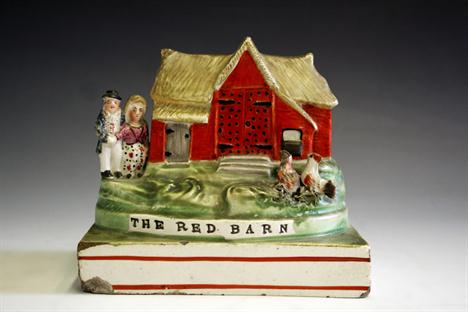
Less confusing, is this astonishing piece of real estate that came up for auction recently. This is an unrecorded example of the Red Barn, attributable to "Sherratt." The little couple to the side are unique and do not appear within any other setting. This gem measures about 5" across (just a tad wider than my iPhone!) and sold to the trade for about GBP5000. I wish I had it on my shelf and doubt we will ever see another.
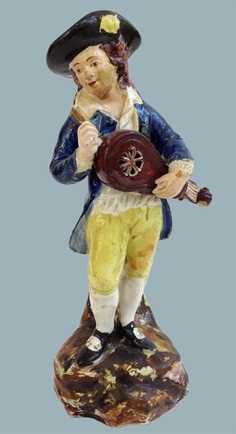
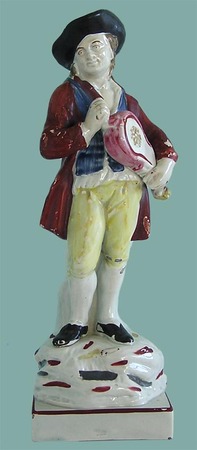
I have come to know many collectors via the Internet, and this past week I was thrilled to meet one of them face-to-face when I lectured in Houston. Of course, I couldn't wait to see my collector friend's treasures, which included a lovely figure of a hurdy-gurdy player. Below, this figure is on the left. Alongside on the right is a hurdy-gurdy player, formerly in the stock of Andrew Dando.
All hurdy-gurdy players are after the Ralph Wood figure sometimes titled Flemish Music. Ralph Wood was the first to make this figure, and all subsequent examples seem to have derived from the Ralph Wood molds. I have recorded an example with an Enoch Wood mark, and one with a "WEDGWOOD" mark, as well as an example I attribute to Dudson. Again, all are very like the Ralph Wood model.
The hurdy-gurdy player in Houston, however, differs noticably from anything I have seen before. He has a broader face--quite a friendly, smiling face. The detailing on his clothing is different, indicating that different molds were involved in his manufacture (at least from the waist up). And the sound box on his hurdy-gurdy is well-defined and it is actually cut open. I recall Andrew Dando telling me he had seen this feature on a hurdy-gurdy player in Pratt colors quite recently, so perhaps there is a relationship. Finding this figure made my day!
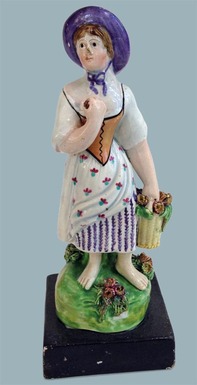
My friend also has this charming figure in his collection.
The figure is emblematic of Spring. That purple bonnet is super, and the lady has a riveting expression that is very engaging. My fingers immediately recognized the feel of the enamels and glazes. Such enamels and glazes occur on a group of figures that routinely have buff-colored bases. I have dubbed this group the Buff Base Group--yes, I know, hardly an imaginative name! And yes, I know, my friend's figure of Spring has a black base. But in every other aspect she is attributable to the Buff Base Group. Below, is an example on a buff base, alongside other figures emblematic of the other three seasons. Note that both Buff Base Group figures of Spring (one on a buff base, one on a black base) have the same flowers on the bases. I am certain that these figures once started life in the same pot bank. I wish we knew the potter's name, but for now we shall just have to lump his work beneath the umbrella title of the "Buff Base Group." BTW, the figures of the Seasons belong to another great collector I have met on the Internet, and we all learn so much when we share in this way.
You might like this small gardener from the Buff Base Group. I hope this additonal picture helps you get a sense of the enamels and glazes that occur routinely on examples from the Buff Base Group. When I started assembling this Group of figures, I dubbed the Group the "Gray Base Group" because most bases are gray. However, colors are never consistent and some of the bases appear an almost yellow color, so the Gray Base Group quickly became the Buff Base Group. The addition of a black base throws a spanner in the works, but at this point the Buff Base Group will keep its name. On a last note, my Houston friend could not have been a more charming host. We had a wonderful dinner at his home, and I wish you could have seen the flowers on the table--and in particular the figures among them. Four figures emblematic of the four seasons coupled with four cherubs. What could be more gorgeous? If you go to Houston, visit Bayou Bend. To my delight, the collection holds two marked Ralph Wood busts, a Ralph Wood figure of Dr. Franklin (impressed "43"), a pair of the boxers Cribb and Molineux, and a host of other delights.
|