Picture
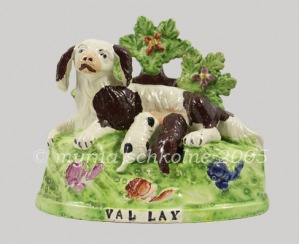
Staffordshire hollow-based bocage figure titled VAL LAY.
This pearlware figure group is unique. A sweet little spaniel together with her pups, it is in the "Sherratt" style and titled VAL LAY. Val's discovery some years ago helped my friends Malcolm and Judith Hodkinson complete a puzzle. Malcolm and Judith owned a similar little dog titled ROVER &. Of course, placed alongside my figure, the full wording reads ROVER & VAL LAY. The meaning is subject to interpretation, to say the least...but the pair are delightful. See them side by side in my book.
Picture
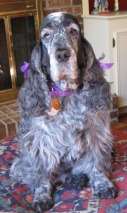
Madeleine Schkolne Sep 6 1999 to Nov 24 2009
The rarest of all treasures and the very best of all dogs, my much-loved friend, Maddie, who wagged her tail for the last time on Tuesday afternoon.
 

Catty

11/24/2009

0 Comments

 
I am a dog person and could not have written my book without the constant companionship of my English cocker spaniels, Martha, Max, and Maddie. But I do think Staffordshire figures of cats are particularly spiffy. These are two of my favorites.
Picture
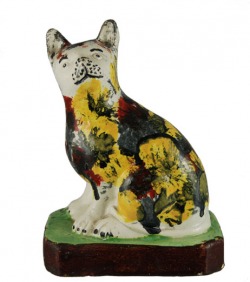
Staffordshire figure of a cat. H: 4-1/4'.
This plump pussy cat is very engaging. Looks you right in the eye, with a fat body that seemsready for cuddling. I love the marmalade enameling, and there is something about the roundness and weight that makes this figure sit comfortingly in the hand. Not a common cat by any means--but then early cats are rather rare. That's because the cat was not yet considered a domestic animal in the early 1800s.
Picture
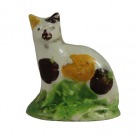
Small Staffordshire cat in the 'Sherratt' style. H: 2'.
This cat is quite small, yet again its round shape is life-lie and appealing. This one is in the "Sherratt" style. The sprig impressed into the green area of the base is found on other small figures made by "Sherratt"--dogs, sheep, deer etc. These animals all occur paired. But I have yet to find a cat to pair with this one. I live in hope!

But because ours is a doggy household, I end this posting with a pearlware figure of a dog. No turkeys, I'm afraid. Nonetheless, happy Thanksgiving to you, your dogs and your cats.
Picture
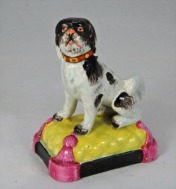
Pearlware figure of a pampered pooch. H: 3-3/4'
 

Updates

11/18/2009

0 Comments

 
If you have already read the posting below, please look again. I have updated it with a picture of the Four Elements, courtesy of a Collector. Also, Jim and Elizabeth Dunn of Bittersweet Antiques had a full set marked Walton in stock at the last SFA meeting, so contact them if you are interested in purchasing. And last but not least, if you skipped reading about the ongoing 'problem' in the luster market, please click here.
 

Water?

11/16/2009

0 Comments

 
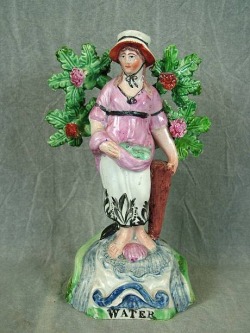
This lady holding fish in her lap is titled WATER. Sometimes this figure is found untitled, and then I am amused at auction houses' attempts to identify her. A fish wife is the most common dubbing, but it is far from correct.
Picture
Staffordshire figure emblematic of Water. Marked SALT. From the stock of Madelena Antiques. H: 6-1/2'.
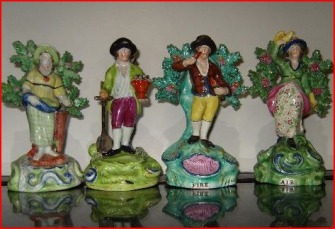
Why a figure symbolizing Water? Well, Water is one of the Four Elements--as are Earth, Fire, and Air. The potters made all four allegorical figures, possibly as sets, although when found thus today they have usually been united in recent times.
Picture
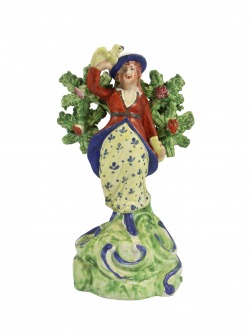
Staffordshire figure emblematic of Air. Marked SALT.
The figure above is emblematic of Air. Like Water, she is marked SALT but she is not titled. You were meant to know your classics in those days!

What of the other Elements? Earth looks as a gardener. Fire is a man holding a magnifying glass and stick of sorts--presumably to concentrate the sun's rays and start a fire. Several potters made very similar figures of each of the Elements from the same molds. Thus, I have illustrated in my book three examples of Fire--same bocages, same molds--yet each one has a different maker's mark on the rear. Walton, Salt, and Dale, and if you would like to see them side by side, flip to page 30 of my must-have book!
Picture
The Four Elements, courtesy of a Collector
What else did the potters make in fours? The Four Seasons, The Four Corners of the Globe (although so far we have only found two of them!), The Four Apostles.... I think that's it.
 
 
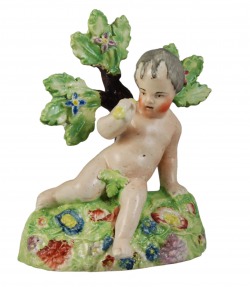
I admit that for a long while I didn't know the difference between a putto and a cherub. Still have to think about it. For those similarly challenged, a putto lacks wings, while a cherub has wings. Not much in it...unless you happen to want to fly. Anyway, the figure below is officially a putto.
Picture
'Sherratt'-style putto before an oak leaf bocage
This Staffordshire figure is no ordinary putto, for it happens to be in the "Sherratt" style. The distinctive base and the bocage leaves and flowers are found on other figure in the "Sherratt" family. The figure can be found facing left or right, so pairs are possible...but in my opinion, pairs were assembled later in life, so the figures were probably sold as singles.  These puttos occur on a variety of "Sherratt"-type bases (even table bases that are footed) and with varying typical "Sherratt"-type bocages. The mystery is this: what is the fat fellow clutching in his hand? A cigar?
Picture
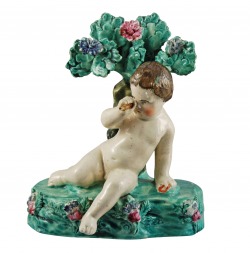
'Sherratt'-style putto in front of a turquoise bocage.
Here we have another pearlware "Sherratt" putto, but the base and bocage are different. Grab my book and look at the splendid "Sherratt" dandies on the cover. Like the putto, the dandies stand in front of a turquoise bocage and their base is also adorned with those signature "Sherratt" garlands. I really like this turquoise putto. The turquoise "Sherratt" bocage has always been one of my favorites...and those garlands make me melt each time.

Note that the turquoise putto has lost the large fig leaf found on the first putto--yes, the same fig leaf used for obvious purposes by nude males in classical sculpture. And the turquoise putto brings us closer to figuring out what our plump friend is doing. Can  you see that the object in his left hand has been carefully painted in red? I think it is intended to be a magnifier--and this ties in with my suspicion that the object in his raised hand is a kaleidoscope or small telescope of sorts. I have still not been able to link this to any classical connotation, so if you know please shout.
 
 
Picture
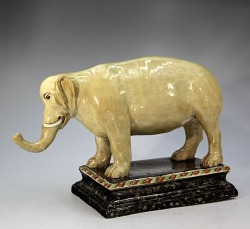
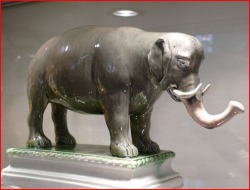
Splendid enamel-painted Wood family elephant for sale by John Howard. Probably made by Ralph and/or Encoch Wood in the 1780s.
Did you notice this very rare figure for sale by John Howard. It is an early example of an enameled Staffordshire figure. The first examples of this elephant were decorated by merely coloring the glazes--and today these too are desirable figures. But an enameled elephant was costlier in its day because it required more careful painting and an additional firing. No sloshing on of colored glazes and popping it in the oven.
Picture
Wood family elephant decorated more cheaply in the limited colored-glaze palette
To make an enamel-pianted Staffordshire figure, the figure was formed, fired, dipped in clear glaze, and fired again. Only then could the enamels be painted atop the glaze, and the whole thing fired yet again. To complicate matters, some enamel colors needed high firing temperatures, while others needed lower firing temperatures. Consequently, there might be several enamel firings, starting with the highest temperature firing first. All this was an expensive process, and an enamel figure was costlier than its colored glaze counterpart. The fact that a figure emerged unscathed is, to me, a miracle. And in those days, there was no means of measuring kiln temperatures, so 'getting it right' hinged on the skill of the man who fired the kiln.

John Howard's elephant is a model that was made by the famous Wood family of Burslem, probably Ralph Wood. As noted, it was also produced in colored glazes typical of Ralph Wood figures. But the enamel example is especially rare. I have only been able to trace one other. It appeared in Jonathon Horne's Exhibition Catalogue in the early 1990s.

If you are thinking of buying this figure, remember that an elephant with a raised trunk is a symbol of good luck!

Think the elephant was an unfamiliar site on Britain's shores by the 18th century? Think again!

  • In 1255, under the watchful gaze of the crowd that had traveled from afar to see it, the first elephant, a gift from the French king, landed on British shores. That same year, Henry III notified the sheriff of London, “We command you, That of the Ferm of our City, ye cause (without Delay) to be built at our Tower of London, one House of forty Foot long, and twenty Foot deep, for our Elephant.” The elephant lived for just two years. 
  • In 1679, the scientist Robert Hook noted seeing an elephant carry a castle and man on its back on London’s streets. The motif of a castellated elephant had been used for centuries in the arms of Coventry and as the emblem of London’s Cutlers’ Company.
  • Displays of exotic animals were not only for the nation’s elite. By the seventeenth century, even ordinary people in distant towns were able to view the wonders of the animal kingdom, courtesty of traveling entertainers.
  • In 1793, Pidcock purchased a male elephant off a trading ship for a thousand guineas for his menagerie.


ANDREW DANDO ANTIQUES
Autumn Selling Exhibition
11am tomorrow (until Saturday 14th)
www.andrewdando.org/ad/


Truth

11/04/2009

0 Comments

 
Picture
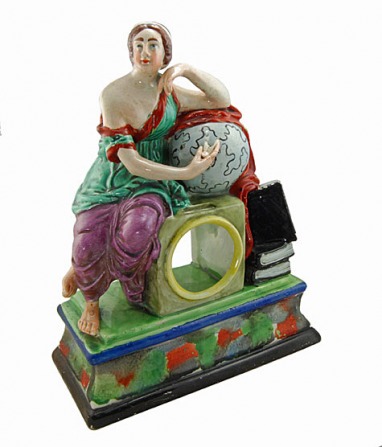
I never cease to be wow-ed by the beauty of this figure: A watch holder depicting Truth as a female allegorical virtue. She reclines on a globe to indicate that she is above worldly matters; her partial nakedness expresses her simplicity. The object in her right hand (which looks more like a double pointer of sorts) is supposed to be a mirror, which always reveals the truth! The figure's formation as a watch holder is most appropriate for in allegory truth is linked to time: with time, all truth will be revealed.

So isn't she absolutely stunningly gorgeous? She is also quite rare, so don't expect a sighting on eBay at any time! A picture can't do this figure justice. At 9" high, it has great presence and an amazing dimensionality. The modeling is superb--just look at those arms. The enamels are dazzling, the painting is particularly meticulous. Aside from this example, I have only seen one other. Also, one is pictured in Earle, and on the front is painted THE GODESS OF TRUTH. I fuzzily recall one in an old Christie's catalogue, but then it may be one of the already-mentioned examples.

Our Staffordshire figure is pearlware, made around1790, probably by Enoch Wood either just before or during his partnership with James Caldwell. Do I know this for certain? No. Mere instinct based on seeing other Enoch Wood figures. Incredibly, this figure is perfect. Tiny chip to the edge of the mirror and that's it. Perfect survival after 200 plus years. A collector's dream.

I am uncertain of the design source for this figure. I seem to recall seeing a similar porcelain representation of Truth in Boston's Museum of Fine Arts. I do wish I could pop in and check. So if you happen to go to that museum, please look in the porcelain cases in the upstairs hallway and let me know. Meanwhile, I shall keep searching. Eventually, the truth will be revealed!