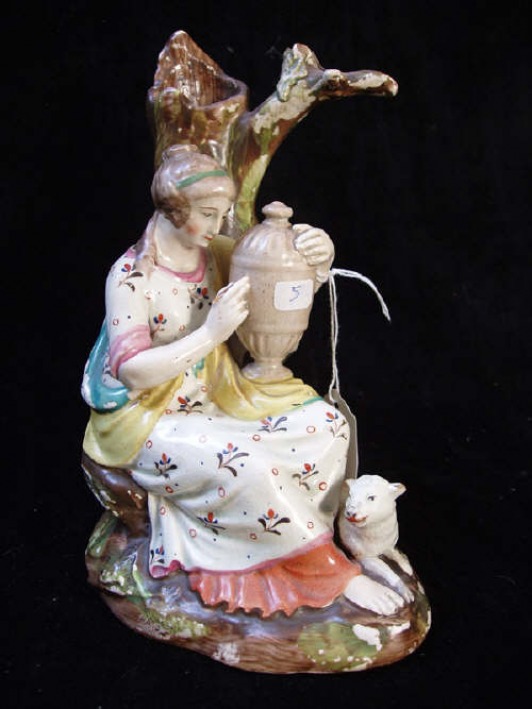
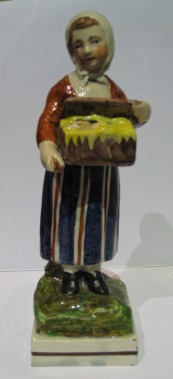
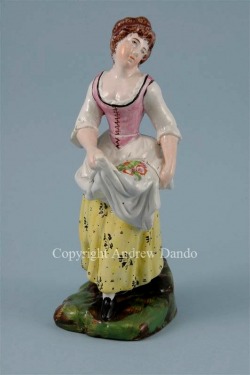
This sweet figure is no ordinary lass. Instead, she portrays someone well-known to the refined early 19th century home-owners who bought her. Her name is Iphigenia. Iphigenia was a character from the operetta Decameron. The figure was made by the Wood family from the late 1700s in both colored glazes and enamels, numbered 96 or 98 of 136.  Iphigenia. Decorated in enamel colours. H: 7 1/2". From the stock of Andrew Dando.
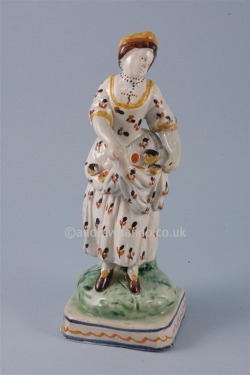
 Iphigenia. Decorated in underglaze colors. H: 9". From the stock of Andrew Dando.
In its first form, The Decameron is a novella written c1350 by the Italian Giovanni Boccaccio. It is set in Cyprus. Cymon, deemed a dolt by his aristocratic father, is sent to live and work among his slaves in the countryside and he becomes increasingly coarse. One day, he finds highborn Iphigenia, slumbering in a field. Cymon has never seen a woman before and he is so smitten by Iphigenia's beauty that his noble bearing surfaces and his father restores his rightful position in the family. But alas--and of course!--Iphigenia is promised to another, yet this tale of wars and abduction in the name of love ends happily with Cymon and Iphigenia united for life. In 1700, John Dryden published his Fables, Ancient and Modern, containing the story as a poem.
So from all this come Staffordshire's glorious Iphigenia--not a particularly common figure. And she reminds us that every figure has a tale to tell!
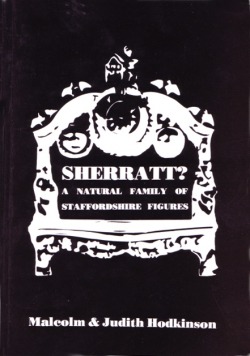
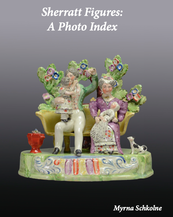
I have my new year resolutions (yes, plural!) ready to go and I suspect most of you do too. But for pottery enthusiasts, can I add one more? Please buy, read, and study the book on pottery that has taught me most. No, this is NOT a plug for my simply gorgeous book that I am sure sits at your right hand side as you read and every moment of your waking day. Instead, it is an endorsement for a little book that has taught me more than any other. Sherratt? A Natural Famly of Staffordshire Figures by Malcolm and Judith Hodkinson is my bible. In fact, I have worn out one copy and am onto the second!
So what is so special about this book? Well, it looks at figures in a different way. It links figures with distinguishing characteristics into a large 'natural family'--as is done in botany. The authors dub this family 'Sherratt'.
So who was Sherratt? Obadiah Sherratt, according to collecting lore, potted those large table-based bull baiting groups and as a result similar figures have traditionally been attributed to him. The problem is that there is no basis for the attribution because, although Sherratt definitely potted in the Staffordshire potteries in the early 1800s, he never marked a single figure he made! But, as the Hodkinsons show us, there is no denying the common relationship of these figures and we do need to call them something--and so for convenience we dub them 'Sherratt.' Perhaps someday we will learn whether this is indeed the true identity of the potter who made these undeniably related--and particularly appealing--figures.
So why is this book so important to collectors? Firstly, understanding what makes a 'Sherratt' figure protects you from buying a figure priced at a premium as 'Sherratt' when it is not. And secondly and more importantly, it opens your eyes to myriad details potentially linking other figures in your collection into natural families. This adds a whole new dimension to collecting. You will look at figures in a different way, always ready to spot the unusual and possibly unique.
When I first read Sherratt? A Natural Famly of Staffordshire Figures, I found it just a little challenging. But it sank in! Slowly, I started finding examples of the attributes the Hodkinsons have identified...and I now very definitely do know what is/isn't a Sherratt figure. So what are you waiting for? Make 2009 the year in which you accept the intellectual challenge of understanding figures as more than pretty things.
BTW, this book is still in print. If you need to know how to get a copy, please email me myrna@schkolne.com
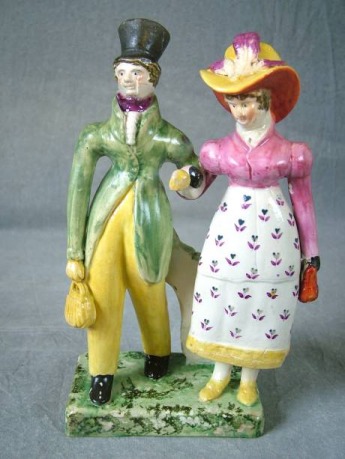
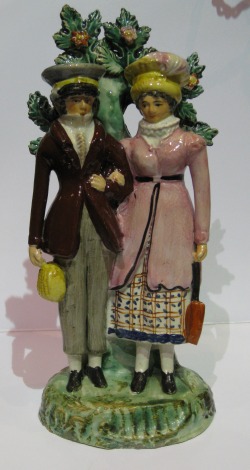
The years 1810-1830 were the glory days of dandies. This era of sartorial elegance created fashionable gentlemen who preened as never before. Appropriate attire for a dandy gentleman was a coat that fitted very snuggly at the waist--the waist was cinched with a corset if necessary. Beneath was worn a white shirt with high collar and a cravat that knotted with the utmost precision.
 From the stock of Madelena Antiques.
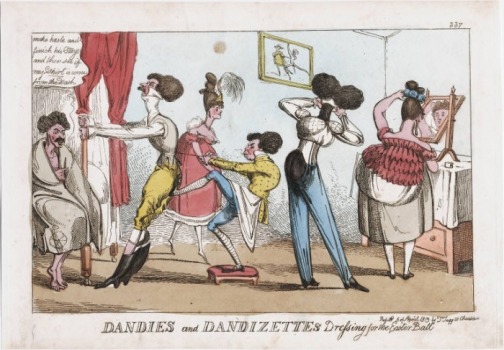
Trousers, loosely fitting, were appropriate for day wear. But for formal wear, tightly fitting pantaloons or breeches were mandatory. Pants had to fit SO snuggly that underwear was not worn lest it disturb fit. Pockets could not be allowed to rumple that sleek look, so dandy gentlemen carried little handbags called reticules for their 'necessary objects'--and we see earthenware dandies carrying them too. Another reminder of how different life once was!
 Getting dressed, 1820s style! Dandies and Dandizettes Dressing for the Easter Ball, published in 1819.
 Early 19thC Staffordshire figure depicting Agrippina with the Ashes of Germanicus. Height 20cms.
The Roman commander Nero Claudius Drusus was renamed Germanicus because of his victories over the German people. He was assassinated in Syria in 19 C.E. His wife, Agrippinna, brought his ashes back to Rome, determined to avenge his death. This subject was a popular one in the neo-classical period, no doubt inspiring this figure. Interesting factoids: 1. This figure is sometimes incorrectly dubbed Antonia with the Ashes of Germanicus. Antonia was Germanicus's mother but she is never portrayed with his ashes. I believe the mistake, which appears in Halfpenny p149, has been perpetuated over the years. 2. You may never had heard of Germanicus, but I bet you know who Caligula was. Germanicus and Agrippina were the parents of this cruel, perverted Roman Emperor.
This has been an exicting week in our home. Last night, our amazing, beautiful daughter, Andrea, got engaged to Will--THE most wonderful guy. We are so happy at the news....but I am appalled at having to plan an elaborate wedding. I'm not sure I signed up for this when I gave birth! Anyway, inevitably my thoughts turn to earlier weddings captured in clay, and early Staffordshire figures do give us delightful peeps into the past. Believe me, weddings were so much simpler then.
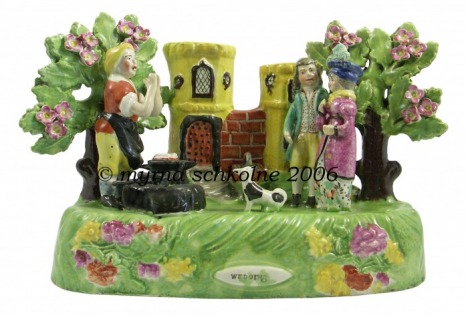
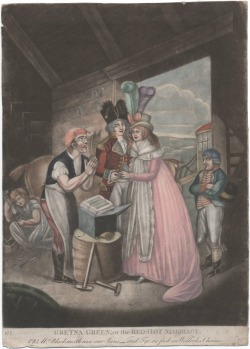
In the early 1800s, England had very rigorous marriage laws. A couple not wanting to comply had an alternative: they could simply flee to Scotland where, providing they had reached 16 years of age, they could plight their troth in the presence of any two witnesses and be married. The first village across the Scottish border on a major roadway was Gretna Green--and the blacksmith's shop on the outskirts of the village was a convenient stopping point for couples fleeing irate family, intent on stopping the union. The romantic notion was that the blacksmith, who forged hot metal at the anvil, similarly forged binding unions. Tales abound of the blacksmith being awakened in the middle of the night to marry a couple before their parents could stop it. One tale tells of there not being enough time for the ceremony, so the blacksmith bundled the couple into bed and the family, arriving to find this, assumed the couple had already wed.
 Staffordshire figure group depicting a Gretna Green marriage. In place of a parson, a blacksmith performs the ceremony at his anvil. Circa 1820. The base, bocage, and open turreted spillholders are all hallmarks of the 'Sherratt' style.
From the 1790s the mezzotint (above) circulated, depicting an anvil wedding. Titled "Gretna Green or The Red Hot Marriage", it probably inspired the Staffordshire figure group. And I wish it would inspire Andrea and Will to consider a much simpler wedding day.
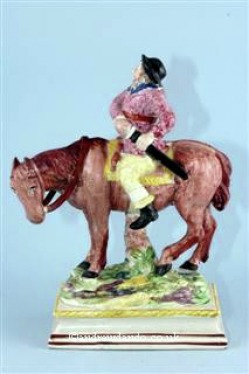
Equestrian figures are particularly impressive. They wow not only the eye but also the mind, for one must marvel at the technical challenges their manufacture posed. This handsome figure of Hudibras is no exception.
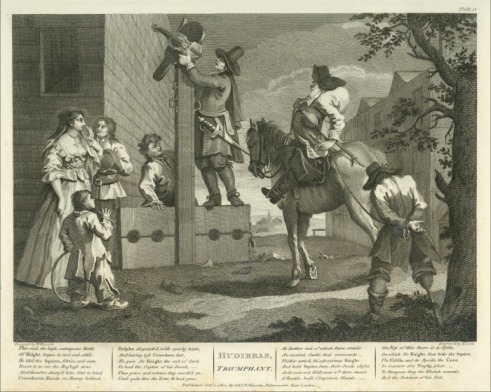
 Enamel-painted Staffordshire figure, circa 1800, depicting Hudibras on horse back. Height approx. 11 inches. From the stock of Andrew Dando. Hudibras was a goofy, zealous knight in a satirical poem of the same name set during England's Civil War. Samuel Butler wrote Hudibras in three parts between 1663 and 1678. In 1721 and 1726, William Hogarth illustrated new editions of Hudibras and these remained popular for another century. The Staffordshire figure of Hudibras was inspired by Hogarth’s engraving of Hudibras leading Caldero—he captured the latter at a bear baiting. Hogarth's images were popular for many more decades and in turn they inspired earthenware look alikes.
 Hudibras, Triumphant published by G& I Robinson in 1802
Staffordshire figures of Hudibras are generally of the same form. The molds were made by the Wood family in the late 18th century. John Wood lists a Hudibras decorated in colored glazes in his order book for 1786 and enamel-painted versions could date from around that time. Now I know it's all a matter of taste, but I prefer the enamel version hands down. The colored glazes are too insipid for such a dramatic figure. And the early, soft enamels on Andrew Dando's Hudibras are simply delicious, aren't they?
I returned in the early hours of this morning from the Wolfson Children's Hospital Antiques show in Jacksonville. This annual event that raises almost $1m for the hospital it benefits. What a razzle-dazzle extravaganza, thanks to the hard work of the 300 women who make it happen. I enjoyed lecturing to a surprisingly large crowd...but the highlight of my time in Jacksonville was my time with collectors.
Elinor Penna represented Staffordshire at the show. The show's theme this year was The Circus, and Elinor had a dazzling display of circus animals and personalities. I have never seen her stand look prettier. Of course early figures were very well represented too...and business seemed brisk. I am kicking myself for not photographing Elinor's stand for you, but here are some shots of figures Elinor had for sale.
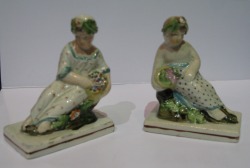
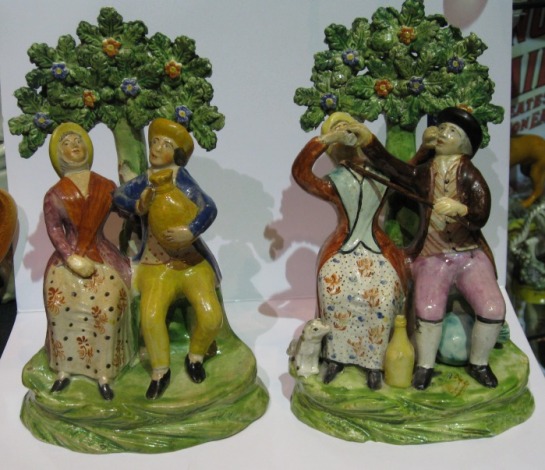
 These are a true pair--so uncommon to find a pair that have been together always. Why am I so sure? Apart from matching in all detail, they each have a painter's mark, the number 89, painted in red beneath!
 I thought these particularly coloful and they sit well together. They are different sizes. The larger is 6" tall, the smaller 5". Sweet? BTW, this is just a snap with my pocket camera. hence the make-do background. I measured the heights by laying the figures on a paper napkin, marking the heights on the napkin....and measuring at home!
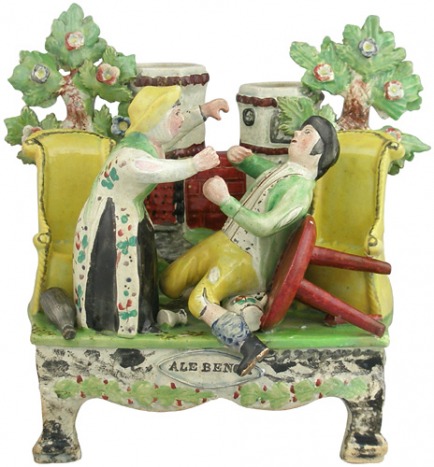
 Ale Bench and Teetotal groups. So unusual to see them as a pair in this form.
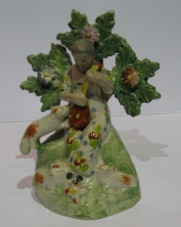
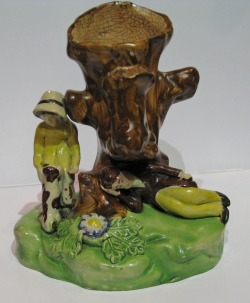
The little shepherdess above is in the 'Sherratt' style. Multiple features link her to the large body of figures we attribute to a potbank called 'Sherratt'--only for convenience. We wish we knew who made these figures, we would like to think they were made by Obadiah Sherratt, but we will probably never know.
The pair of dandies below measure 8".
And a last glimpse of everyday life, as it once was.
 Staffordshire Ale Bench, c1830. Courtesy of Sampson Horne, London.
Let me preface this by saying I love England, problems and all, so my reference to its 19th century national problem is not intended to cause offense. But in the early 1800s, the country faced a crisis: nationwide, public drunkenness had gotten out of hand.
The English had always had a predilection for booze--or as Shakespeare's Iago had commented, "In England they are most potent in potting." Foreigners had long noted that the English consumed prodigious amounts of booze. An 18th century visitor wrote, "I have seen a Lord whom they call the moving Tun of Claret that hath not been sober six Hours together these twenty Years."
In all fairness to the tipplers of those bygone days, the water supply was generally putrid....so what better to drink than beer? Children drank beer, hospitals gave it to patients and workers received daily quotas. A ruddy complexion equated with good health and beer drinking was not considered problematic--so much so that by 1810, England and Wales had around 45,000 licensed drinking places and the nation was awash in suds.
But a far more lethal problem lurked: gin drinking. By now, England's gin epidemic had raged for decades. Whereas drinking beer was believed to be wholesome, drinking gin was recognized as dangerously addictive. And here we have another instance of government meddling going awry! Parliament noted that, despite France's abundant cheap wine, the French were surprisingly sober. Perhaps abundant cheap gin would do the same for England. So in 1825, parliament slashed the duty on all spirits by a whopping 40%. Instead, people were driven to drinking cheap gin instead of beer and the nation tippled further over the cliff of public drunkenness, violence, illness, and crime.
The Temperance Movement was born in the late 1820s. It's founders were middle class reformers and they didn't want to abolish drinking--but they did want to end intoxication. How? They believed that drinking beer instead of spirits would lead to a merrily sober society, so the Temperance Movement set about promoting beer as a wholesome temperance alternative.
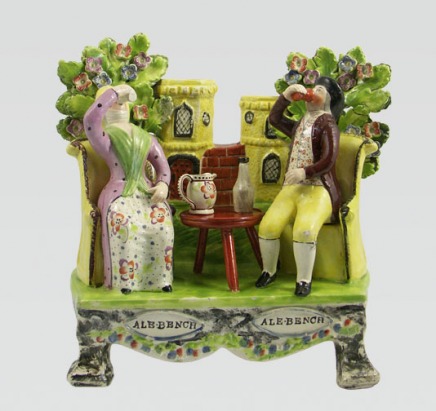
Today, Staffordshire's charming Ale Benches recall that era. These figure groups must have graced the mantles of middle class do-gooders who supported the Temperance Movement. A badge of pride almost.
 Staffordshire Ale Bench, c1830. Image © myrna schkolne 2006
And here we have beer drinking, Temperance Movement style. Done with great sobriety! BTW, the round table in the center of this group is SO frequently lost. I have seen the figure without the table more often than I have seen it with its table.
Both ale benches illustrated here are in the 'Sherratt' style. In other words, they share attributes common to the large body of figures that originated from a potbank we name 'Sherratt' for convenience. Specifically, the distinctive bases, the turrets that serve as spill holders, the bocages, the titled plaques, and the dress patterns help us attribute these figures to 'Sherratt.'
|