When we entertain, I decorate the table with Staffordshire figures.  A small sheep at each place setting is an easy way to go, and, if I have the time, I create a scene on a large silver tray topped with moss (for grass of course). The scene on the tray depends on the occasion. Bridal showers are my favorite because out come the Gretna Green wedding, the New Marriage Act etc.  Flowers in little florists' tube tuck into the spill holders....all this is meant to take attention away from the food because I hate cooking, but I want things to look pretty-pretty.

Our family doesn't celebrate Christmas, but last week I couldn't help wondering what I would decorate the table with if Christmas were my "thing."  Top on the list would be a Madonna and Child. I hunted around, and by some miracle this gorgeous figure is on Aurea Carter site, just waiting for a home. I think this is one of the most beautifully modelled Staffordshire groups of all time. 
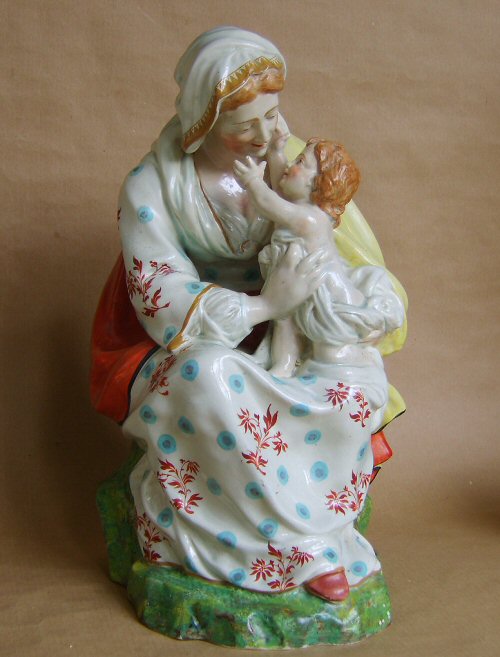
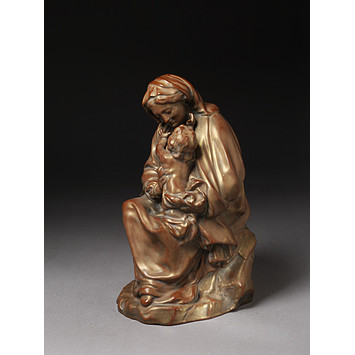
Examples of this groups are attributed to Enoch Wood or to Wood & Caldwell. The existence of marked WOOD & CALDWELL examples verifies the attribution. Below is a bronze glazed version marked thus, in the Victoria and Albert Museum, London. 
This group of the Madonna and child is after a 15" terracotta by the baroque Flemish sculptor, Lucas Fayd'herbe that was at Gopsall Hall from 1773 to 1918 and is currently in the British Museum. The final work, a marble, is in the Rockoxhuis, Antwerp. The terracotta differs just slightly from the figures above. The difference is that the terracotta sits on a square base. 

Some earthenware figures of this Madonna and Child are on square bases and they are so very like the terracotta that the molds were probably made directly from it--the size difference could be accounted for by shrinkage in firing.  Below is an example on a square base, formerly in the stock of Andrew Dando. 
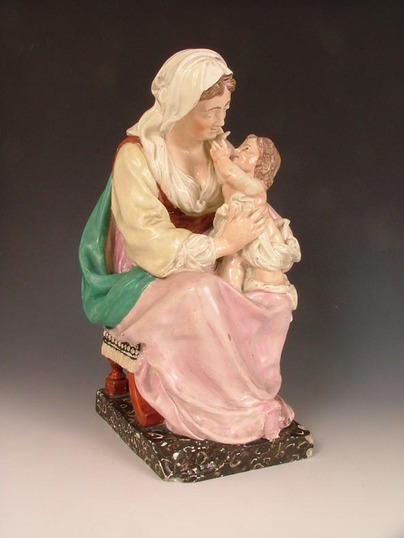
Note that groups on square bases have the Madonna seated on a chair with free-standing rear legs. All examples on square bases are also attributed to Enoch Wood/Wood & Caldwell. An enamel-painted group on a square base in the Potteries Museum is marked Wood & Caldwell.  

Below is another example of this Madonna and Child on a square base. This group is in the Fitzwilliam Museum, Cambridge. Play the slideshow and you will see both the front and back.
I suspect that Wood & Caldwell/Enoch Wood made the first examples of this group on a square base, with the Madonna sitting on a chair, just like the terracotta. But it didn't take long for them to wise up to the fact that a green mound was easier and probably prettier. So the Madonna was relocated. Both versions of the figure are simply lovely, they all date from around the same period, so choose whichever. And I hope it inspires you to decorate your table with Staffordshire figures next Christmas.
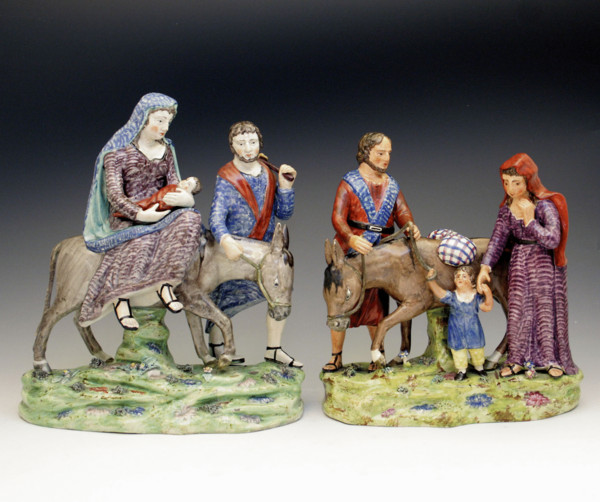
 
 
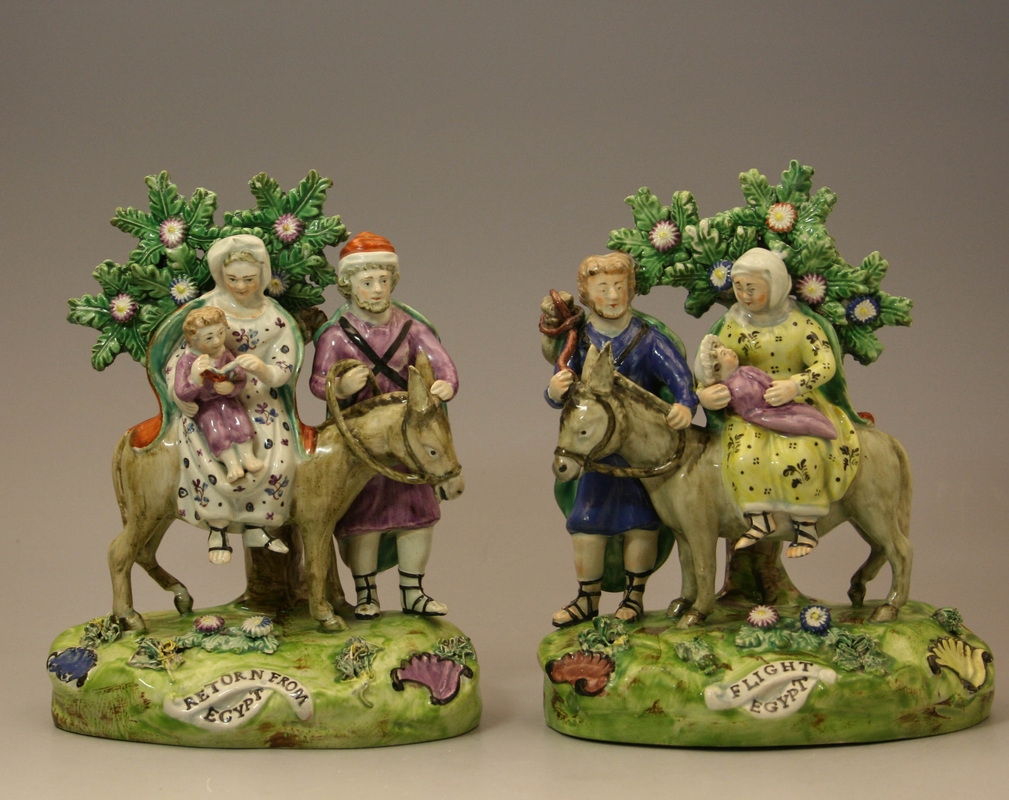
In the holiday spirit? If you celebrate Christmas, you may want to put these under your tree. Fresh into the stock of John Howard....I think we need a blast of angel trumpets to herald these.
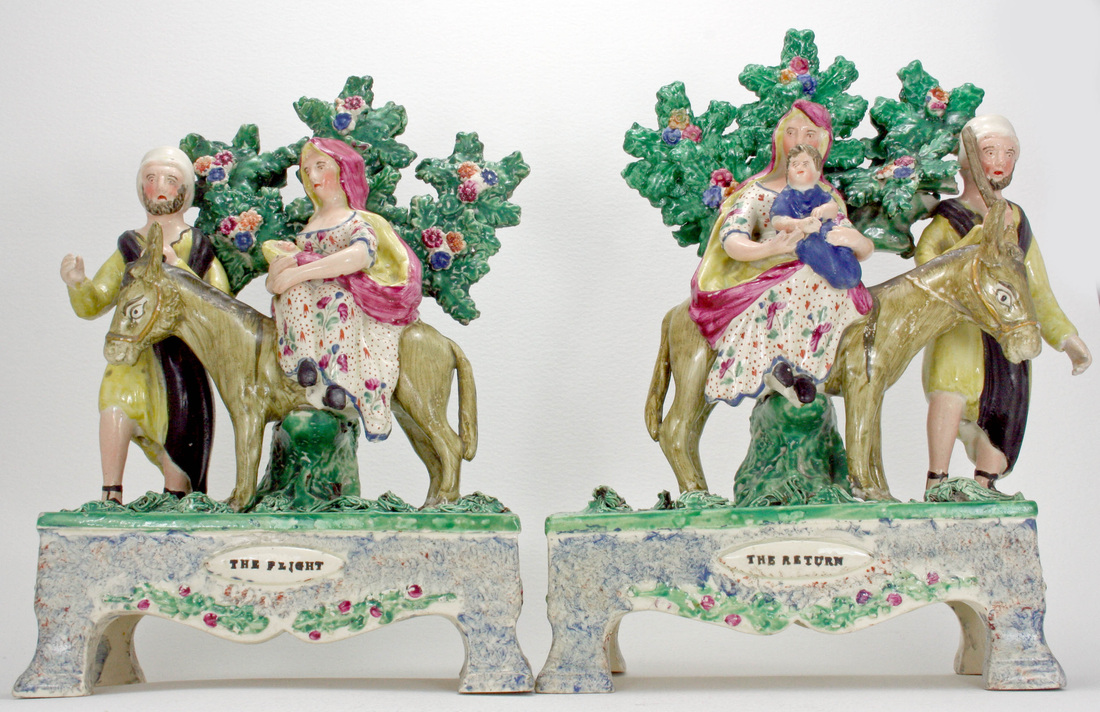
This pair of figures portraying the Flight to Egypt (left, note Jesus is a baby) and the Return from Egypt (right, Jesus is an older child) is far from the usual. Firstly, they are bigger than the typical model, which stands at around 8.5" with bocage. Instead this pair measure 10.5" max--and no bocage. The figures are on a much larger scale, and, while not overwhelming, make an impressive statement. Yes, they were DEFINITELY made without bocages. I have never seen these large Flight and Return figures side by side before. Somehow, they more commonly occur as singles, but then they really don't occur that commonly at all!

Another oddity about this pair: As they stand, the Flight is on the left, the Return on the right. Most of the smaller examples are made the other way around. Why does this matter? Well, it doesn't....BUT when the examples are titled and you want them to read correctly, you have to stand the donkeys tail to tail.
See what I mean?  As you read the titles, your eye REALLY wants The Flight on the left and The Return on the right...but then the donkeys stand like this. BTW, the above are a "Sherratt" pair from my archive.

Below the pair stand correctly, donkeys nose to nose....but the titles read counter intuitively. A gorgeous pair, marked "WALTON" from John Howard's archive. Too late, too late--these are sold.
Ah well, let's put this down to the idiosyncracies of pottery.

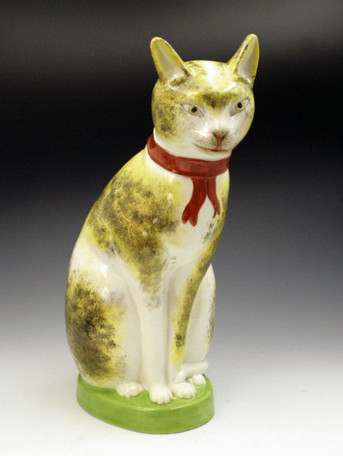
If Christmas is not your thing, don't despair. You can still give yourself a larger-than-most figure by buying John Howard's cat.
Now this kitty is a whopping-but-not-unattractive 14" high. Early Staffordshire cats are uncommon, and usually occur lying on a little pillow. I have recorded three seated cats of about 5" in height. All else is smaller....except for this kitty. Fabulously modeled, is it not?  John tells me that a long time ago a reputable source told him of an example of this cat marked Copeland & Garrett...so that attribution seems reasonable.  I am firmly in the Dog Camp, or I would be tempted. But if you want a cat, no vet bills, no food need....this is for you.

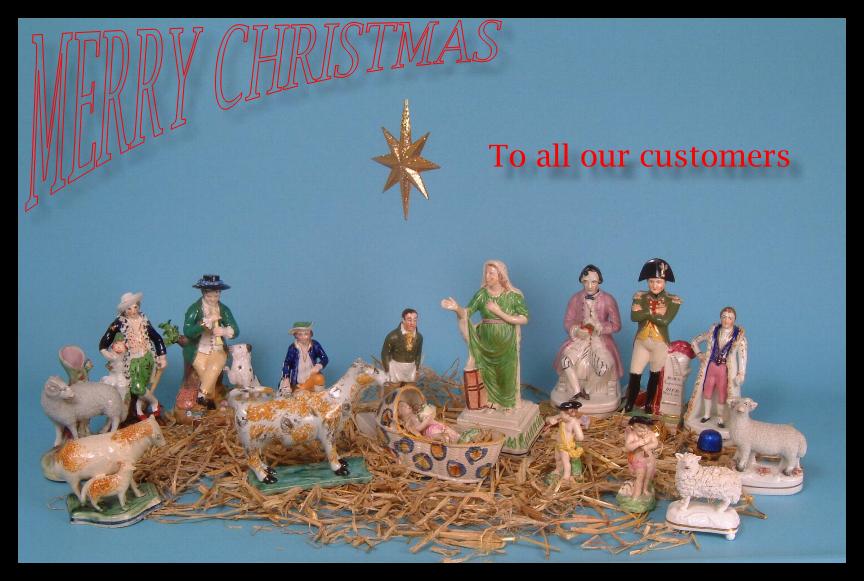
Andrew Dando has a fun nativity scene on the greeting card on his site.  
Is that not terrific and quite inspirational? Thank you, Andrew!

As you browse dealers' stock this week, remember that a pottery figure--be it for you or for someone else--gives a lifetime of pleasure. It is truly a gift that keeps on giving. 
 
 
The Bawdy Barmaid is the title given to a figure that was, in its time, considered erotica. By today's standards the figure is quite tame. The first example I saw was Victorian and a bit late for my taste. The lady looked just like a barmaid, but if you flipped her over there was a hole between her legs. This, apparently, was enough to get Victorian gentlemen in a twitter.

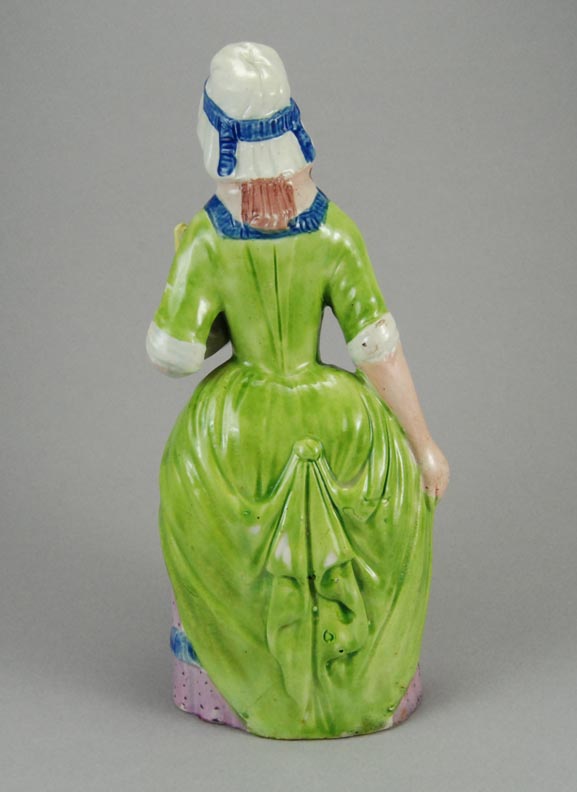
When I was at the Potteries Museum some visits ago, I noticed an early Bawdy Barmaid, beautifully enameled in a Lakin and Poole type palette. Quite yummy. Frankly, I can't remember what went on under her dress, but I assume that the naughty hole was present. What I do remember is that her dress was draped very prettily at the back, and I thought "Hmm, Myrna, wouldn't this look good in your collection?"....so I have been watching.

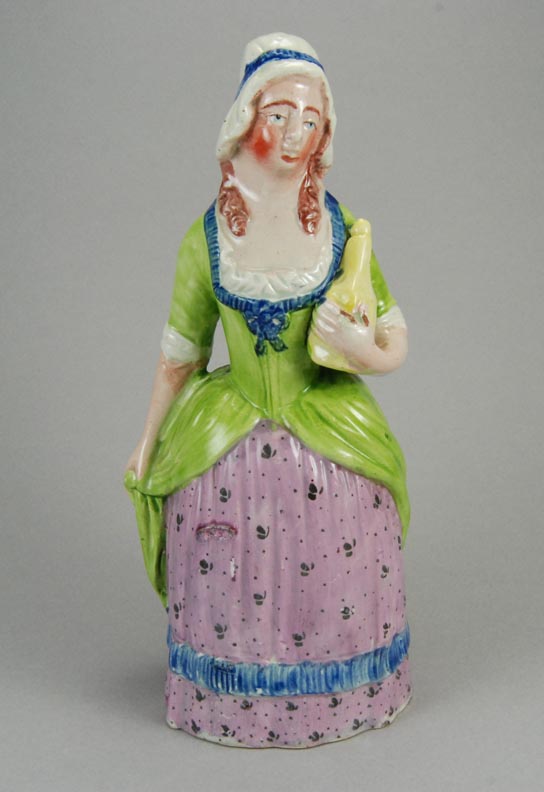
This Bawdy Barmaid now sits on my shelf.
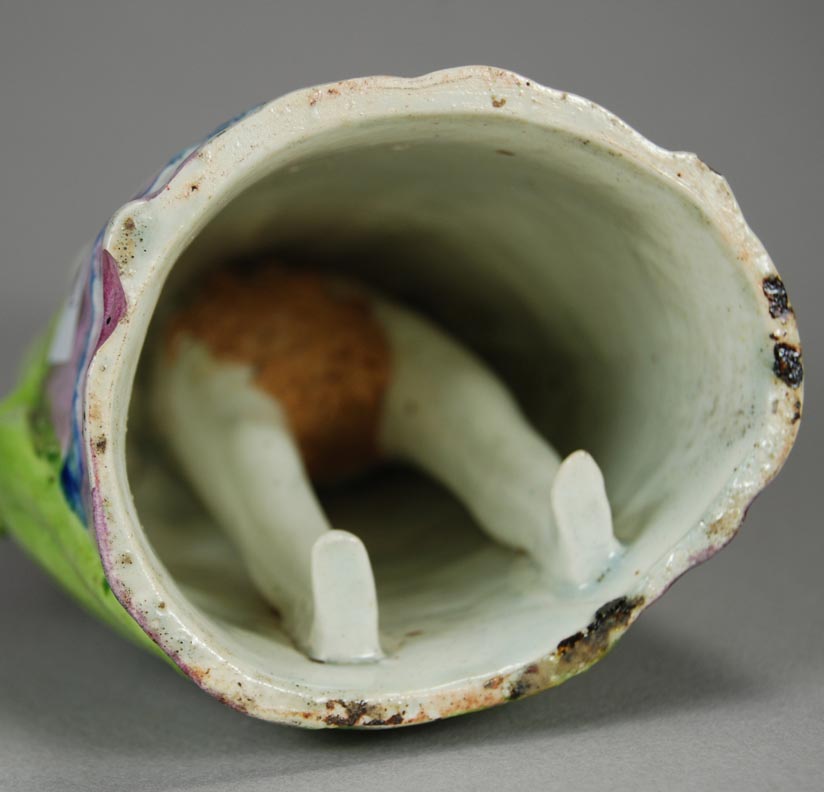
I was drawn to the pretty colors-- a lovely green, is that not?. and it looks great with the pink. And, as you can see, she is equally pretty from the back. Now what about underneath? The seller told me that a former owner has pasted a clay-like substance onto the underneath of the figure and he didn't know if it would come off. Anything but superglue comes off pottery with enough soaking (never use superglue to attach a broken piece, please....another story)  So I bought the figure, without seeing an interior view.

While I waited for the figure to arrive, I contemplated the mindset of an owner who liked this figure enough to keep it---but just HAD to cover the hole. After all, even if there are children in the house, who looks? Has a visitor ever flipped over your figure to check beneath?  The Puritanical mindset that wanted the figure but just had to cover a hole that nobody knew was there amused me. This had to have been done a long time ago, I thought. After all, today nobody would care. Long-time-ago was good for ease of removal. Natural, non-synthetic materials should just float away in some water.

When the barmaid arrived, this is what she looked like. A little out of focus...sorry, but it is the only shot I have. I couldn't wait to get her into a bucket of water. 
 Note a bucket,  not the kitchen sink, because this stuff looked nasty. And it was suprisingly stubborn. As it softened, I picked away gently with a dental pick, being careful to leave the area with the hole till last. I really didn't want to fill the figure with water if the interior was unglazed.

As the brown stuff slowly lifted away, I noticed something strange. A long curly hair, painted onto the surface emerged at the edge of the once-covered area. Dear Reader, at this point I leave the rest to your genteel imagination. Suffice it to say, this Bawdy Barmaid lacked a hole. Instead, she was realistically painted (VERY realistically painted) in colors that included shades of flesh. red, and brown. No, I will not be adding a picture to our G-rated blog.

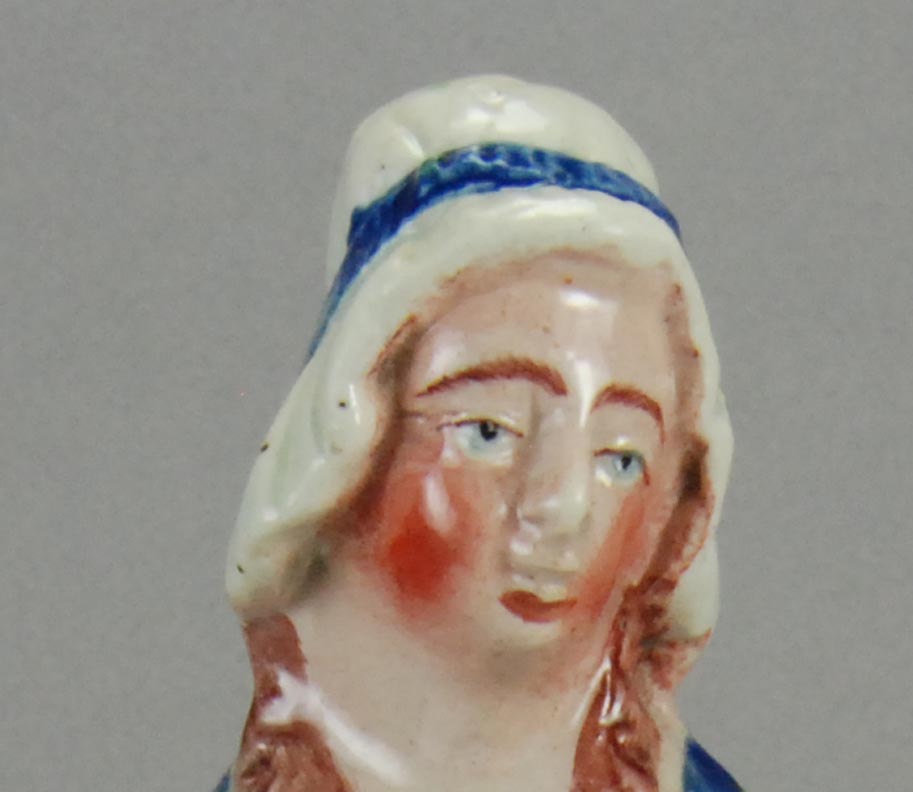
I know of only four early Bawdy Barmaids, so these are quite rare. And at last, I have a figure that my children may be interested in looking at! Meanwhile, notice the smile on my Barmaid's face....her lipstick has slipped.  Seems the painter missed the mark with his paint and planted two lips firmly in the middle of the chin. 


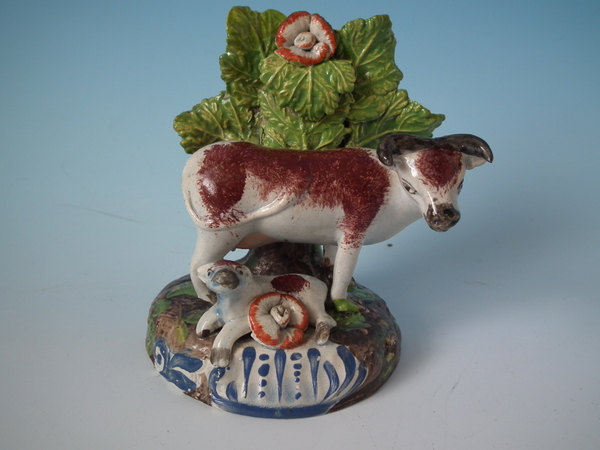
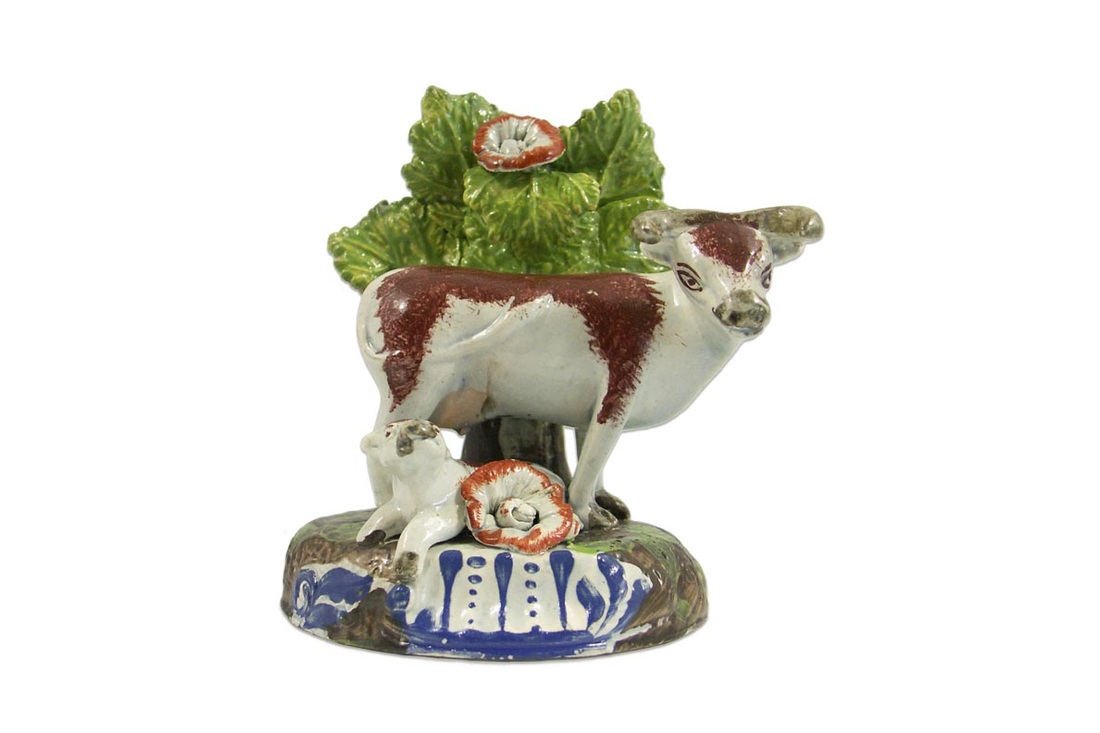
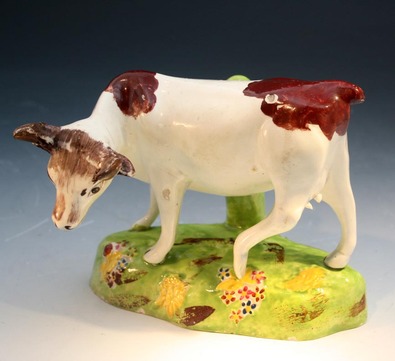
'Tis the season to give gifts, and as I was browsing the web this past weekend, I was struck by some of the lovely items Madelena has in stock. There truly is something for every pocket. I did a double-take when I came across a cow that I thought I had on my shelf!
Top one is Madelena's; the bottome one is mine. Aren't they remarkable similar?  I have had mine for ages and ages, and, although I am not big on cows, I love this example.  I have never seen another--so if you like it, grab it. 

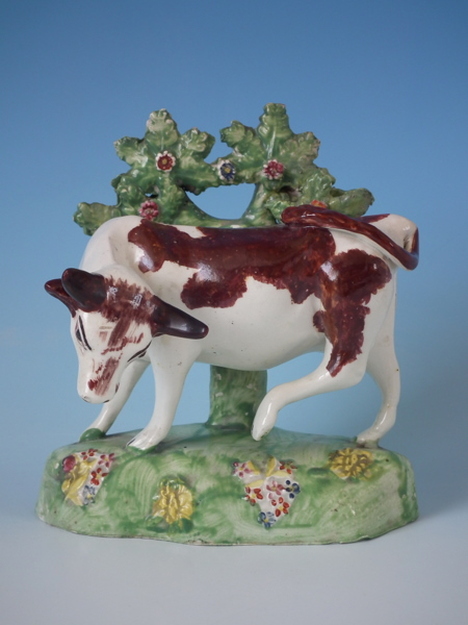
On the cow theme, I noticed this unusual cow, also in Madelena's stock. 
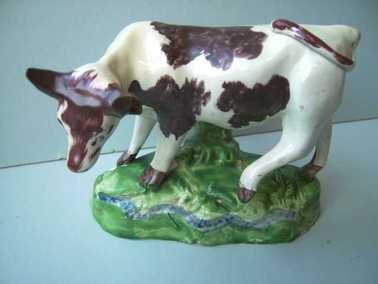
This is a rare cow model, and I have only two others like it  in my archive. By some huge co-incidence, all are on the market. One is currently in the stock of Castle Antiques.
And the other is in the stock of John Howard.

John's cow has the same base as Madelena's but John's was made without a bocage.  You see quite a few other instances of figures made with or without bocages. This is far from uncommon.
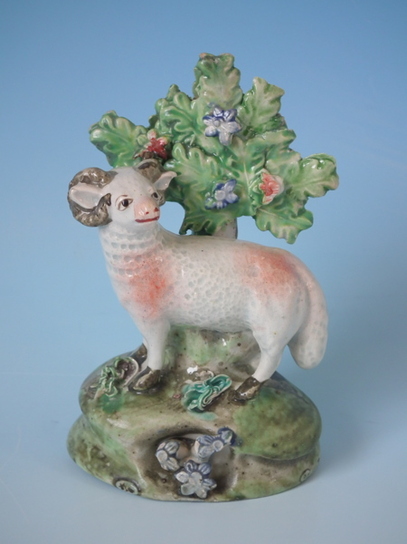
If you prefer sheep, who could resist this perky fella, again in the stock of Madelena. All that eye make-up made me think this might be an ewe, but the big horns say otherwise. Very, very pretty, is it not?
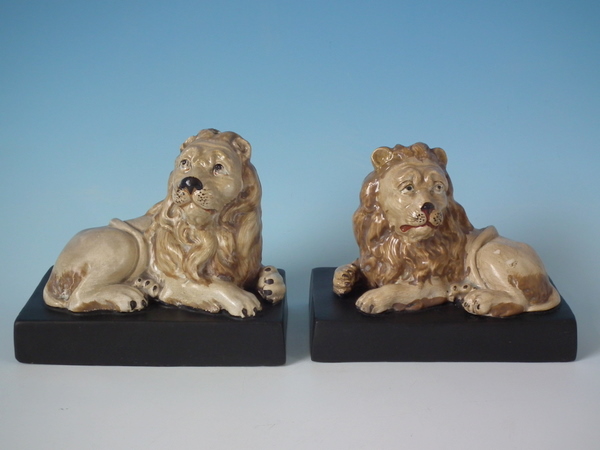
But if you want something more ferocious, Madlena has these lions.
These lions were made by Wood & Caldwell or by Enoch Wood. They are after the rather dog-like lion made by John Bacon for Heaton Hall, Manchester, in the 18thC. Now you can have your own pair, without the upkeep of a stately home.

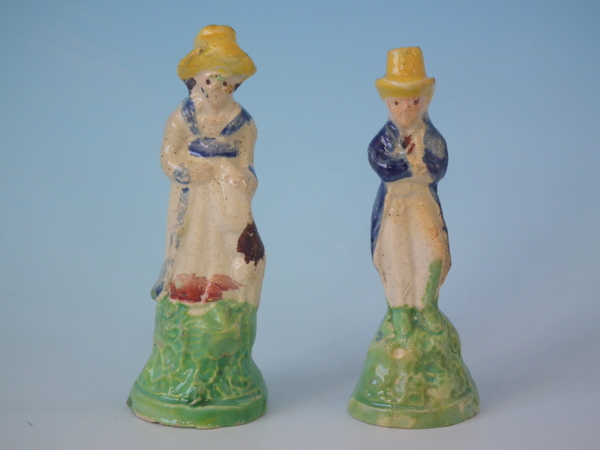
The best things are meant to come in small parcels, and this pair of figures is really tiny, at about 3" each.
Teensy figures are quite rare as, understandably, most have been simply tossed over time. Their primitive naivete is so appealing. I can't think when last I have seen a pair for sale.

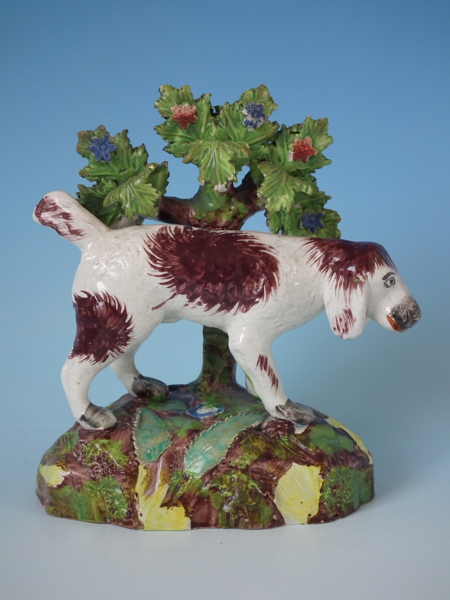
Still with Madelena, how about this rare dog? I have one other like this in my archive, and the bocage is totally restored. Not a pretty sight! This pooch is in original condition.
Is that base and bocage not lovely. I am so tempted....

As I wade through my archive to work on my book, I constantly am reminded of how rare fine figures have become. As a result, when all else seems to be collapsing...the euro, the Dow Jones, housing prices, job prospects.....early pottery is more than holding up. And so it should be. They are not making any more!!  Life is short, so don't hesitate to buy yourself a gift too this holiday season. Remember that when you buy pottery you are not spending money. Instead you are just transferring your assets from one medium to another.