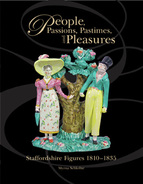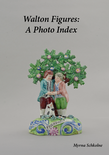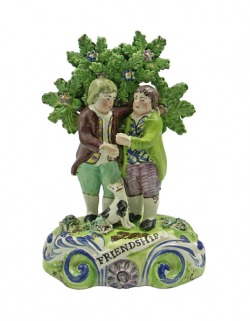
This pearlware figure, titled Friendship, bears the mark of John Walton. The vignette is thought to be after an engraving that accompanied The History of Sanford and Merton. This moralistic children's tale was popular in the early 1800s and it tells of the reconciliation between two quarreling boys. (To see the engraving alongside the figure, see Schkolne, Myrna: People, Passions, Pastimes, and Pleasures: Staffordshire Figures 1810-1835.)
John Walton was a figure potter who potted in the Staffordshire Potteries from around 1806 until the late 1830s. His mark is found impressed or raised on a decorative scroll on the rear of figures, or sometimes beneath.
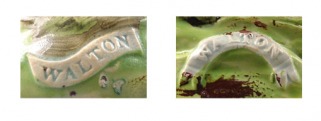
Marked Walton figures are usually well modeled, glazed,and enameled. Some of the Potteries' finest figures bear the Walton banner. However, there are even more figure groups seem so like Walton groups, yet the familiar Walton banner is nowhere to be found. Even if the modeling and enameling are evocative of Walton, there is no basis for attributing unmarked figures to Walton. His style was so generic that credit for similar figures may well go to one or other of the 100 odd figure potters who potted in the Potteries in the early 1800s.
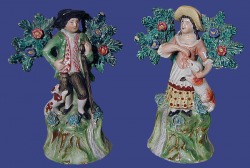
Fine Walton figures that have survived the centuries unscathed do exist. Some simply sing! I have recorded 99 marked Walton figure forms. An additional 11 figures were probably made to pair with examples on my list. On the whole, the figures reflect contemporary rather than classical themes, they have bocages, and they stand on green mound bases.The range of figures is extraordinary.
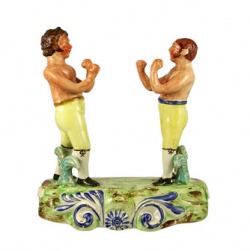
A rare figure of Diana seems to be the earliest Walton figure, stylistically, that I have seen. She is atypical in that she is a heavy-hipped classical lady and stands sometimes on a rectangular base (brown, white with line, or vermicular--not green!). She never has a bocage and was probably made circa 1810. The only Walton figure that can be dated with some certainty is the stunning figure of the pugilists Spring and Langan. This rare figure (I can trace only 3 examples) was made in commemoration of the famous 1824 prize fights between Tom Spring and Jack Langan. It bears each pugilist's name on a scroll at each end and the Walton scroll on the back.
A rare figure of Diana seems to be the earliest Walton figure, stylistically, that I have seen. She is atypical in that she is a heavy-hipped classical lady and stands sometimes on a rectangular base (brown, white with line, or vermicular--not green!). She never has a bocage and was probably made circa 1810. The only Walton figure that can be dated with some certainty is the stunning figure of the pugilists Spring and Langan. This rare figure (I can trace only 3 examples) was made in commemoration of the famous 1824 prize fights between Tom Spring and Jack Langan. It bears each pugilist's name on a scroll at each end and the Walton scroll on the back.
For more photographs of this phenomenal figure, taken from various angles, see my book.
Collector's Caution!
The Walton mark alone is no indication of age, for marked Walton replicas were produced into the 20th century. Later TENDERNESS appears fairly frequently, as do little shepherd and shepherdesses. Watch for simple bocages, lettering usually without serifs, and different color palette and glazes as clues to their later origins. If in doubt, ask me before buying!
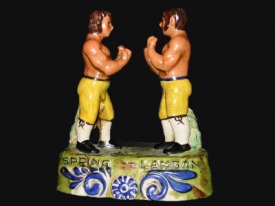
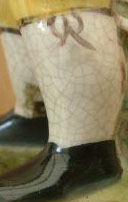
But these copies are absolute gems compared to the even later "Staffordshire" objects of Asian origin that have popped up in the last twenty or so years. Walton's rare and appealing figure of Spring and Langan unfortunately falls into this category and there are crude reproductions on the market. I seem to have a part-time career fighting these fakes. Some sellers auction them honestly; most do not. To be fair, some sellers really think they have the genuine thing. I know this would be laughable were it not so sad. Even collectors with impaired vision should be able to recognize these as copies, albeit in a dense fog. Last year, I helped get an eBay sale undone when a collector parted with GBP 400 for one of these figures, advertised as The Real Thing. Recently, a deluded eBay seller would not part with his 'treasure' to a high bidder--it had not reached its even loftier reserve! Below is one of the nasty reproduction of Spring and Langan. Note the crazing added to the leg.
Collector's Caution!
The Walton mark alone is no indication of age, for marked Walton replicas were produced into the 20th century. Later TENDERNESS appears fairly frequently, as do little shepherd and shepherdesses. Watch for simple bocages, lettering usually without serifs, and different color palette and glazes as clues to their later origins. If in doubt, ask me before buying!
But these copies are absolute gems compared to the even later "Staffordshire" objects of Asian origin that have popped up in the last twenty or so years. Walton's rare and appealing figure of Spring and Langan unfortunately falls into this category and there are crude reproductions on the market. I seem to have a part-time career fighting these fakes. Some sellers auction them honestly; most do not. To be fair, some sellers really think they have the genuine thing. I know this would be laughable were it not so sad. Even collectors with impaired vision should be able to recognize these as copies, albeit in a dense fog. Last year, I helped get an eBay sale undone when a collector parted with GBP 400 for one of these figures, advertised as The Real Thing. Recently, a deluded eBay seller would not part with his 'treasure' to a high bidder--it had not reached its even loftier reserve! Below is one of the nasty reproduction of Spring and Langan. Note the crazing added to the leg.
Avoid a Walton reproduction by buying from a reputable dealer. You may pay a little more, but in the long run it will cost you less. If in doubt about buying a Walton figure, please ask me before you commit!