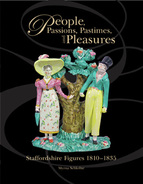
I bought this Staffordshire figure a while ago because it intrigued the social historian in me. Who was the lady with a determined expression, fists clenched? Don't you love the attitude-- not to mention the bonnet! I had never seen another figure like this. Something in me said that this was not just a random figure, but a likeness of a real person, now forever captured in clay.
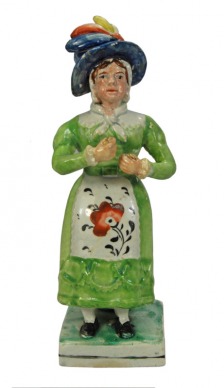
After much digging, I found this very rare hand colored engraving that I believe captures on paper the very same lady.
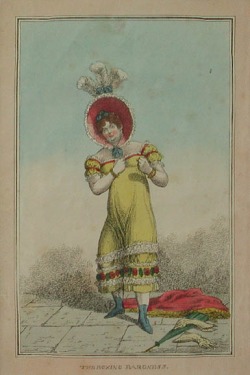
Title: The Boxing Baroness
Artist: Williams, Charles (London, active, 1797 - 1830)
Date: March 1819
Medium: Original Hand-Coloured Etching
The Boxing Baroness, the title of the etching above, is known from only a few copies. It was created in for Bon Ton Magazine in March 1819 by Charles Williams, an important British satirical artist and caricaturist.
Our Boxing Baroness, the fashionably dressed lady in pugilistic stance, is the notorious Lady Barrymore, wife of the fast-living Seventh Earl of Barrymore, who enjoyed amateur boxing. The Earl succeeded to his title at age 3. He came from bad stock and was known as 'Hellgate' because of his rakish lifestyle. The young earl dissipated his life in a series of madcap pleasures. He was a big gambler, and it is estimated that he went through GBP300,000 in 5 years. Anything was good for a gamble, and he once bet he could race on foot against a man mounted on horseback. His gambling reached its lows when he bet the Duke of Bedford that he could get a man to eat a live cat!
Boxing, or pugilism as it was then frequently called, was one of the Earl of Barrymore's particular pleasures. It was fashionable for aristocratic young men to exercise themselves at a sport that even the Prince of Wales had enjoyed in his younger and slimmer days, so the Earl kept a pugilist as his constant companion. He also boxed with his mistress, Miss Charlotte Goulding. The lady--hardly the right word, in this case--was neither rich nor well-born, being the daughter of a sedan chairman. It must have been true love for in June, 1792, the couple claimed to have eloped to Gretna Green. Seems they may never have reached Scotland but perhaps they were married soon after. The new Lady Barrymore enjoyed sparring with her husband---bare-fisted, as was the practice in those days. Their pleasure was short-lived. In 1793, the Earle's musket accidentally discharged and killed him at the age of 24. He was on the verge of financial ruin.
What of Lady Barrymore, our pearlware figure? Seems she lived for many more years and, as her obituary in the Gentleman's Magazine of 1832 tells, she was renowned for her pugilistic skill...among other things!
Our Boxing Baroness, the fashionably dressed lady in pugilistic stance, is the notorious Lady Barrymore, wife of the fast-living Seventh Earl of Barrymore, who enjoyed amateur boxing. The Earl succeeded to his title at age 3. He came from bad stock and was known as 'Hellgate' because of his rakish lifestyle. The young earl dissipated his life in a series of madcap pleasures. He was a big gambler, and it is estimated that he went through GBP300,000 in 5 years. Anything was good for a gamble, and he once bet he could race on foot against a man mounted on horseback. His gambling reached its lows when he bet the Duke of Bedford that he could get a man to eat a live cat!
Boxing, or pugilism as it was then frequently called, was one of the Earl of Barrymore's particular pleasures. It was fashionable for aristocratic young men to exercise themselves at a sport that even the Prince of Wales had enjoyed in his younger and slimmer days, so the Earl kept a pugilist as his constant companion. He also boxed with his mistress, Miss Charlotte Goulding. The lady--hardly the right word, in this case--was neither rich nor well-born, being the daughter of a sedan chairman. It must have been true love for in June, 1792, the couple claimed to have eloped to Gretna Green. Seems they may never have reached Scotland but perhaps they were married soon after. The new Lady Barrymore enjoyed sparring with her husband---bare-fisted, as was the practice in those days. Their pleasure was short-lived. In 1793, the Earle's musket accidentally discharged and killed him at the age of 24. He was on the verge of financial ruin.
What of Lady Barrymore, our pearlware figure? Seems she lived for many more years and, as her obituary in the Gentleman's Magazine of 1832 tells, she was renowned for her pugilistic skill...among other things!
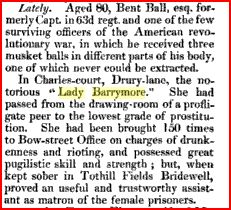
In determining whether my figure was indeed our Boxing Baroness, one thing puzzled me. The figure seems to be clutching something little in her hands. Why would a boxer do this? Last night, the penny dropped! I came across this ad in The London Journal of 1722.

So my Boxing Baroness is holding a coin in each hand. That, it seems, was the way women judged the settling of the score in those days. If you are recoiling in horror at all this, relax. Things really aren't so different today--but female fisticuffs is now less PC. Seems in the early days of boxing, from after 1700, women discovered that they were not such delicate creatures after all, and they participated whole-heartedly in prize-fighting (and fighting just to settle differences). These were no-holds-barred battles--no stays were worn and usually women stripped to their slips. References to female pugilists occur with surprising frequency--but our Boxing Baroness is surprisingly rare.
If my blog entry were worthy of a Dedication, this one would be dedicated to that great lover of all Staffordshire figures, Elinor Penna. Elinor sold me this amazing figure. Thank you, Elinor,
If my blog entry were worthy of a Dedication, this one would be dedicated to that great lover of all Staffordshire figures, Elinor Penna. Elinor sold me this amazing figure. Thank you, Elinor,