Every figure tells a story, and these tales really have me hooked. I must dig and dig until I can hear each figure talk. Along the way, I may find a design source, and when it is all put together I can often date the figure with greater precision—and that knowledge helps date other figures. All this takes time. It’s what I ponder when I can’t sleep at night. The latest candidate for this thought process was a figure titled SHEPPARD, and, if you will bear with me, I will explain how SHEPPARD inspired that 20th century hit song Mack the Knife.
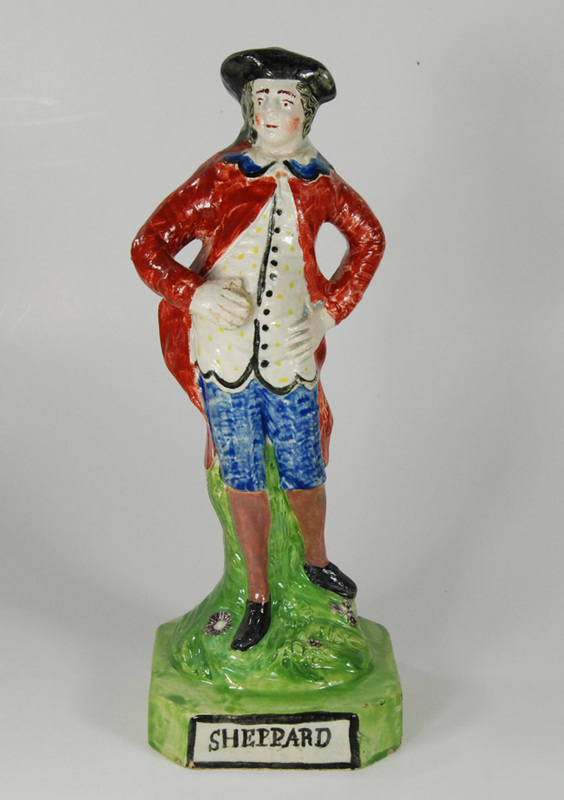
SHEPPARD? I know spelling was not our potters’ strong suit, but this is no shepherd. Rather, the figure represents Jack Sheppard, the colorful criminal who rose to fame in London in the early eighteenth century. Jack was born in 1702 into a life of great poverty and hardship. Despite this, by 1722, he was a model carpenter’s apprentice with 5 years of his 7-year apprenticeship behind him. But then young Jack discovered strong drink and the love of a far-from-virtuous woman…and he was set on the road to ruin and immortality.In 1723, Jack took to burglary. He was arrested in 1724 and imprisoned. He escaped, and was arrested again. The pattern was set, and Jack was arrested four times and he escaped four times—always with daring bravado that captured the public imagination. After the fourth arrest, Jack was chained and shackled to the floor in Newgate prison’s most secure area, but he broke his chains and escaped through six iron-barred doors. Two weeks later, on November 1 1724, Jack was arrested for the fifth and last time. This time, he was weighed down with 300 pounds of weights and kept under round-the-clock observation. His importance was such that the king’s painter, James Thornhill visited to paint his portrait. But on Nov 11 1724, Jack Shephard was hanged. Two hundred thousand people turned out to give their hero a rather celebratory send-off. How times have changed!
Jack Sheppard continued to live in the hearts of the public as a folk hero. His story inspired ballads and pantomimes that appeared shortly after his death. Importantly, his character inspired Macheath in John Gay’s The Beggars’ Opera (1728).. The Threepenny Opera, a twentieth century updating of The Beggars’ Opera that debuted in Berlin in 1928 and in English in America in 1933, included the song Mack the Knife. Mack the Knife made the hit parade in 1956 and it has kept on trucking…well, I think we all are old enough to have heard it.
So why would we have Sheppard, a hero of the 1720s, depicted in a Staffordshire figure made circa 1825? I admit to being a bit puzzled. The most obvious nineteentn century reincarnation of Sheppard was in the novel Jack Sheppard by William Harrison Ainsworth, published in 1839….but this figure looks no later than 1830 to my eye. What could have inspired the creation of a figure in Jack Sheppard’s honor around that time? And then a revealing factoid came my way: A melodrama titled Jack Sheppard, The Housebreaker, or London in 1724, by W.T. Moncrieff was published in 1825. Performances of this play must have inspired the creation of the figure.
Moncrieff’s melodrama could not have been wildly successful for I know of only this one example of the figure of Sheppard. It is a lovely figure, very bold and dashing at a swaggering 10-3/4" inches tall. Sadly, Sheppard himself was a puny runt, but how was our potter to know that? So if you are a potter and you don’t know what Sheppard looked like, what do you do? No problem! After all, nobody else was any wiser…so our potter could take his pick of the molds at his disposal. I have a figure in my archive fashioned from the same molds used for SHEPPARD.
Jack Sheppard continued to live in the hearts of the public as a folk hero. His story inspired ballads and pantomimes that appeared shortly after his death. Importantly, his character inspired Macheath in John Gay’s The Beggars’ Opera (1728).. The Threepenny Opera, a twentieth century updating of The Beggars’ Opera that debuted in Berlin in 1928 and in English in America in 1933, included the song Mack the Knife. Mack the Knife made the hit parade in 1956 and it has kept on trucking…well, I think we all are old enough to have heard it.
So why would we have Sheppard, a hero of the 1720s, depicted in a Staffordshire figure made circa 1825? I admit to being a bit puzzled. The most obvious nineteentn century reincarnation of Sheppard was in the novel Jack Sheppard by William Harrison Ainsworth, published in 1839….but this figure looks no later than 1830 to my eye. What could have inspired the creation of a figure in Jack Sheppard’s honor around that time? And then a revealing factoid came my way: A melodrama titled Jack Sheppard, The Housebreaker, or London in 1724, by W.T. Moncrieff was published in 1825. Performances of this play must have inspired the creation of the figure.
Moncrieff’s melodrama could not have been wildly successful for I know of only this one example of the figure of Sheppard. It is a lovely figure, very bold and dashing at a swaggering 10-3/4" inches tall. Sadly, Sheppard himself was a puny runt, but how was our potter to know that? So if you are a potter and you don’t know what Sheppard looked like, what do you do? No problem! After all, nobody else was any wiser…so our potter could take his pick of the molds at his disposal. I have a figure in my archive fashioned from the same molds used for SHEPPARD.
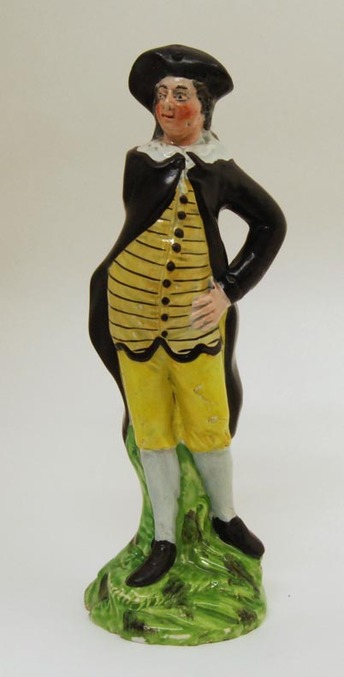
I photographed this 9-3/4" figure in the Potteries Museum. Clearly he has lost his arm, but I didn’t note the loss of the base, so perhaps he was made thus. I really wish he had retained his arm because I want to see what was in the now-lost hand. The figure of SHEPPARD is clutching a very definite round object. Unfortunately, some deviously evil person has chiseled around this object. The nicks look just as if they were made by a chisel, and perhaps a wicked child had nothing better to do on a gloomy day and decided to start on his life of crime by bashing away at SHEPPARD.
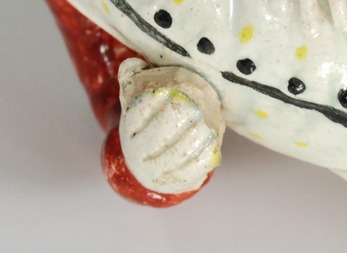
The object could not have broken clean off, nor could it have been very much larger than its present size. I know the latter because there is no indication that the object ever touched the jacket. My guess is that it was intended to be a money purse. So the mystery is almost solved. If you can add to this, please let me know. Meanwhile, Jack Sheppard lives on in our century: a 2002 television drama Invitation to a Hanging and Neal Stephenson’s Baroque Cycle novels (2003, 2004) all derive from Jack Sheppard’s story.