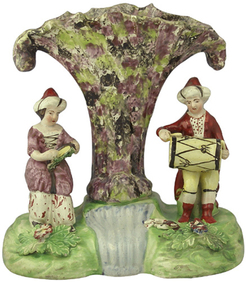
Two weeks ago, a collector emailed to ask if I had seen the Turks on John Howard's site. I had not....but the minute I saw them, my heart plummeted. I had not been quick enough or vigilant enough. The little spill vase, with a Turk to either side of the prettiest trumpet spill, was just delicious. But the collector has seen it first. I have to be fair. So, I replied that the figure was quite lovely and that she should buy it.
Trumpet spills can be a bit overwhelming, but this little baby comes together perfectly. And the colors are so pretty. Trumpet spills with Turks are really quite rare. I have only three in my archive. The one below is a bit of a sore point. I didn't buy it when it came on the market a LONG time ago because my husband didn't like the trumpet. It was in Jonathan Horne's stock, and from there it quickly moved to a happy home.
I have waited and waited....and then I was pipped at the post this month! I gritted my teeth and got on with work. At moments like this, I tell myself "no-one is dead." That puts my petty peeve in context! And I was really pleased that the figure had a good home, and I would enjoy it by proxy, so to speak. And then the collector emailed to tell me that she had rejected the group because there was something missing from the base.
Look carefully at the base. There is a dark patch at the man's feet. If you compare it to the second example, you can see that a little leaf might have been in that spot--and John was, of course, quick to tell me about that loss. The loss of a leaf is no big deal--especially when the whole rest of the figure is in original condition. Some naughty child picked the leaf off the base, and a kitchen-table restorer dabbed some gunk on the spot.
So third time lucky. I POUNCED on John's spill vase--and I am sure that it wouldn't have lasted long. The best things are worth waiting for, and perhaps my husband was right....for once! After all, John's vase has a far prettier spill that the one I first coveted.
By the way, both these spill vases were both made by the same pot bank. Look at the flowers on the bases. Big flowers of exactly that form occur repeatedly on a Group of figures that Pat Halfpenny dubbed the "Patriotic Group." Pat chose that name because the figures often have red, white, and blue swirls on their bases. In any event, the flower that you see on both examples is very specific to the Patriotic Group, and its presence confirms the attribution.
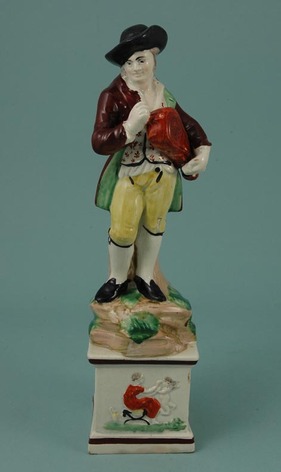
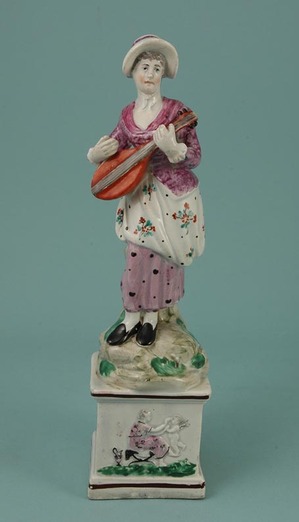
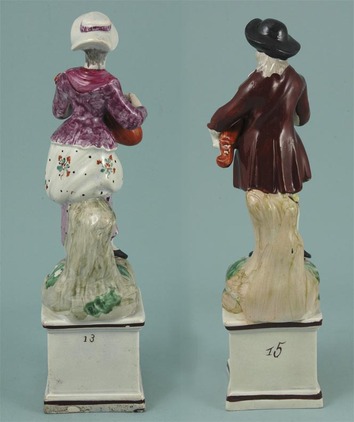
As you know, I live to see the unusual in Staffordshire figures--and that's why I was very excited when Andrew Dando shared these pictures from his Sold Stock Archive. The subject of the Flemish Musicians is a well known one, but have you ever seen these on plinth bases before? Are these not astonishing?....and how I wish they were mine. Andrew, and his father before him, have been in business for a long, long time, and the photos in their archive are enough to bring me to my knees. Did I tell you that I bought my first Serious Purchase from Andrew's father a frighteningly long time ago. It was all of GBP400, and my husband had to twist my arm to indulge because it was so expensive, or so I thought. Oh, what a slippery slope that purchase led me onto....and I still have it and love it. In retrospect, what a bargain!
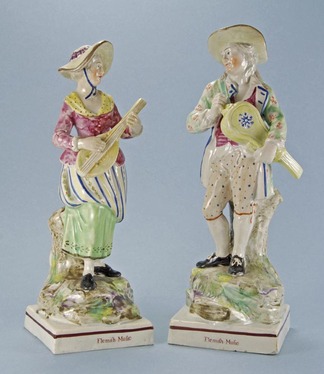
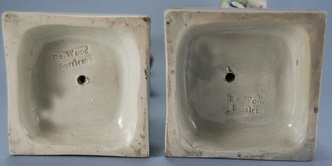
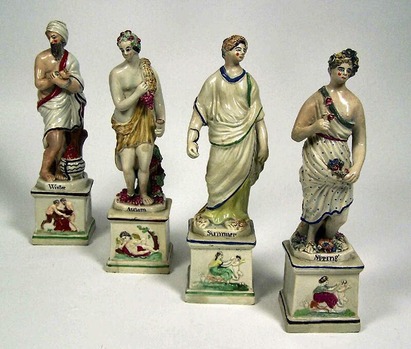
Lord alone knows what pot bank made Andrew's musicians, but the figures must have come from (or been copied from) the molds used for the well-known Ralph Wood models. The pair below are both marked "Ra. Wood, Burslem"--and this mark on a pair of figures is a rare sight. Back to Andrew's sadly-sold musicians. As I said, I don't know who made them, but I have seen figures emblematic of the Seasons on similar plinth bases. In my archive, I have untitled figures of Summer and Spring, each having the number "16" painted behind. And then this set below sold at auction a while ago. I am not sure if they had numbers behind them and they need a very good bath, but they clearly are in the same spirit....and from the same source. Note that Spring and Summer have the same motifs on their plinths, and these motifs are the same as those on the plinths of Andrew's figures.
I end with my usual refrain: pictures p-l-e-a-s-e!
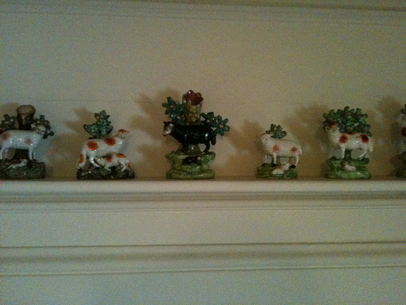
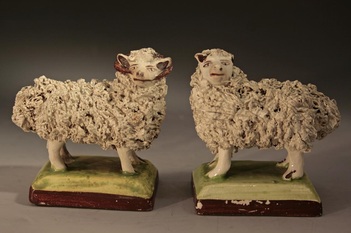
“As rare as hens' teeth” goes the saying. I propose we collectors amend that to “as rare as black sheep.” As you know, nearly all early Staffordshire sheep are white with red markings. Why? I don’t know. So a while ago, when a collector kindly sent me this picture, I saved it.
The picture was taken in one of England’s treasured historic properties. And bang in the middle of the mantel is a black sheep. Dear Reader-to-be, I will be going to the Ends of the Earth to make my next book as comprehensive as possible…..which is why I had to track down this black sheep.
I wrote to the staff responsible for the national treasures in this home and asked if the sheep was still there and if it might just possibly be marked Walton. I held my breath. Usually, it takes four rounds of persistent correspondence to get a reply, but I was in luck. A very nice lady promptly answered that the sheep was indeed in place and that her records note that it is indeed marked Walton. Of course, much correspondence ensued about getting a photograph. I was referred to a Higher Authority and we negotiated terms….for the record, I never pay for photographs. Again, every one could not have been nicer or more anxious to help. And then we hit a major stumbling block. A conservator popped up to say she has “serious reservations” about moving that figure off the mantel, for safety reasons. Aw, come on!! I am the last person to want to jeopardize a figure. But is this not akin to the tree falling in the forest and no one hears it? If nobody sees the sheep and its mark, does it exist….or at least does it exist in a meaningful way? Is it worth conserving? A conundrum to ponder. I have not given up hope. Perhaps a visit with my Nikon camera will secure a picture from across the room. I am very ambivalent about museums and institutions that hold pottery. Some of them are extraordinarily generous about sharing, but the truth is that most of the stuff languishes in dark cupboards. At the same time, when I see all the botched restoration on the market, I am pleased these things are held safe. But if nobody learns to love them, does it matter that they are safe? Above all, I am convinced that there is more than enough in museums. So please DON’T leave your collection to your local museum!
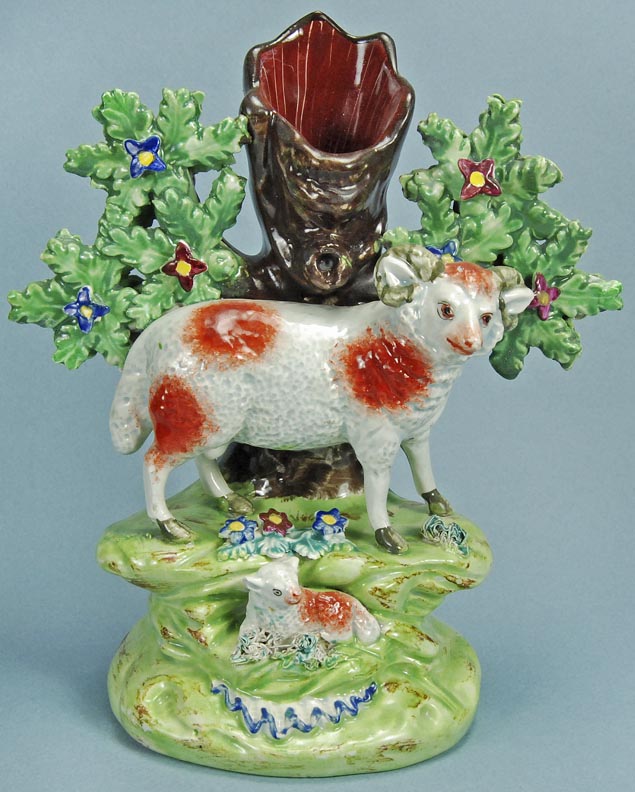
You might enjoy this ram, also made by John Walton.
This ram faces in the opposite direction to the black sheep glued to that mantel. Yes, these figures were all made to pair, so you should be able to find one facing left and one facing right--usually a ram and an ewe. But I simply cannot find this Walton sheep with spill facing right. I have some poor photographs that I can't publish....so if you have the beasty on your mantel, please consider sharing.
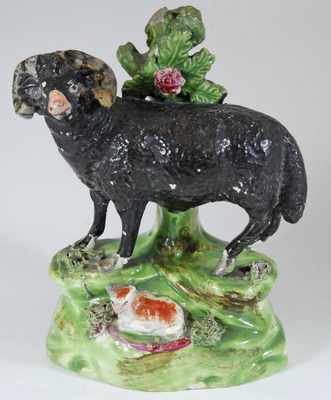
Below is the only standing black sheep I have handled. This one is in the Brighton Museum, one of my favorite collections, a dream for the collector to visit.
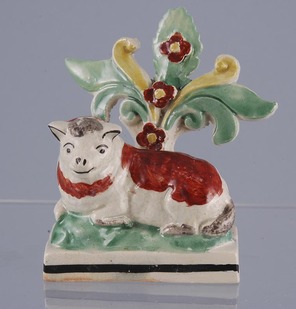
I wish I could say I have enjoyed captioning sheep. Let’s just say it was an arduous experience….there are so many varieties of sheep! At the same time, most are charming. Here are a few of my all time favorites.
From the archives of John Howard Antiques. From the archives of Andrew Dando Antiques. Are you wanting a nice sheep right now? Well, it seems that, whatever their color, they can be as rare as black sheep.
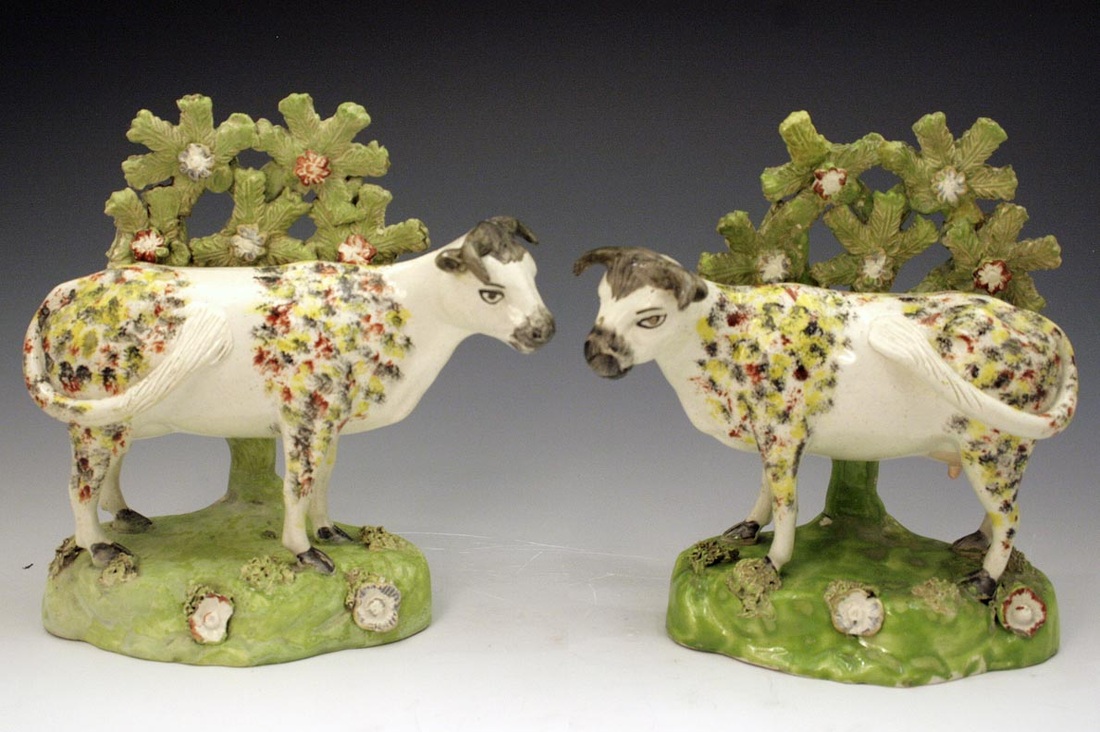
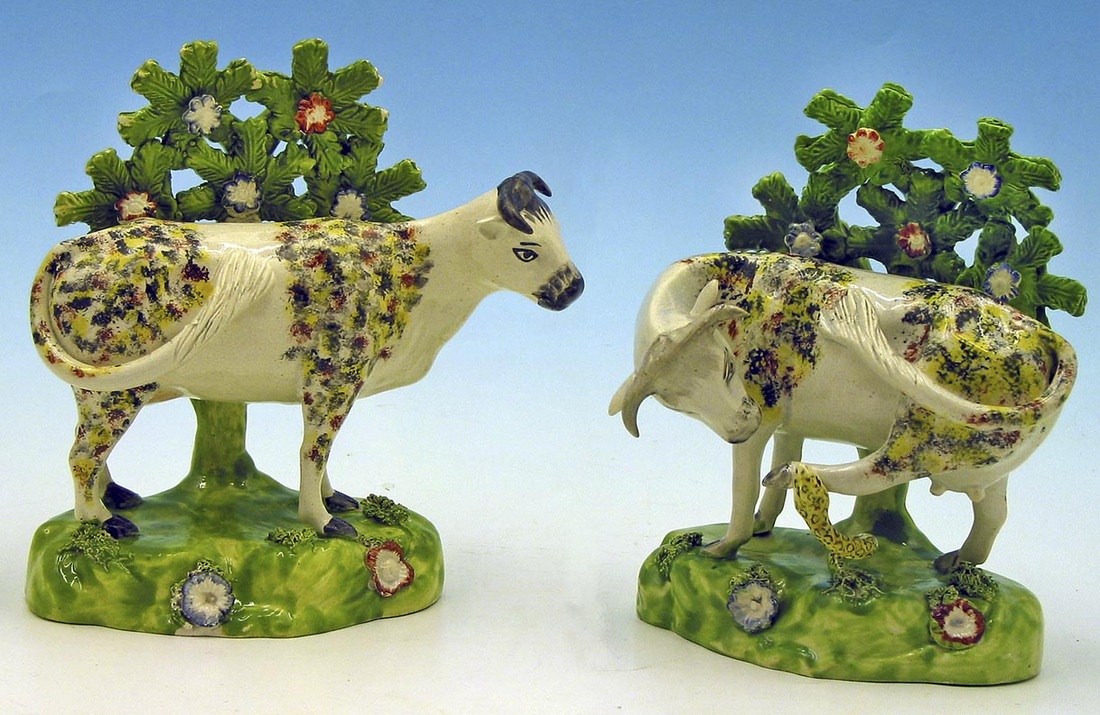
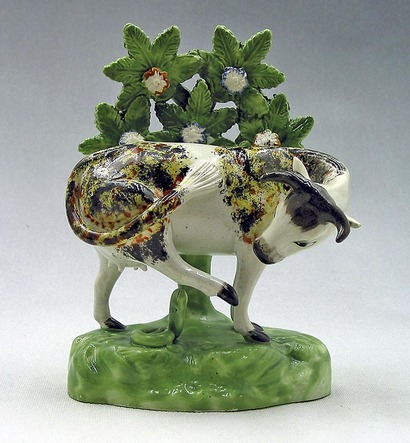
I am working very hard on preparing material for our book, and things are coming together so nicely. Today, I flipped through the images quickly and went WOW. I have 3,658 captioned to date, with more to come. It takes a village. No, it takes a world to get all this together, and I am so grateful to all of you who have kept the pictures coming. I know from first-hand experience that it is a pain, but I hope you will be thrilled in the end. Meanwhile, I had a tiny revelation this morning as I added a new addition to John Howard's site to my material. The first pair of cows is new to John's stock. The pair below and the single have fled his coop...or where ever John's cows live. Interesting, is it not, that you could apparently get either cow either with or without a snake? So you could pair these either way. The potters were always happy to please. These bizarrely painted cows are attributed to what I dub the "Tunstall Group." Excavations on High Street, Tunstall, unearthed some shards that have bocage leaves and flowers just like some that you see above. This has enabled the linking together of a great many figures that were potted by an unknown potbank in Tunstall. The bocage flowers and both forms of bocage fronds that you see above (one pointy, one stubby) match shards. Case closed. Of course, we do not know the identity of the Tunstall potter. I think there are three candidates. The first is Samuel Grocott, but I dismiss him because his tenure in Tunstall was too brief for him to have turned out the wide range of models that the Tunstall Group produced. Otherwise, it is a toss-up between George Hood and Michael Tunnicliffe. You will find attribution material laid out in my book, complete with pictures of shards. I am trying to keep it as simple as possible, with more pictures than words. We collectors are a visual bunch. The process of committing my thoughts to paper has been exacting and rewarding. I have learned a lot! And I hope others will carry on the process of scientifically categorizing our figures. Meanwhile, I have been corresponding with a reporter for The Daily Mail's Weekend Magazine. She is doing a story on the elephant I bought at auction in the UK....but you heard about it first in my blog entry of November 15. The story will run someday, so if you live in the UK and get the Daily Mail, please tell me that they said nice things about the elephant. I was a little amused at the reporter's persistence in knowing how I FELT when I got the elephant. Clearly a generation gap here...
|