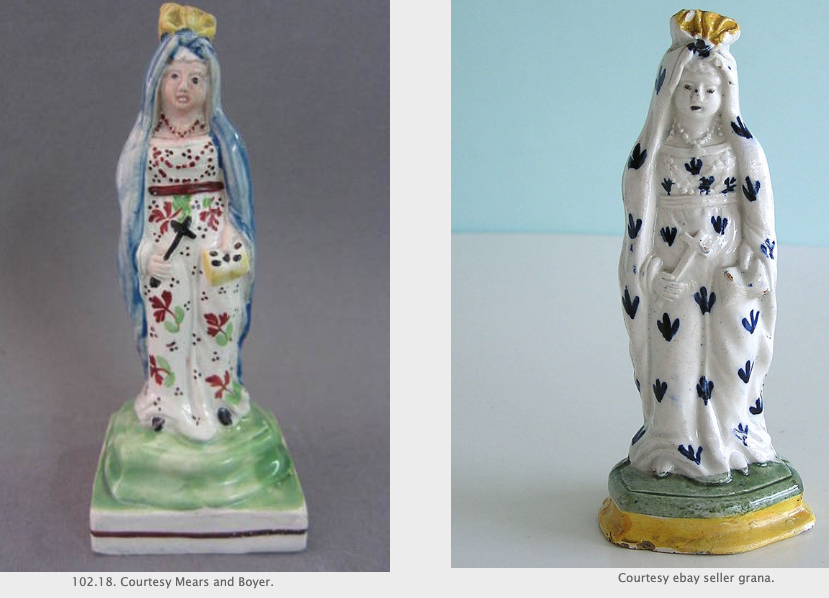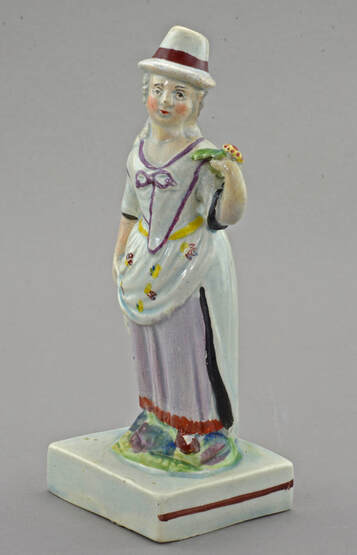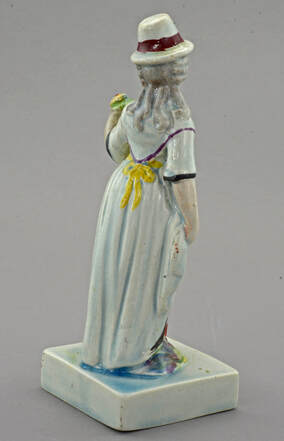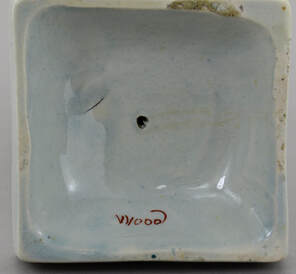
Tiny Treasures 07/07/2010
 
I know a collector with the most amazing collection of early Staffordshire figures--probably the largest collection in the world. Her favorite figure is about two inches tall, not very well modelled or overly decorated, but it just nestles comfortably in her hand. This figure she intends taking with her if she ever has to move into the final stages of retirment living.  I don't find her choice particularly odd, because the longer I collect the more I love little figures. No disrespect to those large masterpieces the potters wrought. I gaze at them in endless awe. But being awed can be tiring...and little figures are so comforting, so tactile.
Picture
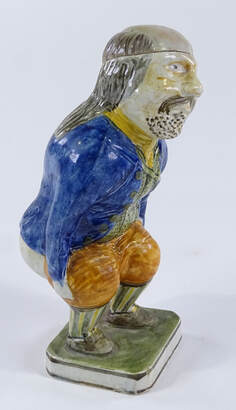
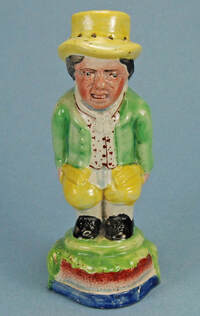
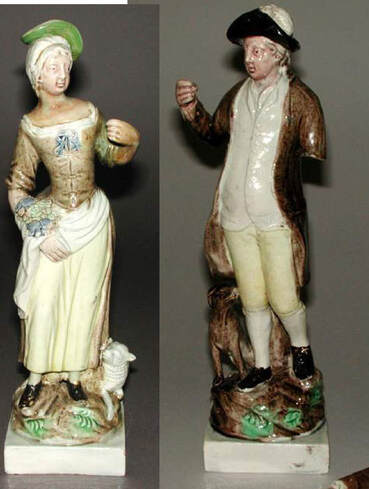
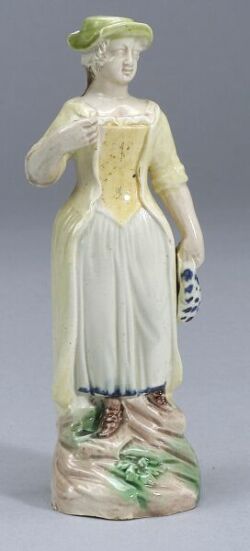
Staffordshire figure of a bird nester. Pearlware. H: 6'
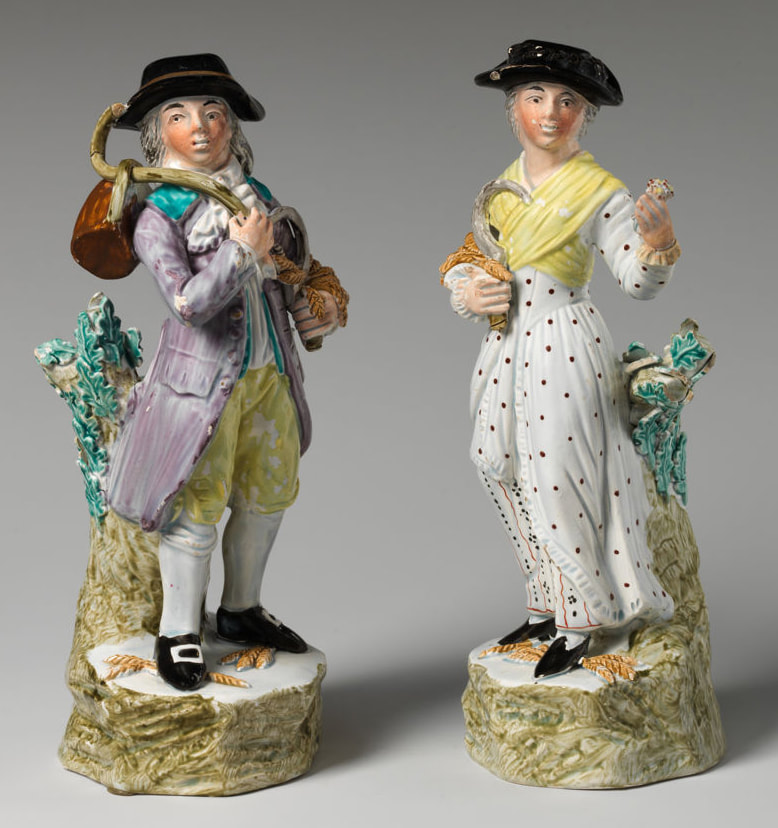
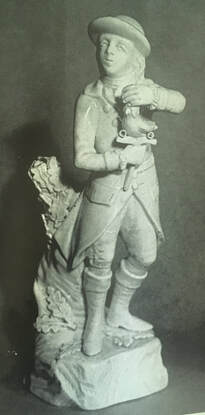
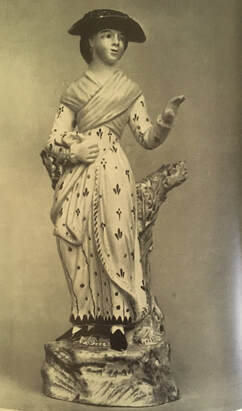
My "Green Man", as I call the figure above, is not quite a tiny figure, but he is small. No more than 6 inches. I fell in love with him and my friend Nick Burton bought him for me a good while ago. I love the color, his sweet face, and the quaintness of the long coat on such a youthful form. A child dressed to look like a little old man.  I can hold this figure in my hand and feel it warm to my touch as it brings a smile to my face. I can even give it a good squeeze--and all becomes right with my day.

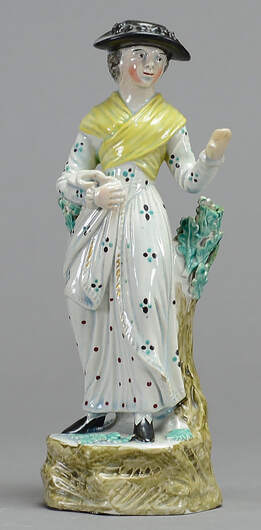
About two years after buying my Green Man, I found the figure below. The similarities and differences intrigued me.
Picture
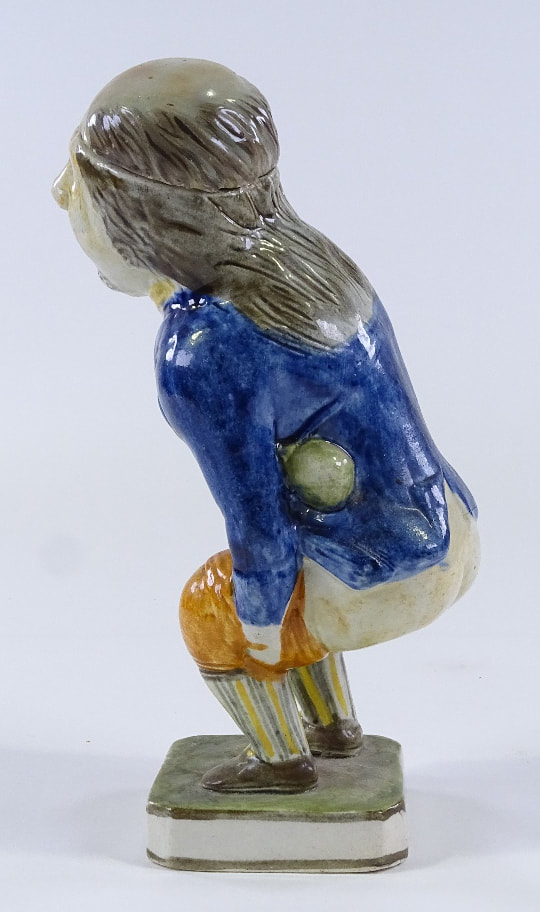
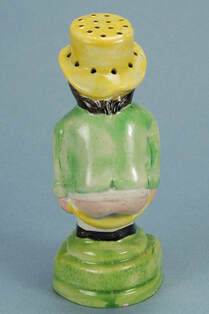
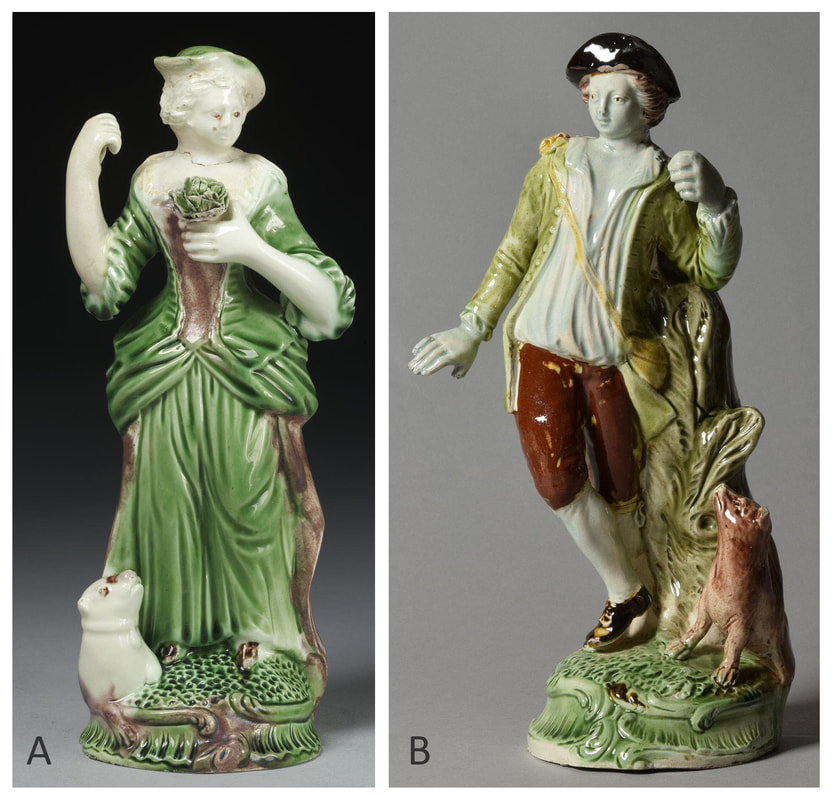
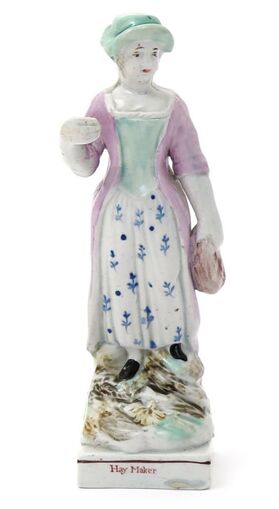
Staffordshire figure of a bird nester. Pearlware. H: 6'
Clearly, this figure has been made by the same factory and from a very similar mold. Just some change to the length of the coat and the hat brim.  Both figure forms are quite uncommon, although I have seen another example of the boy with the short coat. He is lovely, but the Green Man owns a piece of my heart.

Figures such as these add great charm to any collection. And they can be very affordable, despite their rarity. As I always remind beginning collectors, you can get a great little figure for less than the price of a night in a NY hotel. So keep your eyes open!
 
 
Picture
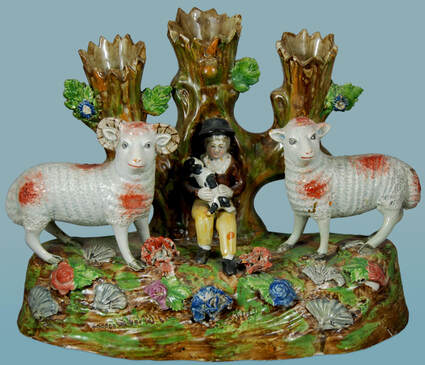
TEETOTAL. H: 8 1/8”. The base, bocage, and turreted spills are typical of the “Sherratt” style.
Ah...I can hear you sigh at the charm of this ever-popular Staffordshire figure group. The distinctive base alone tells us its in the "Sherratt style". Seems that the potbank we dub "Sherratt" was the only one to make this complex figure group. 

The story of the early teetotal movement in the UK is fascinating. In the 1800s, England was seemingly in a drunken stupor.  Good drinking water was scarce, and beer the safest, most palatable drink. Children drank beer, hospitals give it to patients, and workers received daily quotas. In 1827, Robert Macnish documented that the average worker consumed anywhere from 7 pints to 2 gallons of beer a day.

Beer was bad, but gin was far worse and its use was spreading. Gin drinking was addictive and carried to excess it led to illness, poverty, violence, and death.The temperance movement first got going in an attempt to pursuade people to abandon gin and other spirits. Instead, they were encourage to drink a LOT more beer.  The temperance movement of the 1820s was sponsored by middle-class do-gooders, and their fine intentions were aimed at helping the working man stay sober.

Well, it didn't take long for working folk to realize that drinking more beer was NOT keeping them sober. Drastic abstinence was needed, so the TeeTotal Movement was born around 1830. Initially a working-class movement, it encouraged abandoning ALL alcohol. In days when a ruddy complexion equated with good health, some feared that going teetotal would be life threatening! Joseph Lawson, a Yorkshireman who kept a diary, noted that he did not expect the first teetotalers to survive. But they did, and the teetotal movement took hold.

I expect that on middle class mantels TEE TOTAL groups were virtuous displays of support for abstinence.  Today, the groups are increasingly difficult to find. They simply ooze charm. Who can resist the smug wife clutching her baby while she presides over the tea table? After all, what was a more proper drink than tea?  And how about her poor husband clutching his head. A hangover? Or is he afraid that without his beer he will not survive?

Fascinating Factoids
The origin of “teetotal” is controversial, and the date that the word came into the English language is significant to Staffordshire collectors because it could help date titled Teetotal figure groups. Theories include:
  • At a temperance meeting in 1833, Richard—better known as Dicky—Turner was moved to cry out “I’ll be reet down out-and-out t-t-total for ever and ever.” The name “teetotal” then became the name for the total-abstinence movement. Some think Dicky Turner intended creating a play on the word “total” to emphasize the totality of his commitment; others believe he was plagued by a stammer. In any event, Dicky Turner’s tombstone credits him with coining the word “teetotal.”
  • The word “teetotal” was in use in England before 1833, with the repetition of the letter “t” emphasizing the word total, to create t-total or teetotal, meaning “grand total.”
  • The United States also claims credit for the word. In 1827, the New York Temperance Society disbursed pledge cards asking people to sign a commitment to the “O.P.” (for Old Pledge, denoting partial abstinence) or “T” (for Total, denoting total abstinence). By calling out “T-total” to promote the “T” pledge card, the word teetotal was supposedly created.
  • The word is more ancient in origin.  An article, “Derivation of ‘Teetotal” in Meliora of 1865 notes "The term has been in common use in Ireland and in Lancashire these hundred years, and was familiar to the writer when a lad in that county nearly forty years back. It can be found in the literature of England, long prior to the Preston movement, in application to various things. Banim, the Irish novelist, employs it; Maginn, in ‘Maga,’ uses it, and De Quincey also, a master of English, who probably acquired it in Lancashire, amidst the idioms of which county he spent his early years. Richard Turner used the word because it had an established meaning. It was one of those designations to which children and uneducated persons sometimes give spontaneous expression, and because it fell in with popular usage and feeling, Mr. Livesey, wisely or unwisely, adopted it as the name of the new society.

 
Walton 06/29/2010
 
Picture
Three figures emblematic of Fire. Each bears a maker's mark. From left: SALT, WALTON, DALE.

For decades, writers and dealers have routinely described Staffordshire figures with bocages as "Walton" or "Walton-style". In short, if it is sweetly pretty and has a bocage, John Walton was credited with it. About two years ago, a leading ceramics dealer advertised a bocage figure as "Walton"...and it pushed a button for me.  Not a single figure of that form is recorded marked "Walton", so there was absolutely no basis for attributing that particular figure to Walton.

My frustration pushed me to document ALL the marked Walton figure forms I could find. Just when I thought I had them all, I unearthed a fabulous figure in the reserve collection at Brighton Museum. What a find! My total now stands at 84 figure forms.  I have recorded these here.  The point is this: if you see an unmarked figure that bears no resemblance to any of the known Walton figure forms, please don't call it Walton.  Show me a Walton look-alike, and we can debate whether it is Walton or not. But if your figure doesn't even look like anything Walton ever made, just call it a Staffordshire figure, maker unknown.

To learn all about Walton figures, follow the MANUFACTURERS menu at the top of this page.
 
Dancing Queens 06/25/2010
 
A few weeks ago, I traveled to Charlottesville, Virginia, to view the first house sale that Sotheby’s has staged in the US for decades. The home in question belongs to Patricia Kluge, a one-time belly-dancer and nude movie artiste. Patricia's second husband made her the world’s wealthiest divorcee, with a settlement of $1.6 billion after 9 years of marriage. Yes, billion, not million. And that was in the 1990s.  

The Kluges had enough money to try to buy Taste. They hired David Easton to design and furnish a Georgian-styled English country house, complete with vineyards, stables, exquisite landscaping….you get the picture. Money was rolling in those days, and the Kluge’s and Easton scoured the world to find the finest antiques to decorate this Monument to Self. Included among the contents (which fetched over $15m at auction) was Staffordshire pottery.  I viewed the catalog and there was nothing I hadn’t encountered before…with one exception: a pair of figures of dancing maidens--I called them Dancing Queens (the Abba song). I had to see them. Hence my trip to Charlottesville.

Picture
Dancing Queens, sold by Sotheby's NY for Patricia Kluge
What a disappointment. The Kluges may have bought the finest furniture and silver, but when it came to pottery something went very wrong. The figures were less than mediocre, and a restorer had been kept very busy making them marketable. The prices reflected the heavy restoration on most. Prominently displayed in the main bedroom was, to my eye, a rather late pair of copper luster Staffordshire spaniels. I believe I could find a pair on eBay for $150…yet they made $750.  And what of the Dancing Queens that had lured me to Charlottesville? Heavily restored. Like all the other early pottery, they made a price that reflected a chequered past.  My trip was not wasted. I was thrilled to see a figure form I have never seen before. And now I will wait for a near-perfect example.


Ralph Wood was one of the earliest Staffordshire figure potters. He potted from 1782 until his death in 1795. In the early 1900s, his wares became very collectable, and there was heated competition among deep-pocketed, erudite English collectors who strove to amass and study his wares. Ralph Wood Toby jugs were favorites--Ralph Wood made the most exquisite Tobies, always decorated in colored glazes. Ralph Wood figures were also amassed in important collections, such as that of Captain Price, George Stoner, and Frank Falkner.  The focus was on colored glaze wares. At the time, these were thought to be much earlier than enamel-painted figures. While there was recognition that Ralph Wood did decorate some figures in enamel colors, such wares were spurned because they were thought to be later.

Fast forward a century, and today we know better. We know that enamel-painted figures were made in the 1780s, at the very same time as colored glaze figures. And we know that enamel-painted figures were costlier than their colored-glaze counterparts because they required more careful painting AND at least one extra firing. 
Picture
Ralph Wood figure group decorated in the limited colored-glaze palette. Victoria and Albert Museum.
Picture
Ralph Wood figure group decorated in enamels, painted over a lead glaze. Note the limitless color palette available with this decorating technique.
Yes, colored glaze figures are lovely....but enamels are much, much prettier. The market recognized that two hundred years ago, and eventually enamels totally displaced colored glazes.

Although the colored-glazed wares of Ralph Wood have been carefully documented, no-one has studiend his enameled figures. As a result, I frequently see lovely early figures that are not identified as Ralph Wood. The finest enamel-painted figure I have ever seen was a Ralph Wood enamel, and I want everyone to be on the lookout for such beauties. So in the past months, I have spent a chunk of time attempting to document the Ralph Wood enamel-painted figures.

I have added a new section to this site titled MAKERS. You can find it on the top menu bar. If you go to it, you will find a link to almost everything I know about Ralph Wood enamel figures. Perhaps this will help you identify figures in your collection as Ralph Wood. And if you have a RW figure that I have not recorded, please let me know. myrna@schkolne.com

Last summer I documented all the output of the Walton manufactory. I will be sharing this information on this site in the coming weeks. At that point, MAKERS will also include an active link to Walton wares.  And, as the months and years roll on, I will be adding additional Staffordshire manufactories.

If you look carefully at your figures, you may find that some of them share quirky characteristics that you can find on no other figures. It is probable that these figures originated from the same manufactory. Look hard. This makes collecting really fun!
 
 
On my last visit to England, I was struck by the number of individuals at all levels of society who form long-lasting family units….but never bother getting married.  A friend of mine and the father of their child finally tied the knot shortly before he retired. Apparently, marital status impacts retirement benefits.  I Googled around on my return and found that my observations were not far off the mark. The proportion of men and women getting married is below any level recorded since 1862, the year in which stats were first kept! And there are 25% fewer marriages per year than there were in the 1950s. All this has my mind in a whirr about the impact of government welfare and taxation policies on marriage… so it is soothing to slip back to 1823, when the government made an attempt to ensure marriage was treated as a solemn and binding commitment. 

Picture
Pearlware figure celebrating The New Marriage Act, circa 1823.
The figure above is referred to as “The New Marriage Act” and it was made to celebrate the passage of legislation that reinforced marriage. For centuries, cumbersome English marriage law made couples jump through a series of hoops to get wed. These persnickety requirements made marriage difficult, and  they also made it quite easy to make a mistake. If any of the numerous rules was not adhered to, the marriage was not legal. This meant that either party then had a ready-made excuse to nullify the marriage—and annulment might happen many years (and many children) later. Even if both parties were quite happy to have their marriage end, annulment had disastrous consequences for their children who unexpectedly found themselves declared illegitimate! By 1823, it was time for parliament to act.

The case that brought England’s problematic marriage law to parliament’s attention concerned the young Earl of Belfast. On the threshold of the earl’s marriage, his uncle stepped forward, disputing the earl’s legitimacy and declaring himself heir presumptive to what the earl had thought was his inheritance. The basis for this challenge was that the earl’s parents, the Marquis and Marchioness of Donegal, had married without the parental consent that the law mandated. The earl’s noble marriage was postponed while the marquis and marchioness tried every legal maneuver to establish the validity of their marriage and their children’s legitimacy. When all failed, parliament legislated the “New Marriage Act” as a remedy. Society expected marriage to last for life, so the Marriage Act of 1823 made it no longer possible to annul a marriage because of a petty violation of the marriage law.

The plaque on the figure reads THE NEW MARRIAGE ACT. JOHN FRILL AND ANN BOKE AGED 21 THAT IS RIGHT SAYS THE PARSON AMEN SAYS THE CLERK. In other words, whatever the true age of either John or Ann, who claimed to be 21 years old and thus of marrying age, they were married. Amen. No going back. How times have changed!

To get back to our figure: I particularly like this example because the enamels are pretty, the modeling is vigorous (just look at the expressions on those faces) and the condition is great. Even her finger sticking out in expectation of a ring has not snapped off. The only restoration here is to the tip of the ribbon titling the plaque. You can understand why it broke off, sticking out as it does.

New Marriage Act groups also occur in arbor form.
Picture
Picture
Two arbor New Marriage Act figure groups, circa 1823.
Both these groups are The Real Thing. The plaque varies in its placement--yes, the plaque is broken on the second group. Beware reproduction New Marriage Act groups made in an arbor. These date to the 20th century. Their different color palette and very dead modeling betrays their late origins, but they can be easy traps for the novice. You can see one alongside an original figure group by clicking on the REPROS tab at the top of this page. If in doubt, ask me before buying.
 
Another First. 06/13/2010
 
My friend Malcolm Hodkinson shares a huge photo archive with me. We have well over 10,000 images between us. So it is not often that a figure appears that neither of us has seen.  And that happened this week.

Clearly, our mystery figure is damaged, but it is pearlware C1820, very much in the style of Enoch Wood.
Picture
Pearlware figure, made in Staffordshire ca. 1820. H: 6-1/2'

Picture


Despite its problems, the figure is hauntingly beautiful and the embellishments on the base, as well as the flag, seemed to support a military connotation.

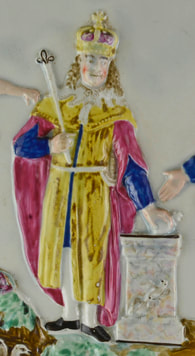
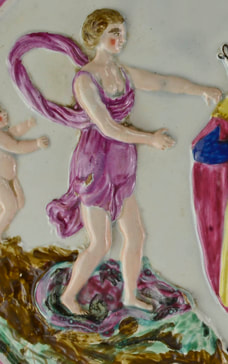
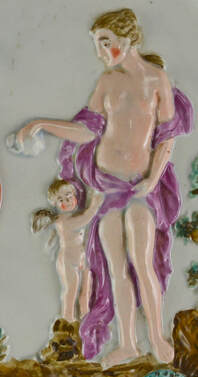
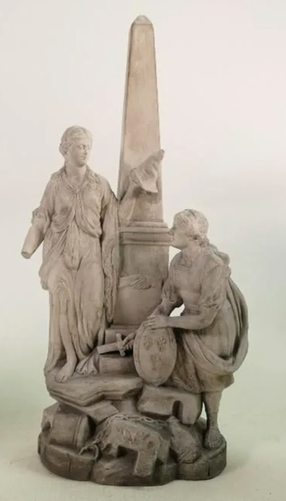
Andrew Dando supplied the answer to my identification mystery by providing this  image of a later pair of Staffordshire figures that he had in his 2007 Exhibition.
Picture
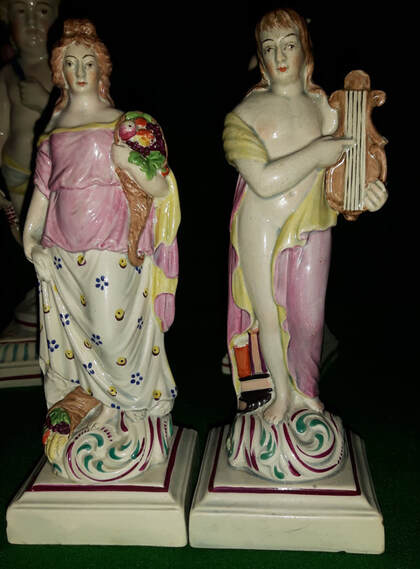
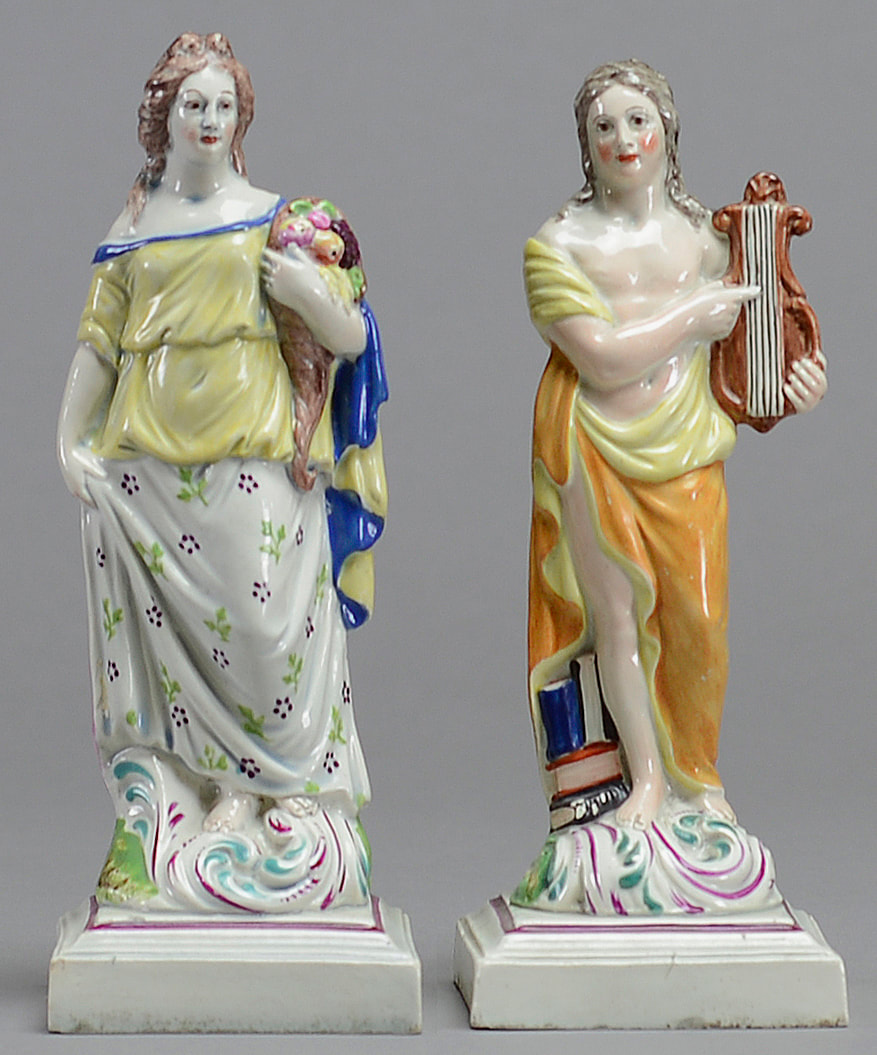
Pair of later 19th-century Staffordshire figures allegorical of Peace and War. Courtesy Andrew Dando.
Thankfully--and, in particular, thanks to Andrew-- the mystery is solved. The Victorian figures, by Thomas Parr, are lovely, but give me an early figure any day. I far prefer the detailed modeling and vibrant coloring of the earlier figure. Also, note the attributes of peace at the feet of the early figure--details discarded in later decades. I remain puzzled by the scars on the early cherub's torso. Did something once touch there? Above all, I remain perplexed as to why other early examples of Peace have not been found--and I am even more puzzled by the lack of any known early examples of War.
Picture
Because Peace is traditionally depicted winged, a putto was appropriate for its representation in clay. Note that our pearlware figure of Peace holds a dove--emblematic of peace because Genesis describes a dove as returning to the ark holding an olive leaf.  I am guessing that the objects at the putto's feet are intended to be the discarded emblems of war. You can see these on more traditional early pearlware portrayals of Peace. Please click here to see an August 2009 blog posting showing such a figure.

A further thought: Is our winged putto intended to represent Victory rather than Peace? The flag at half mast has me wondering. Victory would also be winged and would also have discarded elements of war. If you know, please share!
 
 
Did cleanliness approached godliness in ancient times? Staffordshire figures portraying Hygeia, the ancient Greek godess of health, cleanliness and sanitation, support this. Hygeia was associated with the prevention of illness and maintaining good health. Of course, the word "hygiene" is derived from her name.
Picture


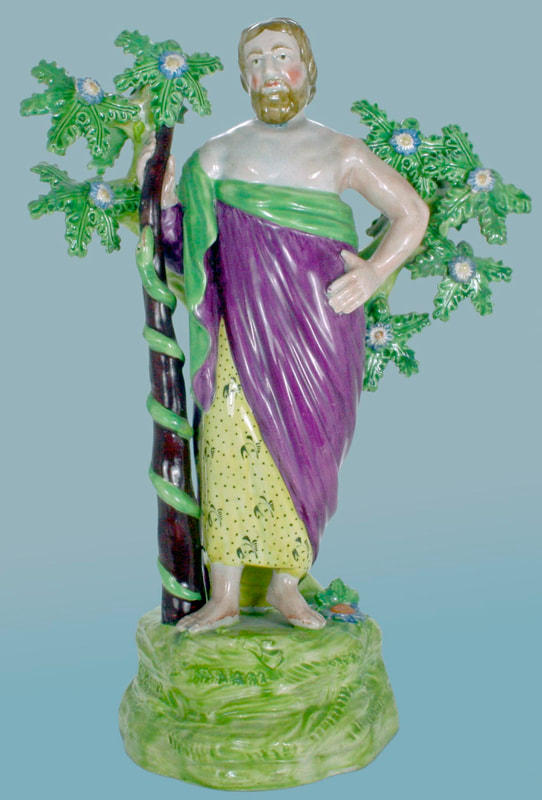
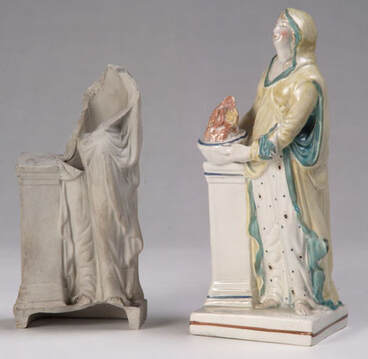
In classical sculpture, Hygeia often holds a large snake (the symbol of medicine--Aesculapius, the god of Medicine, was Hygeia's father). Her other symbol is a water basin. The cult of Hygeia started in around 600 BCE and became 'hot' around 400 BCE because of the spread of plague. By 100 CE temples to Hygeia were established in Rome.

Picture
Pearlware figure of Hygeia. H:9' Courtesy Andrew Dando
Classical subjects were favorites for Staffordshire potters from the late 18thC onward, so, of course, we find Hygeia formed as a Staffordshire figure.  Examples of this pearlware figure can be 'tired' looking, so it is rewarding to wait for a figure with good enamels atop a nice glaze, such as the example on the left. A fine example just requires a little patience--but it brings a lifetime of pleasure.

Picture
Hygeia, in the collection of Manchester Museum.


Hygeia also occurs with a bocage, but as such it is extremely rare. If you want this, good luck trying to find it, especially with original bocage intact.

 
It's a boy! 06/05/2010
 
As many of you know, my beloved English Cocker Spaniels, Max, Martha, and Maddie, co-authored my book People, Passions, Pastimes, and Pleasures: Staffordshire Figures 1810-1835.  We lost our canine kids in 2007, 2008, and 2009...and our home has not been the same.   Now please welcome the newest member of the Schkolne family.
Picture
Johnny Be Goode at 7-1/2 weeks


Johnny Be Goode was born in Wisconsin on March 24, one of a litter of 4 girls and a boy.  All five kids were given names from Beach Boys songs by Amy Kluth of Carefree English Cocker Spaniels. Amy is a devoted breeder of champion show dogs.

Picture
Johnny B saying goodbye to his mother, Em.
JohnnyB  came home yesterday,  Friday, June 4, after I officially adopted him on a day trip to Milwaukee. He and I will be mastering the skills required of a couch-potato house dog...and of course learning all JohnnyB needs to know to help with the next book.


Thought you might like to see this charming whistle, which I came across recently.
Picture
Formed as a bright, perky hen, this whistle is only around 3" tall. Whistles such as this are understandably rare. How easy to break them or throw them away, yet this survivor has almost 2 centuries under its belt. If you scroll down to my blog posting of Feb 17, you will see a parrot whistle that I believe came from the same pot bank.

Small items such as whistles really 'pop' among bigger items in a collection. I notice that some collectors seem not to consider anything that is not Substantial in size. Their collections tend to be boring because most of the large figure forms are so well known and they lack charm. But there is endless variety among the smaller figures, and with luck, they can be found at very affordable prices.